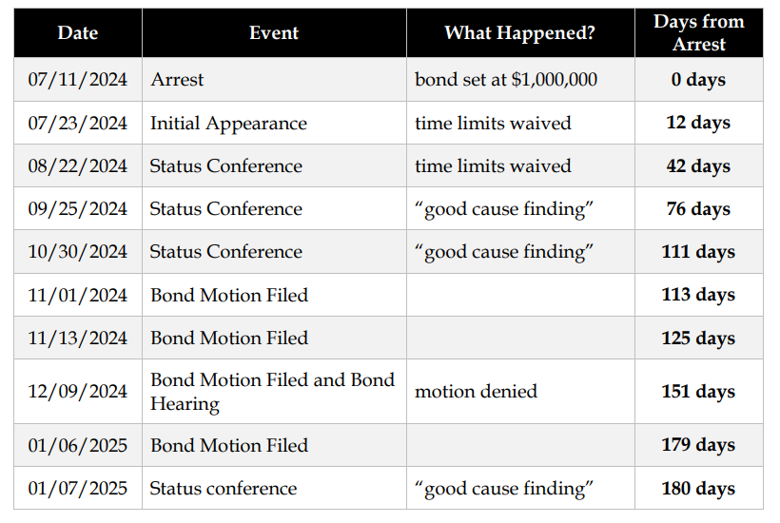
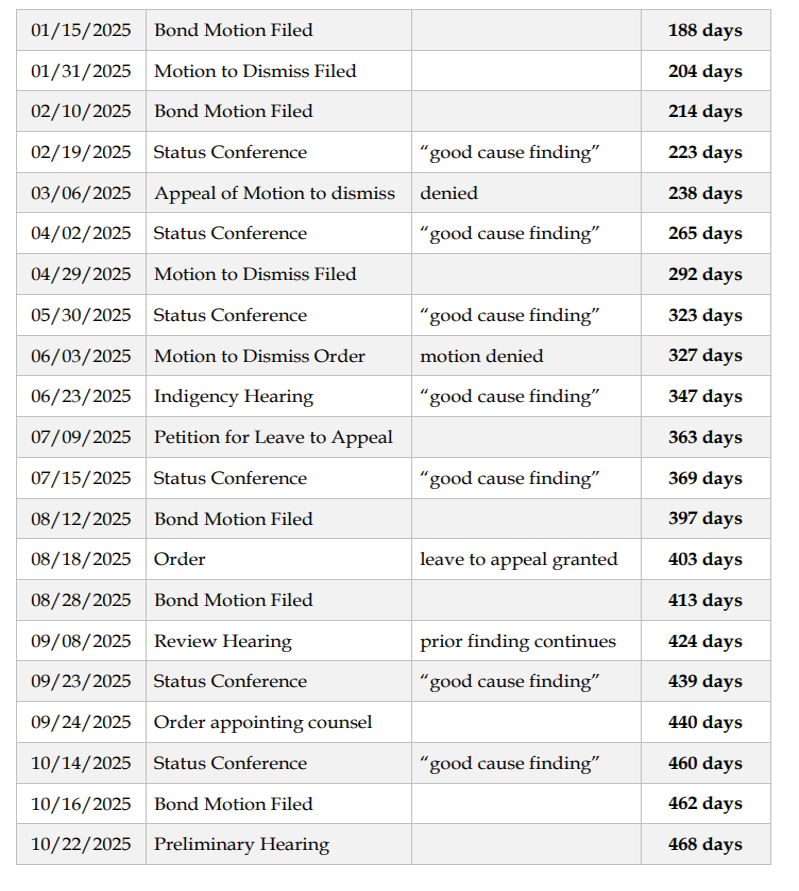
James Grandberry’s criminal case has been filled with delays.
Nearly one year ago, Grandberry filed a motion for interlocutory appeal to District III of the Wisconsin Court of Appeals, challenging the decision of the Brown County Circuit Court to not dismiss his case.
The appeal comes nearly two years after Grandberry’s initial arrest and concerns the 468 days he sat in jail waiting for a preliminary hearing before counsel could be appointed.
During that period, the trial court made several findings of good cause for delays due to the lack of counsel for Grandberry.
During that period, Grandberry filed two motions to dismiss on his own, the first coming more than 200 days into his incarceration. The trial court denied the motions.
Exacerbating matters, Grandberry sat without knowing the contents of the criminal complaint against him. The complaint, which was filed under seal, outlined a large-scale drug dealing operation, in which Grandberry was allegedly a central player.
At least four of Grandberry’s alleged coconspirators fully resolved their criminal cases before Grandberry ever saw the complaint or had counsel appointed, according to the appeal.
An interlocutory appeal happens before a case is litigated all the way through to judgment. It allows parties to contest trial court decisions before proceeding further in the case. For Grandberry, the questions on appeal are whether his case should have been dismissed and whether he should have been released at some point rather than held in custody, and how to incentivize courts to prevent these situations moving forward.
“Delays in finding appointed counsel are not unique to this case; indeed, it’s a tragic reality played out in hundreds of cases across the State,” wrote Grandberry’s appellate attorney, Joseph Bugni, in the appellate brief. He called on the higher court to clarify what should happen when appointment of counsel is delayed.
Wisconsin law ordinarily requires an in-custody defendant to receive a preliminary hearing within 10 days. The Wisconsin Supreme Court wrote in a 1993 case that the preliminary hearing procedure is designed to prevent, among other things, oppressive or malicious prosecution, public expense of a trial, and a defendant’s humiliation and anxiety from a public prosecution, while uncovering whether substantial grounds exist for prosecution.
In 2021, in State v. Lee, the District III Court of Appeals identified a multi-factor test to determine whether good cause exists to hold an individual in custody to continue a preliminary hearing when an attorney cannot be located to represent them.
Lee sat unrepresented for a comparatively paltry 110 days.
“The failure to hold a preliminary hearing within the prescribed time results in a loss of personal jurisdiction,” the Court of Appeals wrote in Lee. The court held that such cases can be dismissed without prejudice.
Grandberry asks the appellate court to view what happened to him as more than a failure of procedure—instead as a matter of constitutional law. He asks the appellate court to render a decision acknowledging that constitutional rights are violated when individuals are indefinitely detained without appointment of counsel.
Case law demonstrates the “indisputable fact that the denial of timely appointed counsel prevents a criminal defendant from exercising his rights and defending his liberty,” Bugni wrote.
These types of constitutional violations warrant two rules from the Court of Appeals, according to Grandberry: one to release defendants on bond if counsel cannot be appointed for preliminary hearing within seven days, and another providing, in situations like Grandberry’s, a hearing to determine whether delay in appointment of counsel has prejudiced the defendant. If so, then the case should be dismissed with prejudice.
Bugni asked the court to “make clear that when the delay prejudices the defendant, that the response is not: we can do better.”
He identified the incredible delay in appointing counsel for Grandberry, “4,460% over what the legislature had demanded,” which he argued clearly prejudiced Grandberry.
Bugni wrote that on behalf of Grandberry, “and every person sitting in jail, endlessly waiting for what the Constitution promises them,” the case should be remanded not just for dismissal but with a prophylactic rule that will give Lee teeth.
“Here and across Wisconsin, the inaction in protecting Grandberry’s and countless other defendants’ rights has been tolerated because the delay has not been met with consequences to the State,” wrote Bugni.
Bugni told WJI by email that he and his firm are “very pleased to help Mr. Grandberry in this important case. No one should have to wait for an attorney.”
The Lee factors for whether to hold a person in custody pending a preliminary hearing or to dismiss the case include
• the reason the State Public Defender has not yet identified counsel, be it the complexity of the case or the extent of SPD’s efforts,
• how long SPD estimates it may take to find a lawyer for the case,
• whether other means of appointing counsel have been explored, such as appointment of counsel by the court directly,
• the cost to the community of continued incarceration,
• prejudice to the defendant,
• any special circumstances of the defendant, and
• whether continued delay will undermine the purpose of a preliminary hearing.
Lee did not include the constitutional due process argument Grandberry makes.
The state agrees that Grandberry’s case should be dismissed pursuant to Lee. “The circuit court’s on-the-record good cause findings did not comply with Lee’s stringent requirements,” wrote Assistant Attorney General Nicholas DeSantis in the state’s reply brief.
But DeSantis disagreed that the Court of Appeals should go any further regarding dismissal with prejudice.
“Grandberry is asking this Court to rewrite statutes and legislate from the bench,” wrote DeSantis.
The National Association of Criminal Defense Lawyers, Wisconsin Association of Criminal Defense Lawyers, the SPD’s office, and a jail house attorney, Logan N. Green, have all filed amicus (friend-of-the-court) briefs or comments to the court on the case.
“Heaping these consequences on an accused and blithely waiting weeks, months, or years before affording accused individuals their right to counsel and due process is patently unfair in a society where guilt is not presumed,” wrote Green. He wrote that “courts must stop acquiescing to these violations of the Constitution and taking an ostrich defense. It is time to uphold the constitution like they swore an oath to do—and stop suspending it.”
Whether or not the Court of Appeals agrees with Grandberry, the appeal effectively demonstrates the slow and frustrating churn of time for those awaiting appointment of counsel, and indifference to the purpose of a preliminary hearing.
“When a defendant is stuck in custody, without a lawyer, and without access to even the allegations . . . the denial of counsel through delay violates the very process Grandberry was due,” Bugni wrote.
In conclusion, Bugni wrote that Lee was intended as a “wake up call: a clear warning against rote unexamined good cause findings for putting off the preliminary hearing and perpetuating an endless cycle of delay.”
“The lower court missed the memo,” he wrote.
Grandberry remains in custody during the appeal.