
Insured Must Give Prompt Notice of Loss
Post 5256
See the video at https://rumble.com/v7400tw-public-adjuster-immediately-retained-but-insurer-not-notified.html and at https://youtu.be/pjGcKo3beOI
Once The Insured Knows There is Damage It is Obligated to Report the Loss to the Insurer
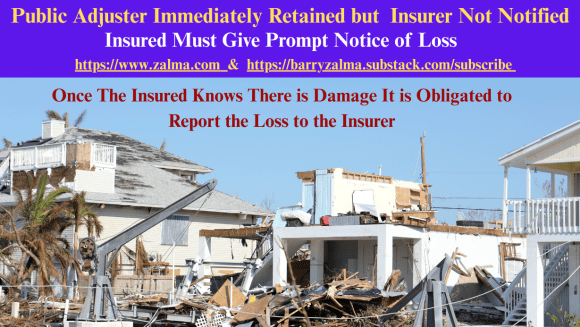
In Greater St. Stephen Ministries, Inc. v. Mt. Hawley Insurance Company, No. 24-cv-3130 (AS), United States District Court, S.D. New York (January 2, 2026) resolved a case brought by a church against an insurance company for denying coverage after Hurricane Ida. After discovery, the insurance company moved for summary judgment because it claimed the insured breached a material condition of the policy.
BACKGROUND
Greater St. Stephen Ministries, Inc., a church located in Louisiana, owned property that suffered damage from Hurricane Ida on August 29, 2021. The property was insured under a policy with Mt. Hawley Insurance Company, which required the insured to provide “prompt notice” of any loss or damage, with an absolute deadline of one year from the date of loss to file a claim.
Greater St. Stephen waited nearly four months after the hurricane to submit its insurance claim. Mt. Hawley investigated and found most evidence of moisture had dissipated, and the engineer concluded that any storm-related damage was minor and repairable, falling below the policy’s deductible. Mt. Hawley denied the claim.
Greater St. Stephen responded by suing.
LEGAL ISSUES
Under New York law, compliance with a notice-of-occurrence provision is a condition precedent to an insurer’s liability. The court must interpret the facts in the light most favorable to the non-movant but requires the non-movant to produce evidence supporting the essential elements of its claim.
In this case, the insurance contract obligated Greater St. Stephen to give “prompt notice” of loss or damage. The notice obligation is triggered when circumstances known to the insured would suggest to a reasonable person the possibility of a claim.
DISCUSSION
Greater St. Stephen Didn’t Give Mt. Hawley Prompt Notice Of The Damage, So Summary Judgment Was Granted To Mt. Hawley
Compliance with a notice-of-occurrence provision in an insurance policy is a condition precedent to an insurer’s liability under the policy. Greater St. Stephen didn’t submit a formal claim until four months after the hurricane. The notice obligation was triggered when the circumstances known to the insured would have suggested to a reasonable person the possibility of a claim. The clock started running for Greater St. Stephen when it should have known about the possibility of a claim.
Greater St. Stephen conceded that it was made aware of damages to the Property approximately 3-4 days after the Hurricane and hired a public adjuster to scope it out. It argued that the clock shouldn’t start then because the property manager was uncertain of the damages. That argument is flatly contradicted by the record. The manager showed up at the property a week or two after the hurricane because he got a call from the tenants about a week earlier telling him that the building was “damaged in the ceiling.” The manager walked around inside the building and saw leaks. Although he couldn’t see if the roof was damaged, when he saw the leaks inside, that’s when he said he needed to call a public insurance adjuster who represented Greater St. Stephen, not the insurer. By calling in a public adjuster the manager admitted that there was a “possibility of a claim.”
That’s the case despite Greater St. Stephen’s two arguments to the contrary.
- It doesn’t matter that Greater St. Stephen may not have understood the full extent of the damages, as it argues.
- The standard for when an insured must notify their insurer is not when they learn of the full extent of the damages but is instead when they learn that there is any reasonable possibility of their policy’s involvement.
- Greater St. Stephen’s property manager testified unambiguously about when he was alerted to the damage, and the parties don’t disagree about any dates of inspection.
Greater St. Stephen Failed To Give Prompt Notice Once Its Duty To Notify Kicked In
Assuming that Greater St. Stephen knew of the possibility of a claim two weeks after Hurricane Ida, that means that its December notice came around 90 days afterward. By failing to give prompt notice of a loss Greater St. Stephen breached the condition. The court concluded the church failed to comply with the policy’s notice requirement, and summary judgment was granted in favor of Mt. Hawley.
ZALMA OPINION
Public insurance adjusters are insurance professionals who work only for the insured against the insurer. I can only assume that the public insurance adjuster was aware of the conditions of the policy requiring prompt notice and should have done so on behalf of his or her client, Greater St. Stephen to Mt. Hawley. By failing to promptly report the claim was denied and the court affirmed the denial. Greater St. Stephen is not without a remedy, it should seek counsel to determine if an action lies against the public adjuster for failing to make a prompt report after being retained.
 (c) 2025 Barry Zalma & ClaimSchool, Inc.
Please tell your friends and colleagues about this blog and the videos and let them subscribe to the blog and the videos.
Subscribe to my substack at https://barryzalma.substack.com/subscribe
Go to X @bzalma; Go to Barry Zalma videos at Rumble.com at https://rumble.com/account/content?type=all; Go to Barry Zalma on YouTube- https://www.youtube.com/channel/UCysiZklEtxZsSF9DfC0Expg; Go to the InsuranceClaims Library – https://lnkd.in/gwEYk.