
The United Nations Charter entered into force eighty years ago on 24 October 1945.
Eighty years is a long life for a world order. Empires, like people, rarely last much longer. Every empire, every world order, moves through recognisable phases. There is the founding impulse – violent, visionary, unifying – when new institutions are hewn out of catastrophe. Then comes consolidation, the peace of routines and paperwork. Then the long plateau of confidence, when the order’s language becomes the world’s common sense. After that, the hairline cracks, paralysis at the centre, overstretch at the edges, and the gradual loss of faith in the order’s own ideals.
The United Nations was born in the first of those phases, a sort of post-traumatic architecture for peace. As the Preamble so powerfully states, the United Nations was established ‘to save succeeding generations from the scourge of war, which twice in our lifetime has brought untold sorry to mankind’. Eighty is the moment when an order still bears the echo of its founding catastrophe yet no longer feels its urgency. The scars of history become ornamental; the fear that once bound it together fades into bureaucracy. In that forgetting lies its danger: the loss of conviction that made it necessary in the first place. The challenge, eighty years on, is not only that the memory has dulled, but that machinery has aged, built for a world that no longer exists. To understand whether the system still serves, we must return to the idea that gave it life: what collective security was meant to be, what it has become, and what it might yet need to be.
Collective security has been described as the ‘dominant purpose’ and ‘supreme ideal’ of the twentieth century. Yet, almost a century on, it remains a loose terminology that hides a real choice confronting nations. The candid international lawyer or diplomat – while readily acknowledging that construction of legal language is at the heart of their trade – may confess they cannot easily explain what the term ‘collective security’ requires.
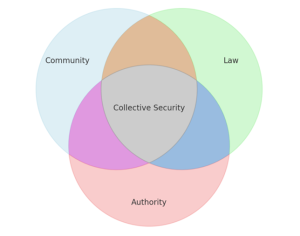
Standing on the precipice of the next eighty years, we face real decisions. Yet we should neither let collective security wither away nor embark on costly reform projects without understanding the elements from which the system is built and their intended role. In my broader project, I explore how collective security is not a single idea but relies on the interdependence of three connected elements serving three connected purposes: the international community as a site of value-making; the international legal order as a source of law-making; and international authority as a site of decision-making. Collective security operates most effectively and legitimately at the point where these three intersect.
Eight decades after the UN’s establishment, this collective security machinery is increasingly out of balance. The sense of community that once bound nations in the shadow of world war has faded into a politics of sovereignty and self-interest; law is unevenly applied and, in terms of authority, power has outpaced representation. Yet we must not mistake trajectory for progress. Determining the best system for contemporary world order requires learning from the past as well as planning for the future. In this blog marking the 80th anniversary of the establishment of the United Nations, I examine three fault-lines in the collective security framework, reflecting on why they took the structure they did and proposing where renewal might begin.
Rethinking the Security Council: Great Powers by Design, Not Destiny
The idea of ‘Great Powers’ was not born at the San Francisco conference at which the Charter was drafted but inherited from an older world. The League of Nations had already distinguished between the powerful and the many, though the identity of the powers was different: Britain, France, Italy and Japan held permanent seats on its Council, while Germany and the Soviet Union hovered uneasily at its margins, admitted late and expelled early.
When the Second World War began, it was clear that any new order would again have to rest on the consent of the strong, but also their unity and willingness to enforce it. The structure took shape not in committees but in a series of wartime conversations between the men who would later write the Charter. In August 1941, on a warship off Newfoundland, Franklin Roosevelt and Winston Churchill drafted the Atlantic Charter, the first sketch of a post-war settlement. The two men saw the future differently. Roosevelt imagined a world policed by four great powers, each stationed with garrisons across the globe. ‘The small nations’, he told Anthony Eden in 1943, ‘should have nothing more dangerous than rifles’. Churchill, still thinking in imperial terms, preferred a looser structure of three regional councils (the concept he described as his ‘three-legged stool’) – one for Europe, another for Asia and the third for the Americas, with Britain at the centre of the European sphere. To Roosevelt, this was outdated thinking. ‘Winston’, he said, ‘you have four hundred years of acquisitive instinct in your blood. You just don’t understand how a country might not want to acquire land somewhere if it can get it. A new period has opened in the world’s history, and you will have to adjust yourself to it’.
At the Tehran Conference in 1943, Roosevelt courted Stalin, much to Churchill’s irritation, and welcomed the Soviets as ‘new members of the family circle’. ‘There I sat’, Churchill later said, ‘with the great Russian bear on one side of me, paws outstretched, and on the other the great American buffalo, and between the two sat the poor little English donkey, who was the only one who knew the right way home’. Stalin, meanwhile, distrusted talk of moral purpose and favoured a small directorate of great powers with veto authority. Having been treated as an international pariah since the Bolshevik revolution, Stalin viewed any new organization primarily as a means of blocking any decision contrary to its interests and securing the Soviet Union’s borders. ‘Stalin began to show his claws’, Anthony Eden wrote after visiting him in 1941, when the Soviet leader pressed for recognition of his claims to eastern Poland. The Soviet view of collective security was territorial rather than legal.
By the time of the Dumbarton Oaks Conference in 1944, the outlines of the new directorate were becoming clear. At Roosevelt’s insistence, China, then represented by the Chunking government of Chiang Kai-shek, was invited to join the discussions – less for its strength than for its symbolism, a non-Western and non-Communist partner to lend legitimacy to a largely Western design. The British and the Soviets were sceptical. Gladwyn Jebb admitted that the UK Foreign Office ‘never thought that China had any chance of being a real world power’, but ‘we had to imagine that it was in order to please President Roosevelt’. The Soviet Union went further, refusing to meet directly with the Chinese. In a carefully staged act of diplomatic choreography, two separate conferences were held at Dumbarton Oaks: first among the US, the UK and the Soviet Union, and then, after the Soviets’ departure, between the Western powers and China. It was at Dumbarton Oaks that the four powers agreed to add a fifth member. The US proposed Brazil, yet ultimately it was agreed that France would be offered a permanent seat, its inclusion secured by de Gaulle’s defiance and Churchill’s refusal to contemplate ‘the prospect of no strong country on the map between England and Russia’, especially as he could not foresee American forces being maintained on the continent for a long period of time.
The point of this quick march through history is to serve as a reminder that the Great Powers were not ordained by destiny but arranged by design – the result of contingency, negotiation and fear. Eighty years later, the world’s demography, economy and distribution of power have shifted. If the Security Council were to be redrawn on the same pragmatic logic that guided its founders, its permanent members might look very different: India, Indonesia and Nigeria for population; Germany and India for military expenditure; Japan for economic weight; Brazil for regional influence. The problem is that the system has no means of recognizing these shifts in power.
Perhaps permanence too should have a limit. The Charter’s authors assumed that the Great Powers would act with self-restraint and that their cooperation would secure peace. But if those assumptions no longer hold, the principle of permanence itself demands review. The idea need not be revolutionary. A periodic review and vote on permanent membership – once every ten, twenty-five or even fifty years – could ensure that the Council continues to reflect the geopolitical order it claims to regulate. Being ‘great’ requires military and economic heft but also demonstrable capacity and willingness to uphold the Charter, to contribute forces and funds to collective measures, to refrain from unilateral aggression, and to accept the jurisdictional and normative constraints the system imposes.
Rethinking the General Assembly: An Assembly for the World
If the Security Council embodies authority, the General Assembly was meant to embody community. Conceived in 1945 as a deliberative forum rather than a decision-making body, it was designed to give every state a voice, even if not a vote of consequence. Yet almost from the beginning, as Cold War paralysis swiftly set in, the General Assembly began to stretch the limits of its design. Through the 1950 ‘Uniting for Peace’ resolution, the General Assembly authorized itself to recommend collective measures, including the use of force, in the event the Security Council was deadlocked – a quiet revolution that shifted the UN’s moral centre of gravity.
In recent years, its representative function has deepened. The General Assembly has become the closest thing the international system has to a democratic conscience and now acts as the world’s barometer of legitimacy. In 2022, the General Assembly passed a resolution requiring there to be a debate on any use of the veto, making visible the exercise of Great Power privilege. Its votes have also become a moral ledger of global opinion: in March 2022, 141 states condemned Russia’s invasion of Ukraine; in December 2023, 153 demanded an immediate ceasefire in Gaza. At the same time, the Assembly has increasingly turned to law to give expression to community values, requesting Advisory Opinions from the International Court of Justice on climate change, the legality of Israel’s occupation, and the decolonization of the Chagos Archipelago.
The General Assembly’s authority is still moral rather than coercive. However, it is an important compass, representing the collective mood of the world, a reminder that legality without legitimacy cannot long endure. Further strengthening the connection between General Assembly debate and Security Council decision-making would not be a radical redesign but a return to the balance required by collective security, bringing law and authority into balance with community values.
Rethinking International Law Enforcement: The Missing Crime
Eighty years after the entry into force of the Charter, the most daring part of its vision lives not in New York or Geneva but in The Hague. The International Criminal Court, though standing outside the United Nations, represents the most radical expression of the Charter’s logic: that peace depends not only on restraining states, but on holding individuals to account. Conceived as the institutional heir to Nuremberg, it was meant to complete the post-war architecture – replacing the victors’ tribunal with a permanent one, ensuring that those individuals bearing the greatest responsibility would be judged for wars of aggression.
The crime of aggression was recognized at Nuremberg as the ‘supreme international crime’, containing within itself the accumulated evil of the whole. Yet, it has proved the most elusive to enforce. It took more than half a century to establish the International Criminal Court in 1998, another twelve years to agree on a definition of the crime of aggression, and another seven years before the Court’s jurisdiction over the crime of aggression was activated. When it was, in 2017, the result was a decaffeinated compromise based on the need for states to ‘opt in’ to jurisdiction, placing it beyond the reach of the very powers most likely to commit the offence. It is a bitter irony that the architects of Nuremberg have become, half a century later, the engineers of its undoing – the United Kingdom and France from within the ICC, the United States from without, leading efforts to narrow jurisdiction over the very crime they once called supreme.
Even so, the world continues to demand individual criminal accountability for aggression. At the July 2025 session of the ICC Assembly of States Parties, an overwhelming cross-regional majority backed a proposal to grant the Court strengthened jurisdiction over the crime of aggression, aligning it with other crimes under the Court’s jurisdiction. A small but powerful minority – the UK, France, Canada, Japan and New Zealand, backed by the US as a non-party-state observer – blocked consensus. The final resolution deferred reform until 2029 but, for the first time, commits the Assembly to the aim of strengthening jurisdiction.
Conclusion
At the conclusion of its eighth decade, it could be that the UN is nearing the end of its life. In a budgetary sense, it survives on life support, with its most powerful member hovering by the switch. The question is more than simply whether the institution is in crisis, but whether it can be revived, or whether we will simply stand by and let it die.
Collective security was never a finished design; it was a promise – that the world could restrain its worst instincts through shared institutions of judgment and restraint. The Charter’s survival depends on whether a collective willingness remains to renew the balance between its three pillars: authority, law, and community. Reform must begin where the strain is greatest – in clarifying the role and identity of the Great Powers; in strengthening the representative function of the General Assembly; and in reinforcing the reach and credibility of international courts.