
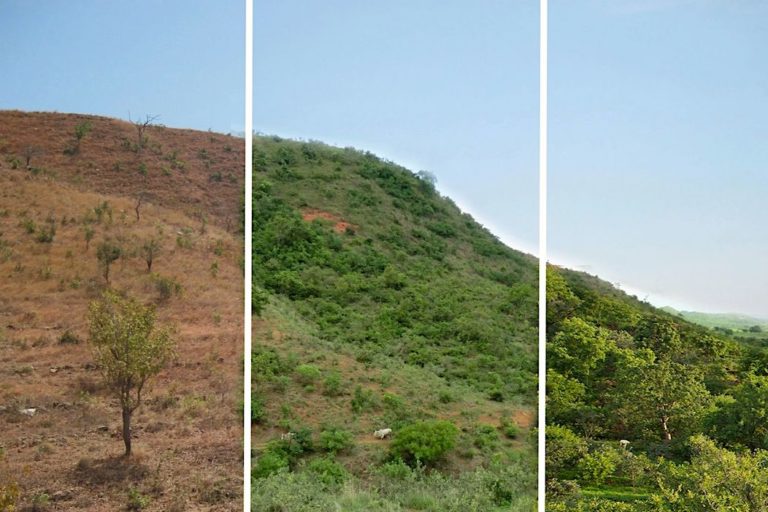
- Australian agronomist Tony Rinaudo’s reforestation project in Niger was failing, with 80% of his planted saplings dying, until he stumbled upon a simple solution in plain sight: stumps of previously cut trees trying desperately to regrow in the dry, deforested landscape.
- Rinaudo realized that the degraded land contained numerous such stumps with intact root systems capable of regenerating themselves, plus millions of tree seeds hidden in the soil, which farmers could simply encourage to grow and reforest the landscape, something he refers to as “an invisible forest in plain view.”
- Today, the technique of letting trees resprout and protecting their growth from livestock and wildlife is called farmer-managed natural regeneration (FMNR) and is responsible for reforesting 6 million hectares (15 million acres) in Niger alone.
- Rinaudo joins Mongabay’s podcast to speak with Rachel Donald about his journey implementing this technique and its massive potential to help tackle biodiversity loss and food insecurity through resilient agroforestry systems.
Tony Rinaudo had been attempting to reforest degraded land in Niger in the 1980s at a rate of 6,000 trees a year, but most of them died. While driving to a village hosting one such project, what he caught sight of what he initially thought was a bush. Upon closer inspection, though, it turned out to be the inspiration he was looking for.
“In that instant, everything changed because I realized it’s not a bush, it’s not even a weed. That’s a tree,” he says, growing out of an old stump. The degraded land he was attempting to reforest in fact contained “millions and millions” of them, which, if protected from browsing animals and encouraged to grow, would sprout trees to rebuild the region’s depleted soil and water tables, and provide nutrients and partial shade that farmers’ crops could grow better in, via a system called agroforestry.
Thus began his journey promoting what is now known as farmer-managed natural regeneration (FMNR), which has reforested 6 million hectares (15 million acres) in Niger — an area twice the size of Belgium — and even more globally. Rinaudo joins Mongabay’s podcast to discuss with co-host Rachel Donald the potential for this technique to reforest a meaningful portion of the world’s degraded land, while boosting farmers’ livelihoods and food security through increased resiliency via agroforestry in the face of growing climate impacts, and creating habitat for wildlife.
Listen here:
Rinaudo details the positive benefits FMNR has had on land restoration efforts and people’s lives, which he says could have massive potential to uplift the world’s 500 MILLION? smallholder farmers.
And the world’s farmland could use such restoration efforts: the United Nations says as much as 40% of the world’s land is degraded due to human mismanagement of natural resources. Its reported solution includes investing in land restoration, “nature-positive” food production, and rewilding, which could return between $7 and $30 for every dollar spent.
“The biggest change that I see when I go back into these communities is the restoration of hope,” Rinaudo says. “If you can put yourself in the shoes of these families who struggle to feed their children adequately [and] then here comes this very, very simple concept, literally a solution at your feet which empowers you and enables you to create that future that you want, simply, by now working with these wonderful forces of nature, instead of fighting them, and seeing them as the enemy that needs to be conquered.”
Subscribe to or follow the Mongabay Newscast wherever you listen to podcasts, from Apple to Spotify, and you can also listen to all episodes here on the Mongabay website, or download our free app for Apple and Android devices to gain instant access to our latest episodes and all of our previous ones.
Banner image: Results of farmer-managed natural regeneration in Luhundwa, Tanzania, from 2019-2022. Image courtesy of World Vision.
Rachel Donald is a climate corruption reporter and the creator of Planet: Critical, the podcast and newsletter for a world in crisis. Her latest thoughts can be found at 𝕏 via @CrisisReports and at Bluesky via @racheldonald.bsky.social.
Mike DiGirolamo is a host & associate producer for Mongabay based in Sydney. He co-hosts and edits the Mongabay Newscast. Find him on LinkedIn, Bluesky and Instagram.
Related Reading:
Farmer-managed natural regeneration: the fastest way to restore trees to degraded landscapes?
Let it grow: Q&A with reforestation and land restoration visionary Tony Rinaudo