
A duty of candour will be imposed on more than 1.9 million public servants under legislation to be introduced today. The Ministry of Justice says that its bill, if passed, will mean that officials “must act with honesty and integrity at all times, with criminal sanctions for egregious breaches”.
There will also be a new offence of “misleading the public in a way which is seriously improper”.
In addition, legal aid will available to support bereaved families at inquests and funded for the first time by the public body represented at the hearing.1 Public bodies will be under a duty to ensure the amount they spend on their own legal representation is proportionate and state bodies will be expected to act “with the sole purpose of helping the coroner establish the facts of the case”.
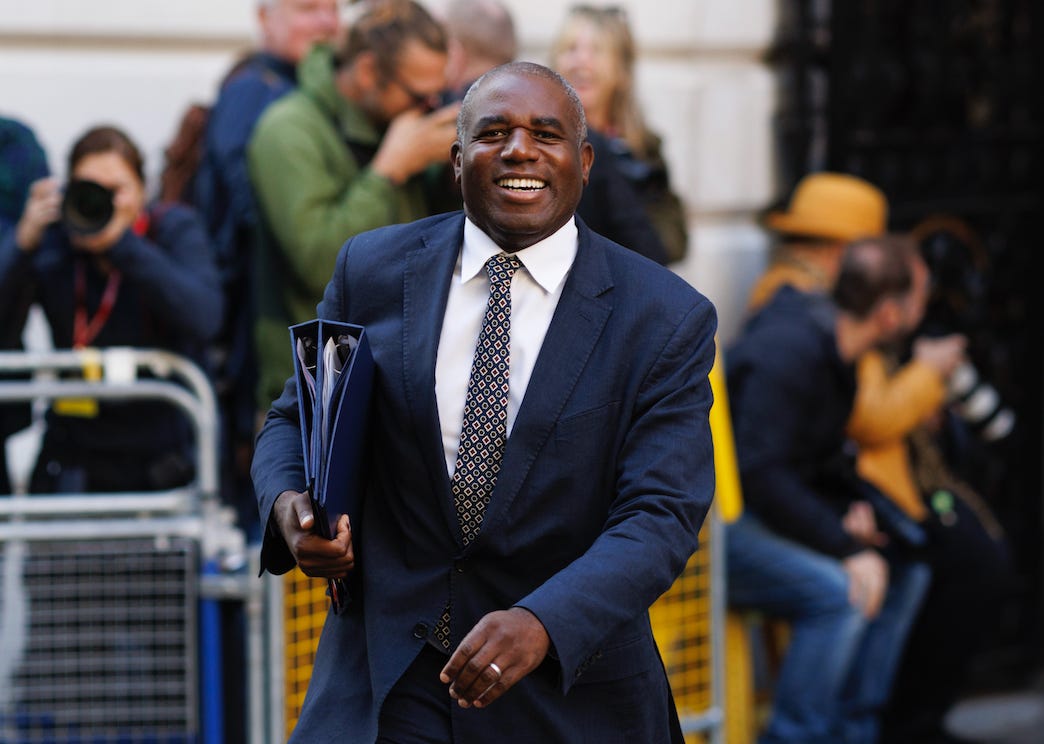
The proposals will be contained in a Public Office (Accountability) Bill. Government bills are usually published in the late afternoon. This timing means that David Lammy, who will be answering MPs’ questions as justice secretary for the first time this morning, can extol his bill’s virtues without any risk that he will be asked about its detailed provisions.
But we can already see the bill’s limitations. According to the Ministry of Justice, criminal sanctions will be reserved for “egregious” breaches or misleading the public in a way that is “seriously” improper. Merely being economical with the truth will presumably be just fine.
Lammy used other limiting adverbs in a piece for today’s Guardian:
When something has gone badly wrong, public servants — from the bobby on the beat to the highest office in the land — will be under a duty to act with honesty and integrity at all times. Anyone who fails to do so will face criminal prosecution.
And it will be supported with a new offence for flagrantly misleading the public, with those found in breach of the law facing up to two years behind bars, along with replacing the current offence of misconduct in public office with two new offences.
The bill has been a long time coming. Sir Keir Starmer promised legislation when he spoke at the Labour party conferences of 2022 and 2024.
There were also pledges last year in his party’s election manifesto and the King’s Speech. Indeed, the prime minister undertook to introduce a bill before 15 April this year, the anniversary of the disaster at the Hillsborough football stadium in 1989 that killed 97 Liverpool supporters.
Why the delay? I suspect because there has been disagreement within government about how far the bill should go. And why is the bill being published now? No doubt because it’s the last day MPs sit before the Labour Party holds its annual conference in Liverpool.
According to Ian Byrne, who attended the Hillsborough match in 1989 as a teenager and who now represents a Liverpool constituency as a Labour MP, a version of the government bill was shown in March to Pete Weatherby KC and the Liverpool solicitor Elkan Abrahamson. They had drafted a private member’s bill in 2017 for introduction by Andy Burnham, a once-and-perhaps-future MP.
The two lawyers said unequivocally that the government bill “fell far short”, Byrne told MPs on 2 July, “because it had no legally binding duty of candour; no provision for equal legal funding during inquests and inquiries; and loopholes allowing public bodies to avoid disclosure”.
It was a a “watered-down version of the legislation, stripped of its moral force and legal teeth”, Byrne added in a debate earlier this month.
To make the point, Byrne re-tabled Burnham’s original Public Authorities (Accountability) Bill in July. That version will provide a useful point of comparison with the government’s bill when it appears later today.
The backbenchers’ bill says that “public authorities and public servants and officials have a duty at all times to act within their powers in the public interest, and with transparency, candour and frankness”. They also have a duty “to assist court proceedings, official inquiries and investigations relating to their own activities, or where their acts or omissions are or may be relevant”.
A chief executive of a public authority who intentionally or recklessly failed to assist an investigation would have faced up to two years’ imprisonment under the backbench proposals. So would a public servant or official who “intentionally or recklessly misleads the general public or media”. But defendants could rely on the privilege against self-incrimination.
When I wrote about Byrne’s bill for the Law Society Gazette in July, I argued that its definition of “public servants and officials” was too broad. Did it include members of parliament? Ministers? Judges? All could be accused of misleading the public or media from time to time, if only by withholding information that, perfectly properly, they cannot disclose.
And what degree of candour will be required? As the justice minister Alex Davies-Jones told MPs this month,
we will be legislating on a duty of candour for more than 1.9 million public servants. We need to get that right, with no unintended consequences, and it needs to be worthy of the families.
Finally, how effective will the legislation be? Parliament’s joint committee on human rights reported last year that the existing NHS duty of candour backed by potential criminal sanctions was not being met. Fear of sanctions could create a perverse incentive to cover up, the committee observed.
Today’s announcement from the Ministry of Justice says its Public Office (Accountability) Bill is “to be known as the Hillsborough Law”. Not by me, it isn’t. A bill is not a law unless and until it is passed by parliament.
And although the families of the 97 Liverpool supporters have spent decades campaigning for reform, the prime minister says “this a law for the 97, but it is also a law for the sub-postmasters who suffered because of the Horizon scandal, the victims of infected blood and those who died in the terrible Grenfell Tower fire”.
It’s certainly what they, too, have been campaigning for — but in fact it will be a law for the victims of future disasters. Past inquests and inquiries are not likely to be reopened.
The candour bill, as I prefer to call it, may well influence the way people behave — for better or worse. But I would be surprised if the drafters have included adjectives as subjective as “egregious” and “flagrant”.
We shall see: not much longer to wait now.
Since the aim is equality of arms, there will still be no legal aid for victims and their families if no public body is represented at an inquest. We wait to see who’ll pick up the bill if more than one public body is involved.