
16th November 2023
Yesterday the Supreme Court handed down its appeal judgment in the Rwanda policy case.
For an informed view on the case, it is worth taking the time to watch Lord Reed, the President of the court, giving the summary of the judgment:
A court-approved summary can also be read here – and the full judgment is here.
*
I wrote a couple of quick posts on the case yesterday for the mainstream media.
At the Financial Times, I did an “instant insight” (and it certainly had one of those two qualities) which emphasised two things which were immediately evident about the case.

First, it was remarkable – and, to me, a surprise – that the current Supreme Court under Lord Reed, which is generally regarded as deferent to the executive and legislature on “policy” matters, went unanimously against the government.
In essence, and to echo John Kander and Fred Ebb’s New York, New York: if a government cannot win on a “policy” matter before a Lord Reed Supreme Court, it cannot win that case anywhere.
Second, the court – perhaps showing more political sense than the entire cabinet – deftly avoided resting the case on the European Convention of Human Rights or the Human Rights Act.
Both instruments were, of course, mentioned in passing – but the effect of the judgment would have been just the same had neither instrument applied to the facts.
The court instead had regard to a range of other legal instruments and sources of law, including what is called customary international law.
*

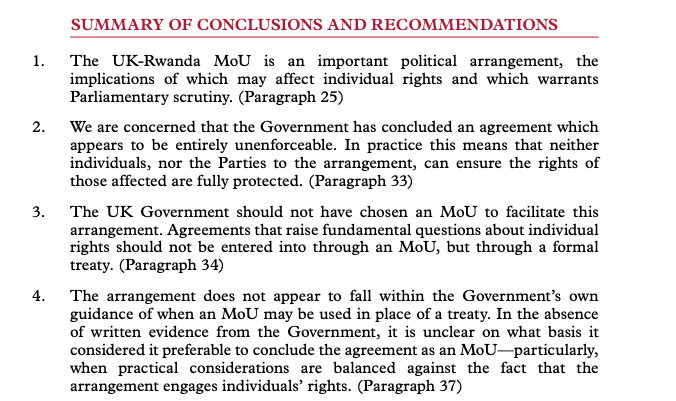
Over at Prospect, I approached the judgment from a different perspective, and I averred that the government could have won the case had they wanted to do so – by which I meant that the government could have negotiated a treaty with Rwanda that would have addressed the concerns ultimately expressed by the Supreme Court, instead of relying on a flimsy Memorandum of Understanding.
And this was not just a commentator-with-hindsight, it was what the government had been explicitly warned about a year ago by a House of Lords committee:
Some other commentators are not with me on this point – and they say that even a substantial treaty with Rwanda, which ensured there was no risk of asylum seekers being wrongly returned to their country of origin, may not have been enough to save the policy in this appeal.
Perhaps they are right and more would have been needed, but on any view such a treaty would have been necessary, if not sufficient: a non-enforceable MoU was inherently inadequate. It would not have been relied upon had the government been actually serious about this policy.
*
I am now thinking about writing a detailed post on the case from a constitutionalist perspective; but in the meantime, let me know below what you think about the decision and what you reckon to be its significance.
****
Comments Policy
This blog enjoys a high standard of comments, many of which are better and more interesting than the posts.
Comments are welcome, but they are pre-moderated and comments will not be published if irksome, or if they risk derailing the discussion.
More on the comments policy is here.