
The attorney general should have corrected factual inaccuracies in a press release published by the Crown Prosecution Service on 21 May after three boys were sentenced for rape offences at Fordingbridge, Hampshire, the Court of Appeal said today. I published a detailed account last week of the “very significant errors” that were left uncorrected for nearly three weeks.
Three judges headed by the lady chief justice observed that Lord Hermer KC had chosen to comment on the case before the Court of Appeal had been able to consider whether the sentences were unduly lenient.
Generally speaking, ministers and others within government who are involved in ongoing legal proceedings do not comment publicly upon them at all. Here, however, the attorney general chose to comment publicly on these legal proceedings whilst they were ongoing: on 26 May 2026 in a press release and in a video clip announcing that he had made the references, and again in the podcast interview [with Nick Robinson] broadcast on 6 June.
The lady chief justice continued:
Centrally, the attorney general chose to volunteer public comments on the gravity of the offending. In the podcast interview he professed detailed knowledge of the facts.
If a member of government, and in particular the attorney general, chooses to make public statements about the gravity of offending, and to refer to “understandabl[e]” “huge public concern”, then they should ensure that what is communicated is fair and accurate, correcting any widespread misreporting of which they are aware. Otherwise, they lend currency and endorsement to the misreporting.
It therefore seems to us that in these circumstances it did fall to the attorney general publicly to correct the factual inaccuracies [in the Crown Prosecution Service press release] to protect the administration of justice, the safety of all involved (victims and offenders), and to underscore the cardinal importance of the public being given accurate information about what is happening in their justice system (good or bad).
CPS
The Crown Prosecution Service said it was tightening up its procedures to ensure that errors such as these did not recur. The court accepted an apology from the director of public prosecutions:
With these assurances, and with the acknowledgements and apologies rightly made by the DPP, we simply mark our concerns and trust that errors such as these will not be repeated.
Threats
Carr noted that Judge Rowland, the trial judge, “had been personally threatened and had to leave his home”. Hermer had not been aware of even generalised concerns about the judge’s safety at the time he gave his interview to Robinson. If he had, he told the court, he would have expressed his concerns publicly.
The Court of Appeal said:
The attorney general states that he was unaware of any security threats to the judge and would have acted differently, had he been so aware. But even if he did not know about specific threats, we consider that he must have known from the widespread commentary, including publicised comments from other prominent public figures, that the judge was under personal attack.
Carr pointed out that Edward Henry KC, counsel for the second defendant, had emailed the attorney general’s office on 28 May inviting him to correct misleading press reporting. She commended the KC and other counsel who had tried to get the factual inaccuracies corrected and the judge given proper protection.
In his email, Henry had told Hermer:
The personal vilification of the judge is disturbing. The failure of the national press (none of whom attended the trial) to report accurately the basis of the sentence is driving ill-informed statements from politicians and the public at large.
There is a substantial risk of serious prejudice in that the fairness of these proceedings may be undermined if the reference [to the Court of Appeal] is conducted against a backdrop of hostile and misleading media reporting, of a degree that is without precedent.
Hermer told the court he had not been told of Henry’s email until 3 June. On advice, he did not reply. He intended no discourtesy.
Noting that the attorney general had known about the personal vilification of the judge by 3 June, Carr said:
No one within government has said publicly, even now, that the attacks on the judge were improper and a threat to the independence of the judiciary.
Keep politics out of law
That led to the court’s central conclusion — the importance of keeping the attorney general’s power to refer a sentence to the Court of Appeal separate from politics.
In this case, Hermer had exercised the power properly. Two of the three offenders had their sentences increased.
But Carr noted that, very soon after referring the cases to the Court of Appeal on 26 May, Hermer had issued a recorded video statement in which he said “no one should doubt the determination of this government to tackle the scourge of violence against women and girls”.
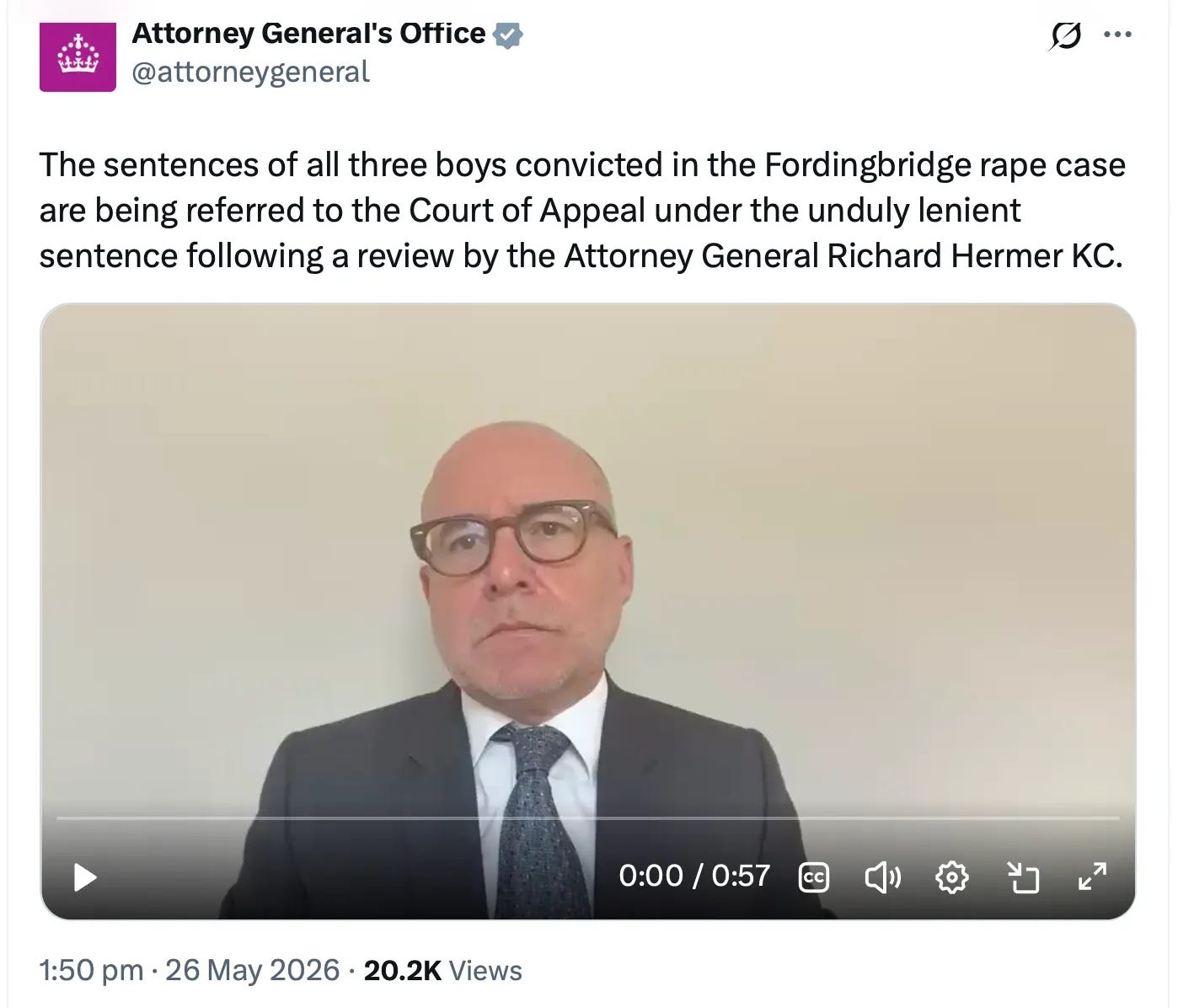
This was followed by a press release in which Hermer said:
There has understandably been a huge amount of public interest, and concern, at this horrific case… This government will not hesitate in taking action to ensure all women and girls feel safe and have confidence in the justice system.
It was “difficult to escape the conclusion that he associated the making of the references with government policy from the outset,” Carr concluded.
“The power to refer [sentences as unduly lenient] is not vested in the government but in the attorney general who is to exercise it independently and not in pursuit of government agenda, however worthwhile”.
A spokesperson for the attorney general’s office said:
We still study this judgement carefully. The CPS has rightly accepted responsibility for the inaccuracies in their press release and once the attorney was made aware in the weeks after he sought assurances about what went wrong and what steps are now being taken to avoid this happening again.
At every turn this attorney has been a staunch defender of the independence of the judiciary and has publicly commented numerous times of his concerns about attacks on judges. The attorney also remains firmly committed to ensuring the criminal justice system has the faith of victims, particularly survivors of violence against women and girls.