
Highlights
- CLEAR Investigate uses agentic AI to automate multi-source searches and connect findings intelligently.
- The platform consolidates public records, proprietary data, and open-web sources into one interface.
- Built-in documentation and source transparency support audit-ready, high-stakes investigative decisions.
Every investigation starts with a question. Who is this person? Is this business legitimate? Where does this network of relationships lead? The quality of your answer depends entirely on the tools you use to find it.
For many corporate and government professionals, those tools are a patchwork: a general-purpose database, some open-web searching, a spreadsheet for notes, and hours of manual cross-referencing to stitch it all together. It works, until the volume gets too high, the risk gets too complex, or the deadline gets too tight.
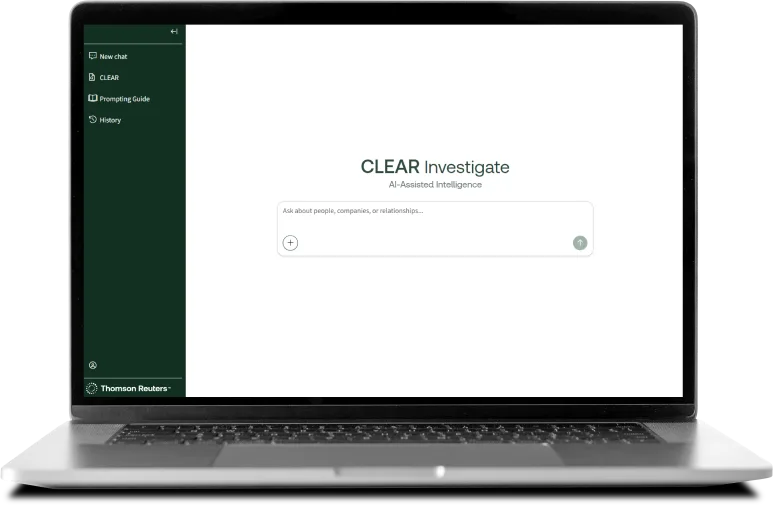
CLEAR Investigate was built specifically for this problem. Not as an upgrade to a legacy workflow, but as a fundamentally different way to conduct investigations — one where AI does the heavy lifting, and your expertise drives the judgment.
Jump to ↓
The limits of the tools most investigators rely on today
What agentic AI actually means — and why it matters here
From search-based tools to intelligent investigation
Security, privacy, and professional-grade standards

The limits of the tools most investigators rely on today
Most investigative tools follow the same model: you search, you retrieve, you piece together the picture yourself. That approach has three compounding problems:
- Volume: data has outpaced what any individual can manually process
- Fragmentation: critical connections are spread across separate systems that don’t talk to each other
- Documentation burden: audit-ready records require manual effort on top of the investigation itself
The result: too much time on process, not enough on analysis. As fraud grows more sophisticated and caseloads increase, that imbalance is no longer sustainable.
What agentic AI actually means — and why it matters here
You may have encountered AI tools that summarize documents or answer questions. Useful, but limited. Agentic AI is a different category.
Rather than responding to a single prompt, an agentic AI system interprets your goal, plans a sequence of actions to achieve it, executes those actions across multiple sources, and adapts based on what it finds. It thinks in workflows, not isolated queries.
In an investigative context, that distinction is significant. A traditional AI tool might tell you what’s in a single record. CLEAR Investigate’s AI agent searches across person records, business filings, adverse media, sanctions lists, beneficial ownership data, and open-web sources simultaneously — then connects what it finds into a coherent, sourced answer to your original question.
This isn’t automation for its own sake. It’s the difference between having a research assistant who retrieves documents and one who actually investigates.
“CLEAR Investigate is a time saver for detailed research because you are able to ask a question specific to your needs. It alleviates having to look at multiple resources to find answers.”
— Jony Labrado, First National Bank Texas
What CLEAR Investigate offers
CLEAR Investigate brings together several capabilities in one platform:
1. Comprehensive data access
CLEAR Investigate provides access to a wide range of data sources, including public records, proprietary datasets, and selected openweb and social media content. This includes information on people, businesses, assets, legal history, and related records such as sanctions, beneficial ownership, and vehicle information.
Bringing these sources together in one place can help support investigations that rely on multiple types of information.
2. AI-assisted workflows
Users can ask questions in plain language. The system helps organize searches across relevant data sources, surfaces possible connections, and presents results in a structured format. It also highlights areas where information may be unclear so users can review and decide how to proceed.
Follow-up questions can be used to explore results further while maintaining context.
3. Built-in documentation
Each output includes a record of the steps taken, sources used, and how results were generated. This documentation is created automatically and can support internal review or external reporting needs.
From search-based tools to intelligent investigation
The shift from traditional research tools to CLEAR Investigate isn’t a steep learning curve. The interface is conversational — you ask questions in plain language rather than constructing database queries. The Prompt Guide helps new users get started with common investigative scenarios immediately. And the underlying CLEAR data environment, already recognized as the industry standard for public records, provides a foundation your team can trust.
The difference shows up in outcomes:
With traditional tools: Multiple searches across separate systems, manual cross-referencing, and hours of report consolidation for a single subject investigation.
With CLEAR Investigate: One question. The AI searches across all relevant sources, identifies connections, and delivers a structured, sourced answer with recommended next steps — in minutes.
The same trusted data. The same professional standards. A fundamentally different experience of getting to the answer.
Security, privacy, and professional-grade standards
Investigations often involve sensitive subjects and consequential decisions. CLEAR Investigate is built with that in mind.
- Your data is never used to train AI models
- Role-based access controls ensure only authorized personnel can access relevant data
- The platform meets federal, state, and local data protection requirements
- Full source transparency means every finding can be verified and every conclusion can be explained
- Access is limited to authorized, vetted customers
This is AI designed for environments where accountability is not optional.
The era of manual investigation is ending
The investigative landscape has changed: more data, more sophisticated threats, more demanding compliance requirements, and less time. Tools that require investigators to manually stitch together fragmented records and build documentation from scratch are no longer equal to the challenge.
CLEAR Investigate represents the next generation of professional investigation: purpose-built agentic AI, grounded in the most trusted data in the industry, with the transparency and auditability that high-stakes decisions demand.
The question isn’t whether to move to agentic AI. It’s whether to move now or catch up later.
Disclaimer
Access to these tools is limited to authorized, vetted customers.
Thomson Reuters is not a consumer reporting agency, and none of its services or the data contained therein constitute a ‘consumer report’ as such term is defined in the Federal Fair Credit Reporting Act (FCRA), 15 U.S.C. sec. 1681 et seq. The data provided to you may not be used as a factor in consumer debt collection decisioning, establishing a consumer’s eligibility for credit, insurance, employment, government benefits, or housing, or for any other purpose authorized under the FCRA. By accessing one of our services, you agree not to use the service or data for any purpose authorized under the FCRA or in relation to taking an adverse action relating to a consumer application.
The post The CLEAR difference in investigations appeared first on Thomson Reuters Law Blog.