
The third instalment of this series about the Cabinet Manual discussed what it should say about mid term changes of Prime Minister. The great value of the manual is that it seeks to codify the UK’s core constitutional conventions. But conventions are flexible, they evolve, their scope and application may be contested. In this fourth post, Robert Hazell analyses five key constitutional conventions, and identifies where there is disagreement about how they should operate.
Dissolution and the Lascelles Principles
When the Cabinet Manual was published in 2011 the Fixed-term Parliaments Act had just been passed, which abolished the prerogative power of dissolution. That power was revived in the Dissolution and Calling of Parliament Act 2022, so the revised manual will need to describe the circumstances in which the King might properly refuse an untimely request. The Johnson government initially sought to claim that the Prime Minister could advise, rather than merely request a dissolution, but that suggestion was robustly dismissed by the parliamentary Joint Committee on the Fixed-term Parliaments Act.
The main precedent the committee relied on was the letter sent to The Times in 1950 by Alan Lascelles, Private Secretary to King George VI, outlining the circumstances in which a ‘wise Sovereign’ might properly refuse to grant a dissolution. In a modern restatement the Cabinet Manual might identify situations where it would not be appropriate for the PM to request a dissolution, such as very soon after the previous election; or where the Prime Minister loses the confidence of the House of Commons, and there is a viable alternative government that can command confidence. More contentious would be where the PM is under threat as leader of their political party, but tempted in turn to threaten his critics by seeking a dissolution, appealing over their heads to the country: a temptation which Boris Johnson reportedly toyed with before his resignation in July 2022.
Prorogation
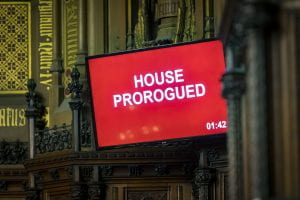
In August 2019 Boris Johnson as Prime Minister advised Queen Elizabeth II to prorogue parliament for five weeks when the Brexit negotiations were nearing a vital deadline. The Queen obliged; and some constitutional experts argued that the order of prorogation was non-justiciable. But in a subsequent court challenge the Supreme Court declared that the prorogation was unlawful and of no effect, because it offended against the fundamental constitutional principles of parliamentary sovereignty and parliamentary accountability. There can no longer be any doubt that a request for prorogation can be refused; but there is still scope for argument about what constitutes ‘reasonable justification’ in the court’s ruling that
…the relevant limit on the power to prorogue is this: that a decision to prorogue (or advise the monarch to prorogue) will be unlawful if the prorogation has the effect of frustrating or preventing, without reasonable justification, the ability of Parliament to carry out its constitutional functions as a legislature and as the body responsible for the supervision of the executive.
Devolution and the Sewel convention
When the devolution legislation was being passed by parliament in 1998, Lord (John) Sewel (then a junior minister in the Scottish Office) gave an undertaking that the Westminster parliament would not normally legislate on devolved matters without the consent of the devolved legislature. This undertaking, which became known as the Sewel convention, was subsequently codified in the Scotland Act 2016, which provides in section 2:
But it is recognised that the Parliament of the United Kingdom will not normally legislate with regard to devolved matters without the consent of the Scottish Parliament.
A similar provision exists in the Wales Act 2017; but in relation to both Scotland and Wales the Sewel convention was widely ignored under the exigencies of the Brexit legislation, with the EU Withdrawal Act, the EU (Withdrawal Agreement) Act, and the Internal Market Act all being passed against the wishes of one or more of the devolved legislatures. In its 2024 manifesto, Labour pledged to reset intergovernmental relations and strengthen the Sewel convention by ‘setting out a new memorandum of understanding outlining how the nations will work together for the common good’; but almost two years later, the memorandum has yet to appear. So in relation to this convention, the redrafting is still a work in progress.
War-making powers
The Cabinet Manual records that in two recent examples of significant military action, in Iraq in 2003 and Libya in 2011, parliament was given the opportunity of substantive debate. It goes on to recognise the emergence of a convention:
In 2011, the Government acknowledged that a convention had developed in Parliament that before troops were committed the House of Commons should have an opportunity to debate the matter and said that it proposed to observe that convention except when there was an emergency and such action would not be appropriate (para 5.38).
Successive governments have been inconsistent, however, in how they have observed the convention. Parliament was consulted on decisions relating to military action against the Syrian regime’s chemical weapons facilities in 2013, and against Islamic State in Iraq (in 2014) and in Syria (in 2015), which appeared to strengthen the convention. However, as recorded in the latest Commons Library briefing, in more recent years governments have taken military action without consulting Parliament: in Syria in 2018 (under Prime Minister Theresa May), in the Red Sea/Yemen in 2024 and 2025 (under Rishi Sunak and Keir Starmer), in support of the wider Middle East in April and October 2024 (under Sunak and Starmer) and in the Middle East in 2026 (under Starmer).
Keir Starmer said in October 2024 that ‘there will be occasions when it is important for a Government to act without first coming to this House’. So the convention has effectively become optional: Prime Ministers will consult parliament when they feel like it, or see some advantage in doing so, but suffer no penalty when parliament is ignored.
This makes revision of this section of the Cabinet Manual extremely difficult. Is there still a convention, albeit of a more limited kind: for example, if military action is planned well in advance (as in Iraq in 2003), leading to a sustained campaign rather than a single strike? The difficulties are compounded by the changing nature of modern warfare, with drone strikes, targeted killings and cyber warfare becoming more frequent than deployment of troops on the ground. This is to say nothing of British support for Ukraine, through training and supply of munitions, which has been very significant in terms of expenditure. Although there have been debates on select committee reports, and on take-note motions, there has not been single set-piece debate resulting in a Yes/No vote.
The caretaker convention
This final convention is not named as such in the Cabinet Manual, which talks simply of ‘Restrictions on government activity’, particularly around election time. To Whitehall watchers that may connote purdah (recently renamed the ‘pre-election period of sensitivity’); but that means restrictions on government communications, discussed below. The manual would be clearer if it used the terminology of a caretaker convention, with a caretaker Prime Minister and caretaker government (as they do in Australia and New Zealand). It would also be clearer if it explained the rationale of the convention, which is that governments which no longer command confidence are expected not to make decisions which would bind the hands of a future government.
The convention applies in the period immediately preceding an election, immediately afterwards if the result is unclear, and following the loss of a vote of confidence. In all three cases essential business must be allowed to continue, if necessary consulting with the opposition parties (as Alistair Darling did, for example, before attending an emergency ECOFIN meeting to discuss a bailout for Greece on 9 May 2010).
The manual would also be clearer if it explained the separate rationale for restrictions on government communications at election time, which is that the government should not use its control of government communications to promote good news stories which confer unfair advantage over its electoral opponents. The restriction applies during all elections, including to the devolved administrations and local government, as well as general elections.
Conclusion
Spare a thought for the Propriety and Ethics team in Cabinet Office, who have only just emerged from working day and night going through the Mandelson files, and now must revise and update the Cabinet Manual to a very tight timetable. These five examples serve to illustrate just some of the difficulties they face. It may not be easy to reach agreement within government, let alone with the consultees outside. But they may take heart from Gus O’Donnell’s caveat, ‘It is not intended to be legally binding, or to set issues in stone’.
Some of the conventions are more clearly delineated than others. Defining the circumstances in which parliamentary consent is needed for military action is the most challenging, given the changing nature of modern warfare. Dissolution and prorogation will continue to be contested. In seeking to codify the UK’s core constitutional conventions the Cabinet Office is undertaking a supremely important task, and deserves all the help it can get.
This is the fourth and final post in a series about the government’s plans to revise the Cabinet Manual. The first post outlined some of the key issues involved. The second post explained the need for wide consultation, for which the timetable is tight. The third post discussed what the manual should say about mid-term changes of Prime Minister.
About the author

Professor Robert Hazell is the founder of the Constitution Unit and served as Director from 1995 to 2015.
Featured image: Prorogation September 2019 (CC BY-NC-ND 2.0) by ukhouseoflords.