
Here’s the latest in a case we’ve been following, which asks whether Williamson County‘s final decision ripeness requirement is limited to takings claims.
Earlier today, the U.S. Supreme Court granted the petition which asks this Question Presented:
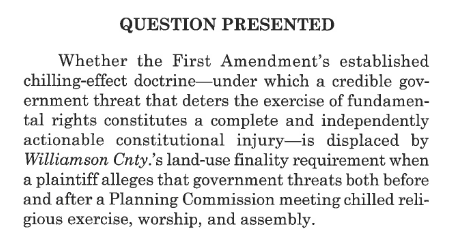
This is the case where the owner was using a room in his home to hold a gathering to conduct religious activities, and the city demanded he stop unless and until he obtained a permit. A neighbor was “displeased” that the owner was using his home to hold a “shul,” which “in Hebrew refers to a synagogue or a house where prayers are held.” The city told him to stop because his use as “a place of religious assembly” violated the zoning code (his home is zoned U-1, which doesn’t allow such uses).
The owner applied for a Special Use Permit, which would allow him to make the use as a “house of worship.” The Planning Commission conducted a hearing, but didn’t make a decision. It “tabled the discussion,” requesting more details” from the owner. Apparently, there was some question about whether this use would indeed be considered operating a “house of worship,” and eventually the owner withdrew the SUP application, stating that he did “not wish to operate a house of worship.” The Planning Commission never decided.
The Sixth Circuit held that the owner’s RLUIPA and constitutional claims were not ripe under Williamson County‘s surviving ripeness requirement because the city had not made a “final decision” on whether to issue a permit. This is a “land use” case, and “[i]n the land-use context, one important factor in a dispute’s fitness for judicial decision is a ‘finality’ requirement–a concrete and final decision by local authorities.” Thus, the ripeness requirement applicable to takings claims are also applicable to RLUIPA claims because this “approach ensures that municipal land-use policy begins in local, politically accountable hands.”
The petition points out the circuit split on the issue, noting that some courts apply Williamson County outside of the takings context while others limit it to takings claims. The owner asserts that the rationale for the rule in takings does not apply in First Amendment land use claims:
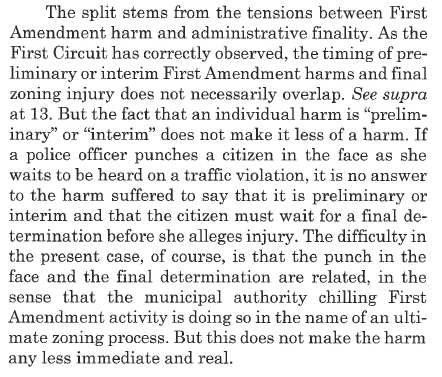
We think the Williamson County final decision requirement should go to the same place that Williamson County‘s “state procedures” requirement went: the trash heap. The better option is to evaluate a complaint’s ripeness not on whether it involves “land use” as the Sixth Circuit did, but what constitutional or statutory right is alleged to have been violated, and whether the plaintiff has been injured by government’s actions or inaction.
The petition wrongly puts space between the owner’s First Amendment claim and takings claims, which, in effect, renders private property a second-class constitutional right. Thus, this case unfortunately has the potential for hardening of the cement on Williamson County for takings claims, while exempting every other constitutional claim from the requirement.
The answer should be that Williamson County ripeness should govern neither Free Exercise nor any other claim, including takings claims — not that takings alone should be subject to a requirement that undermines the courts’ Article III jurisdiction and duty to resolve disputes. The advocates and the Court must be extraordinarily careful here.
Follow along on the Court’s docket.