
The Seventh Circuit just reminded musicians: register the right copyright or risk losing even when tracks sound indistinguishable. But what if the artist actually did register correctly—and nobody noticed?
Eddie Lee Richardson thought he did everything right.
When the then–16-year-old producer known as Hotwire heard his beat “Hood Pushin’ Weight” playing behind French Montana‘s vocals on the hit “Ain’t Worried About Nothin’,” he moved fast—registering a copyright the next day, then later hiring a lawyer and filing an infringement lawsuit. His expert testified that the two songs were “shockingly similar,” and last week the Seventh Circuit agreed that Richardson’s beat “to the naked ear, seems indistinguishable from the beat in” Montana’s track.
He still lost.
In its October 16 opinion in Richardson v. Kharbouch (read here)—a matter of first impression for the Seventh Circuit—the court turned what looked like a clear case of copying into a cautionary tale about copyright registration—and understanding what you’ve actually registered. (Karim Kharbouch, for those not fluent in liner notes, is French Montana’s legal name.)
According to the court, Richardson hadn’t registered the musical composition in “Hood Pushin’ Weight”—the melody, harmony, and rhythm—but only the sound recording—the specific digital file he uploaded to SoundClick. But there may be a big problem with that finding, as I’ll discuss below.
First some quick background: Under section 114(b) of the Copyright Act, sound recording rights are limited to preventing duplication and remixing of the actual recorded sounds on a track. They don’t cover imitation of those sounds. If another artist re-creates your beat from scratch—no matter how precisely—that doesn’t infringe the sound recording. Without a composition copyright, Richardson had to prove that French Montana’s producer sampled his file rather than re-created it—and he couldn’t.
Judge Candace Jackson-Akiwumi acknowledged the harsh result, but similarity alone wasn’t enough. Richardson’s expert had testified that the tracks shared several musical motifs and were “extremely unlikely” to have had a common public source—but crucially, neither the expert nor Richardson’s counsel addressed whether “Ain’t Worried About Nothin’” actually sampled Richardson’s digital track or how the song was produced. Without that connection, there was no evidence of duplication.
As the court put it:
“To make out a claim of copyright infringement, a sound recording copyright holder must present evidence that the defendant duplicated the specific digital sounds employed in the copyrighted material. Evidence that the works contained the same generic sounds, without specific facts about those sounds’ origins, may be sufficient to show infringement of a musical composition copyright—but not a sound recording copyright.”
And as the court noted, Richardson’s team had opportunities to close that evidentiary gap—by deposing French Montana (Kharbouch), producer Rico Love, or presenting expert testimony suggesting that sampling occurred—but didn’t do so. That legal distinction between duplication and imitation proved decisive.
One Song, Two Copyrights
To understand why the court’s analysis mattered so much, it helps to remember a concept that many musicians overlook: every recorded song contains two separate copyrights.
- The musical composition covers the melody, harmony, rhythm, and lyrics.
- The sound recording covers the actual captured performance.
When you’re the author or owner of both—as Richardson was—you can register them together on a single application. But here’s the catch: you have to explicitly claim authorship in both the “music” and the “sound recording.” Miss that detail, and you might protect one but not the other.

Richardson’s registration was treated as covering only the sound recording—at least according to his pleadings, the district court’s 2024 summary judgment ruling in favor of French Montana, and the Seventh Circuit’s affirmance last week.
But here’s where the case gets interesting—and a little maddening: I looked up Richardson’s Form SR copyright registration, and it actually lists his authorship as “sound recording, production, music.”
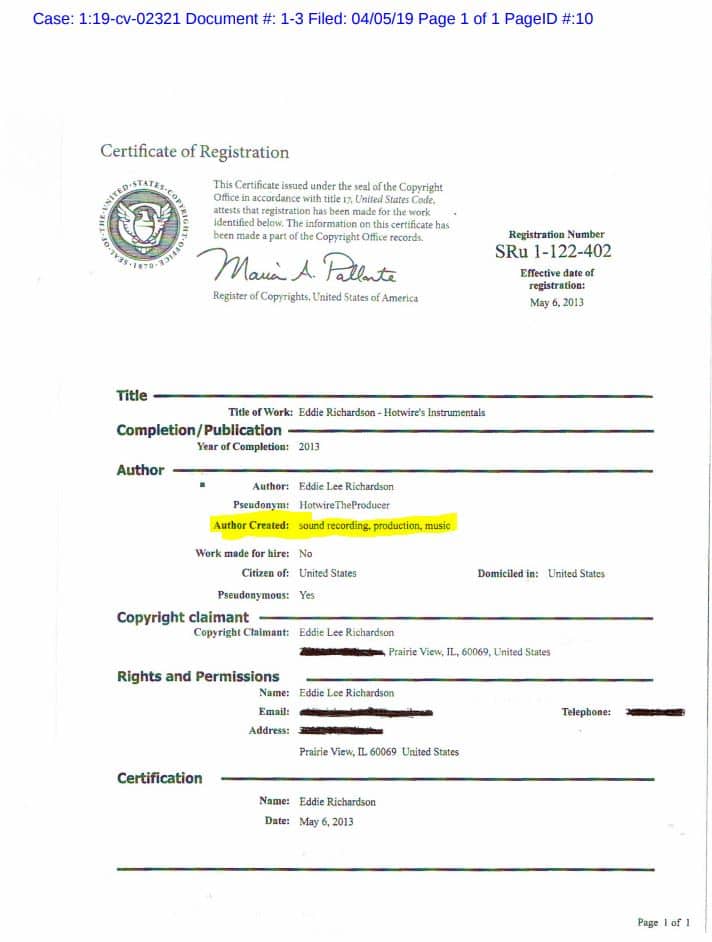
Yes, it’s all on a Form SR, which stands for “Sound Recording,” and that alone might seem to end the analysis. But under the Copyright Office’s regulations—see 37 C.F.R. § 202.3(b)(1)(iv) and section 803.8(A) of the Compendium (Third) of U.S. Copyright Office Practices—if the same person owns both the recording and the underlying music, claiming authorship of “music” on Form SR extends the registration to the musical composition as well as the sound recording. In other words, Richardson may have done everything right after all. If so, the case that’s being cited as a warning about registration formalities may actually be a warning about misreading what registrations actually cover.
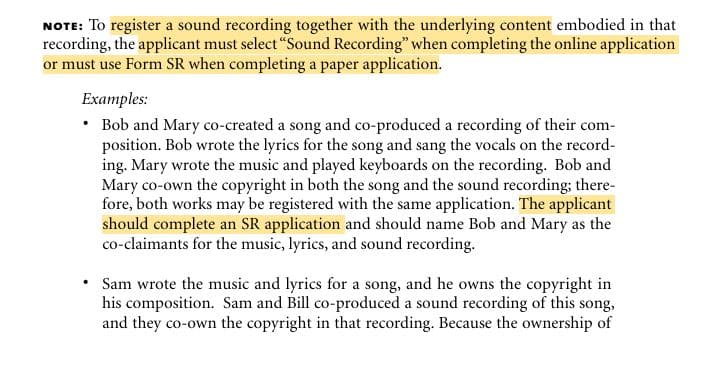
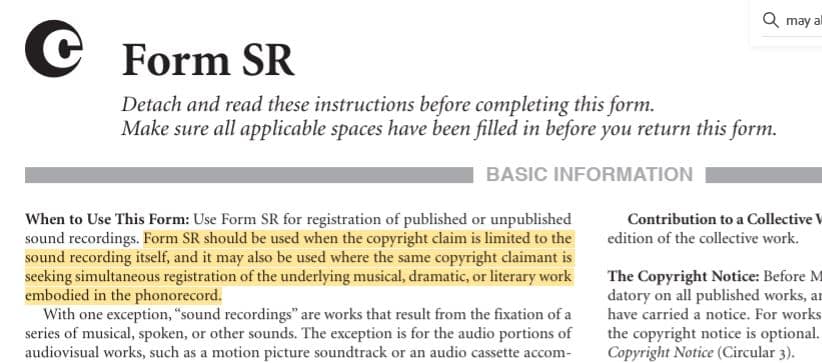
This all raises an uncomfortable question: Did Richardson actually have the rights he needed all along, only to lose because no one realized what his registration actually covered? The Seventh Circuit relied on Richardson’s own concession—repeated throughout the case—that he “did not obtain a musical composition copyright.” But given that his Form SR registration listed “music,” that assumption may have been mistaken.
Duplication vs. Imitation
Here’s that distinction matters: as I’ve discussed before—including when Rick Astley sued Yung Gravy for “vocal impersonation”—the exclusive rights for a sound recording copyright are much narrower than those for a musical composition, protecting only against duplication or remixing of the actual recorded sounds.
Section 114(b) of the Copyright Act spells it out clearly: sound recording rights “do not extend to the making or duplication of another sound recording that consists entirely of an independent fixation of other sounds, even though such sounds imitate or simulate those in the copyrighted sound recording.”
Translation: You can re-create someone’s sound without infringing their sound recording copyright—as long as you record it yourself rather than sample their file.
What Went Wrong in Discovery (Almost Everything)
Richardson’s case also suffered from what might charitably be called some discovery missteps—though the biggest oversight might have been failing to discover what his own copyright registration already showed.
When Richardson first heard his beat on the radio, he messaged French Montana on Twitter demanding credit. Montana told him to talk to his producer, Rico Love—a direct lead to the person who could confirm how the beat was made. Yet Richardson’s team apparently never followed up. As the Seventh Circuit observed:
“Despite having the opportunity to depose Kharbouch, depose the song’s producer Rico Love, or present expert testimony suggesting that sampling occurred, Richardson failed to do so.”
His expert testimony also missed the mark. While the expert testified that the tracks were “shockingly similar,” he never addressed the key question for a sound recording case: was there actual sampling? “Shockingly similar” might carry weight in a composition case, but not for a sound recording. To prove duplication, you’d need evidence like waveform or spectral analysis showing identical digital patterns or metadata revealing copied audio. Richardson’s expert provided neither. That omission left the court with no factual basis to infer duplication—and under section 114(b), similarity alone isn’t enough.
Lessons for Musicians
- Register both the composition and the recording—if you own both. If you’re the author or owner of both the musical composition and sound recording, you can use one application (Form SR) to register both, but you must explicitly claim and describe the musical composition authorship (“music,” “lyrics,” “musical arrangement,” etc.). It costs the same as registering just one.
- Understand when you need separate registrations. If someone else wrote the composition or owns those rights, you can only register the sound recording. If you’re the songwriter but someone else recorded it, you can only register the composition. Different owners = different applications.
- Keep your session files and stems. If you ever need to prove sampling versus imitation, you’ll need forensic evidence—waveforms, spectral analysis, or metadata showing actual duplication. “Sounds similar” won’t cut it.
- Know what you’re actually protecting. A sound recording copyright stops people from copying your file. A musical composition copyright stops them from using your melody and rhythm, however they record it.
- Register early—and accurately. While copyright protection arises automatically, Copyright Act section 411(a) still requires registration before you can sue. And timing matters for another reason: under section 412, you can recover statutory damages and attorney’s fees only if your work was registered before the infringement began or within three months after its first publication.
- Understand what your registration actually says. Richardson’s registration might have covered both the composition and recording, though that point seems to have gone unnoticed throughout the litigation—by the district court, the Seventh Circuit, and the lawyers alike.
The Bottom Line
Following its 2024 summary judgment ruling, the district court clearly saw the inequity in the outcome, calling its ruling “a technical win for Kharbouch… which he should not claim as a substantive victory.”
Naturally, French Montana’s law firm did just that. In a press release titled “French Montana’s Legal Triumph,” the firm announced a “significant legal victory” and “complete dismissal of the case”—quoting the district judge’s warning that it wasn’t a substantive victory, then calling it one four more times. No word yet on whether the Seventh Circuit’s affirmance will prompt another victory lap of press releases.
Meanwhile, Richardson’s beat lives on in a chart-topping song with a YouTube video approaching 100 million views. His compensation? A hard lesson in copyright formalities—and perhaps an even harder lesson about the importance of understanding what you’ve actually registered. The registration form that could have saved his case was sitting right there, listing music among the authored materials. Five letters on that Form SR that should have protected the underlying composition apparently went unnoticed during six years of litigation.
Sometimes the real technicality isn’t what you failed to do—it’s what you failed to realize you’d already done.
As always, I’d love to know what you think. Drop me a line in the comments below or @copyrightlately on social media. In the meantime, here’s a copy of Richardson v. Kharbouch. No soundalikes, just the real thing.
The post How French Montana Won on a Copyright Technicality appeared first on Copyright Lately.