
Plans to make offenders attend court for sentencing have been modified after critics suggested they would prove ineffective.
Old plans
In November 2023, the Conservative home secretary James Cleverly published a criminal justice bill dealing with the issue. Clause 22 would have added two provisions to the sentencing code, passed by parliament as the Sentencing Act 2020.
The first would have applied only to offenders who may — or must — be sentenced to life imprisonment. If they refused to obey an order to attend, they would have faced an additional penalty for contempt of court of up to two years’ imprisonment.
The second proposal, applying to any adult offender convicted in the Crown Court, would have allowed a prison officer or a custody officer to “use reasonable force, if necessary and proportionate, to give effect to” the court’s attendance order.
As I wrote at the time, the power to punish offenders for non-attendance would have applied only to those least likely to be deterred by an additional prison sentence. I also doubted the practically of dragging offenders into the dock.
That bill never reached the House of Lords and lapsed when the general election was called last year.
New plans
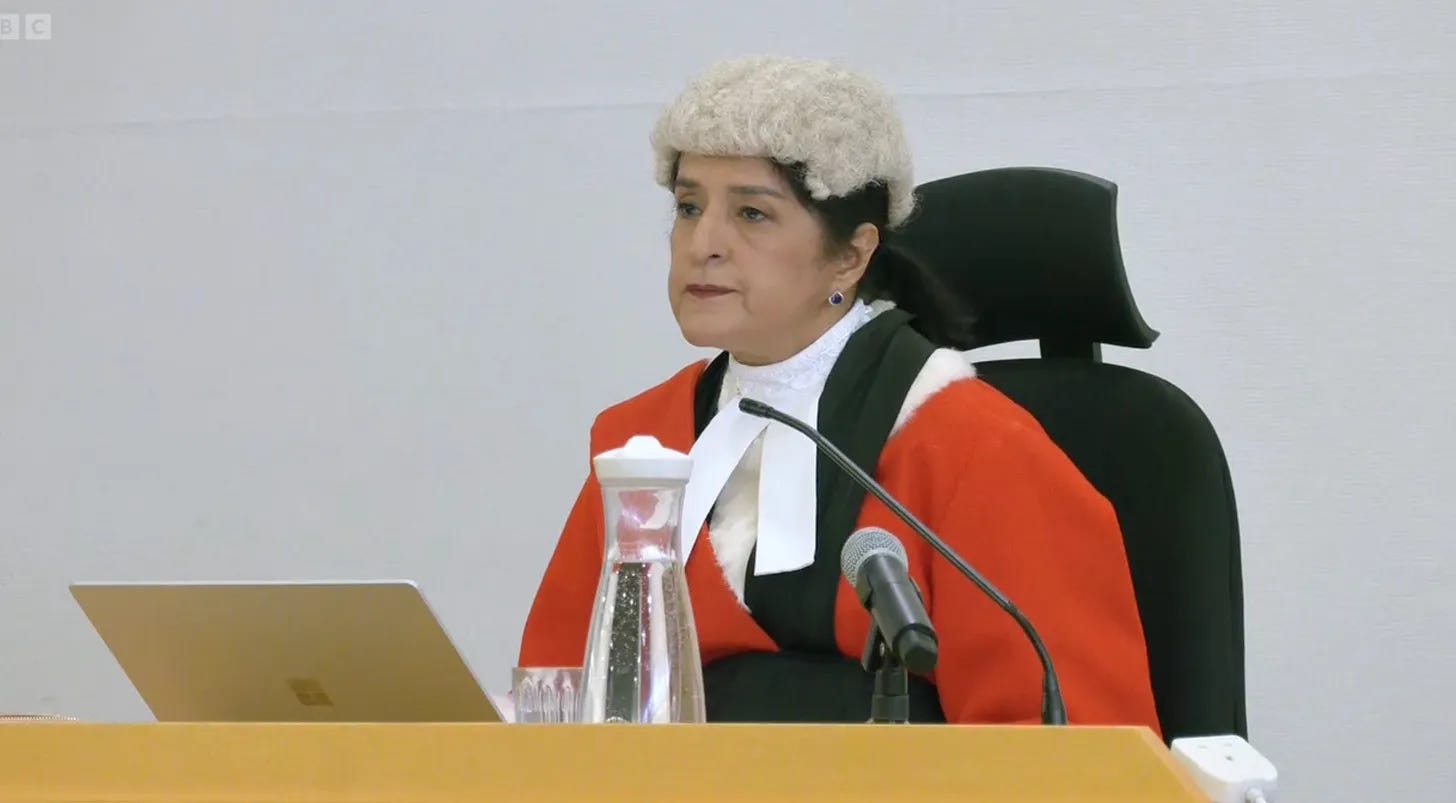
In January, the prime minister promised something similar. But an announcement expected this morning makes it clear that the government intends to go further.
The justice secretary Shabana Mahmood is to publish a victims and courts bill. Frustratingly, we won’t get to read it until this afternoon. But a press notice — shorn of some of its more excitable adjectives — says:
-
Because offenders facing long sentences or whole-life orders may not be deterred solely by additional time behind bars, the government is giving judges the power to impose a range of sanctions on prisoners — including confinement to their cells and loss of privileges such as extra time in the gym — as well as up to two more years behind bars.
-
The bill also extends eligibility for these penalties to all cases in the Crown Court.
-
Offenders who have been ordered to attend court by a judge but whose behaviour results in their removal from the courtroom will face the same penalties.
Comment
It seems the government may have abandoned the idea of authorising custody officers to use reasonable force. That power is undesirable: no judge wants to see an offender dragged into the dock and restrained by dock officers. It may also be unnecessary as prison officers can already use force to restrain prisoners.
On the other hand, I’m not sure how judges can make binding orders withdrawing privileges from prisoners who have not yet been awarded them. Won’t that undermine the authority of prison governors?
Update 1515: the bill, as published, introduces the concept of a prison sanctions order. This means
an order—
(a) imposing one or more sanctions of a description specified for the purpose of this section by regulations made by the Secretary of State, and
(b) in relation to any sanction for which the regulations provide for there to be a maximum period, specifying the period for which it is imposed, which must not exceed the maximum.
It adds:
The only sanctions that may be specified in the regulations are sanctions that correspond to the punishments that may be imposed by a governor under prison rules for an offence against discipline.
All rise?
HM Courts and Tribunals Service made an announcement last week that would have been inconsistent with any thoughts of shackling defendants in the dock:
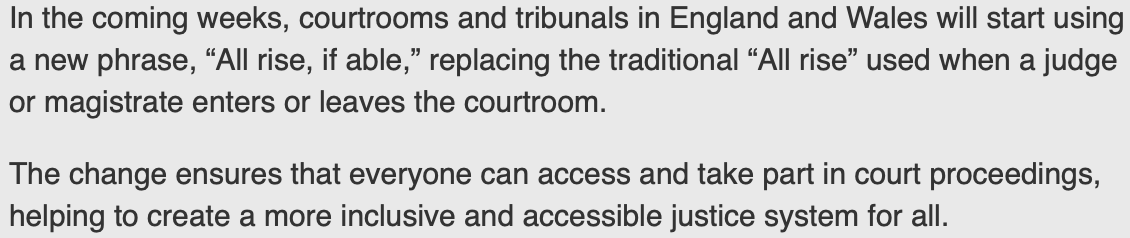
I’m sure this change will be welcomed by those who are unable to stand. But isn’t “all rise” an Americanism? In the courts I report from, the ushers always say “court rise” when the judges enter.
Further measures
Separately, the bill will limit parental responsibility for offenders who are convicted of serious sexual abuse offences against their own children.
Further measures include:
-
Updating the victim contact scheme and establishing a new helpline so victims have a clear route to request information about an offender’s release;
-
Placing a duty on local authorities and social housing providers to co-operate with the victims’ commissioner in relation to anti-social behaviour;
-
Increased flexibility for the director of public prosecutions in appointing crown prosecutors;
-
A power for the lord chancellor to prescribe rates at which private prosecutors may recover their costs from central funds; and
-
More time for the attorney general to refer a sentence to the Court of Appeal as unduly lenient where a request is made to the law officers in the last 14 days of the current 28-day time-limit.