
Hours before a revised guideline on the imposition of community and custodial sentences was due to take effect in England and Wales this morning, the Sentencing Council announced that its introduction would be postponed to a future date. As a result, the existing guideline remains in force.
After a meeting yesterday between Shabana Mahmood and Sir William Davis, the council issued a short statement:
The Sentencing Council remains of the view that its guideline Imposition of Community and Custodial Sentences, as drafted, is necessary and appropriate.
The lord chancellor and the chairman of the Sentencing Council met this morning. At that meeting, the lord chancellor indicated her intention to introduce legislation imminently that would have the effect of rendering the section on “cohorts” in the guideline unlawful. The lord chancellor also shared details of that draft legislation as it is likely to be introduced.
The chairman indicated that the council would not introduce a guideline when there is a draft bill due for imminent introduction that would make it unlawful. On that basis, the council, an independent statutory body, has chosen to delay the in-force date of the guideline, pending such legislation taking effect.
Comment
This is clearly a climbdown by both sides, but a dignified one. With the House of Lords beginning its Easter break on Thursday, Mahmood would not have been able to get her planned legislation through parliament much before the end of this month. It would be unsatisfactory for magistrates and judges to have one version of the guidelines in force in March, another in April and a third in May.
On the other hand, the council is not prepared to change its guideline simply because the justice secretary has asked it to. In dismissing widely repeated allegations that the Sentencing Council is no more than a quango, Davis has made it clear that this is the decision of an independent statutory body — albeit one taken under protest.
-
As promised, I shall have more to say about this on Friday. This is the first of four stories I have for you this April morning. All are true.
The law’s delays
Judges who spend too long writing their judgments may be disciplined by other judges of greater seniority. But what happens when the most senior judges of all are accused by a lower court of deferring a decision for the best part of five years?
In December 2006, Daniel Junior Geddes, then aged 17, was convicted of wounding with intent to inflict grievous bodily harm. Geddes, a Jamaican national, was sentenced the following month to six years’ detention in a young offender institution.
-
April 2014: home secretary orders Geddes to be deported
-
November 2014: First-tier tribunal dismisses his appeal
-
March 2015: Upper Tribunal dismisses his appeal
-
October 2016: Court of Appeal dismisses his appeal
-
November 2016: he asks the Supreme Court to allow him time to seek public funding for an application to seek permission to appeal
-
May 2017: he receives a decision on public funding
-
June 2017: he files his notice of appeal at the Supreme Court
-
September 2017: a deportation order is made
-
30 October 2017: he is detained pending deportation
-
13 November 2017: he seeks judicial review of the deportation order and the High Court puts his deportation on hold
-
15 November 2017: he is released on bail. He claims he was unlawfully detained for two weeks because the deportation order was invalid
-
March 2018: his application for permission to seek judicial review is put on hold by the High Court while the Supreme Court considers a case raising issues about family life
-
October 2018: the Supreme Court dismisses appeals in that case
-
February 2022: the Supreme Court turns down the application for permission to appeal that Geddes had lodged in June 2017, more than four years and seven months earlier.
-
March 2023: the High Court grants him permission to seek judicial review of the deportation order made in September 2017. He argues that the order should not have been made because he had already sought permission to appeal to the Supreme Court.
-
December 2023: the High Court hears his application for judicial review.
-
January 2024: the High Court holds that the deportation order was validly made and that he could be lawfully detained under it.
-
March 2025: the Court of Appeal hears and dismisses his appeal against that decision. Lord Justice Bean says this:
The Supreme Court eventually refused [Geddes] permission to appeal on 15 February 2022, over four years and seven months from the filing of the notice of appeal with that court. This delay has never been explained.
So I asked the Supreme Court for an explanation.
It appears from the court’s records that lawyers acting for Geddes were not in a position to file an electronic bundle at the Supreme Court until February 2021. It’s not known why that was but I suppose it’s possible that the lawyers were waiting for legal aid funding. By early 2021, the court was dealing with a significant backlog of applications for permission to appeal that had accumulated during the pandemic. This meant, it said, that the wait for decisions on permission to appeal was longer than usual.
Comment
The courts have now made it perfectly clear that an application for permission to appeal to the Supreme Court is not, by itself, a bar to deportation.
The appeals process has been tightened since this case was dealt with and there are plans to tighten it further. With limited resources, non-urgent cases inevitably go to the back of the queue. Even so, there are lessons here for both the Home Office and the courts.
Geddes must now be in his mid-30s. There is no information in the published judgments about his current circumstances.
Regulating lawyers
The Legal Services Board — which regulates the other legal regulators — has published its annual score-card:
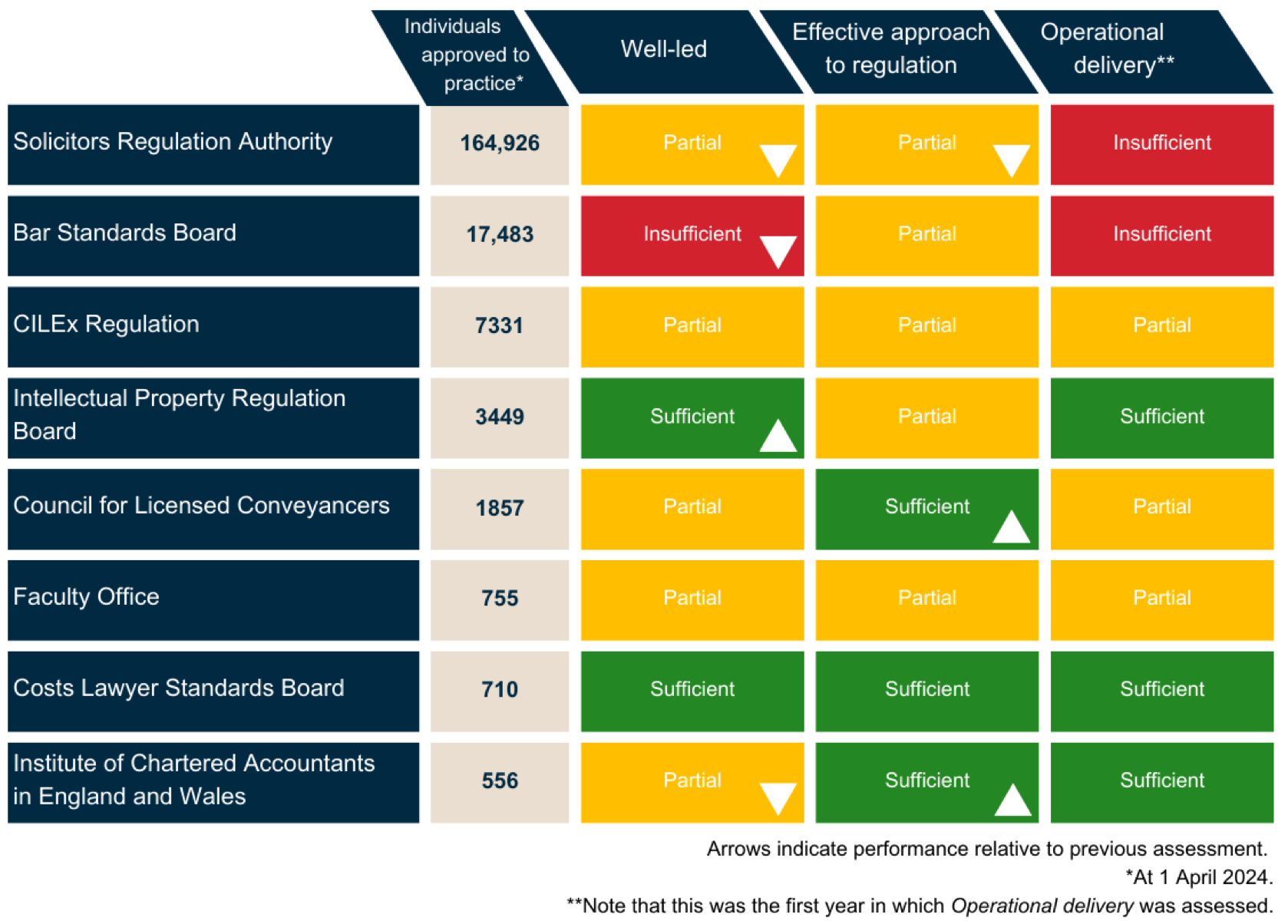
As we can see, the barristers’ regulator picked up two red marks and the solicitors’ regulator picked up one.
But the delivery failures of the Solicitors Regulation Authority are arguably worse for practitioners who will have to pick up the bills. As the Legal Services Board explains:
After the end of the assessment period, the SRA became involved in three significant and high-profile regulatory events: the identification of serious wrongdoing by some solicitors in relation to immigration advice; the SRA’s intervention into a large law firm, Axiom Ince, following the identification of the misappropriation of a large amount of client funds; and the collapse of SSB Group, a large bulk litigation claims law firm, resulting in many clients being pursued to pay unexpected legal costs in relation to their claims.
The Law Society, which represents solicitors, said:
The SRA has been found to be lacking in its performance. Only urgent action from SRA’s leadership which focuses on the organisation’s performance and accepts that it has to do much better from top to bottom will start the process of regaining the trust of the sector, our members and consumers.
Effective regulatory oversight is the cornerstone of consumer confidence. However, while the events leading to the collapse of Axiom Ince were happening, the SRA was focused on increasing its fining powers and proposing regulatory expansion.
Instead, it should have been tackling the known risks from accumulator-style firms and ensuring its operations were joined up and laser-focused on protecting consumers.
Turning to the Bar Standards Board, the Legal Service Board said this:
In respect of the well-led standard, we note the intent and ambition outlined in the reform programme, and recognise the considerable work being undertaken by the BSB in this area. We do however have significant concerns, about which we are in ongoing dialogue with the BSB at executive and board levels, around how the BSB plans to measure and quantify the success of the projects within the programme, how the BSB Board is effectively holding the executive to account on this, and about the pace of delivery. We are also concerned about long-standing issues with capacity and resourcing…
Our rating against the operational delivery standard reflects ongoing concerns we have had about the BSB’s performance in this area. We recognise that the BSB is taking steps to improve its authorisations process and to address delays in processing investigations. Ahead of those improvements being realised, however, we are unable to take assurance as to the BSB’s performance in relation to operational delivery.
We value this annual regulatory performance assessment and make use of the performance framework and findings in self-assessing our performance and impact and evolving our work…
The Bar Standards Board is changing and changing fast…
We recognise, however, that there is more to do and share the LSB’s view that change needs to happen at pace. Colleagues are working diligently and tirelessly to both run the BSB alongside progressing the reforms that will generate greater efficiencies and consistent performance. Getting this balance right remains a key focus and we look forward to continuing to work with the LSB to give them the assurance they seek.
Parole

“Victims can attend the parole hearings of their perpetrators from today,” the Ministry of Justice says. Except they can’t.
Parole hearings take place in prison and victims won’t get any closer than a video screen in an office somewhere. And even that will be switched off when the panel is hearing confidential evidence — on risk management, for example. And the scheme will be open only to victims who are part of the victim contact scheme and who have applied successfully for access.
So this story is true — but only up to a point.