
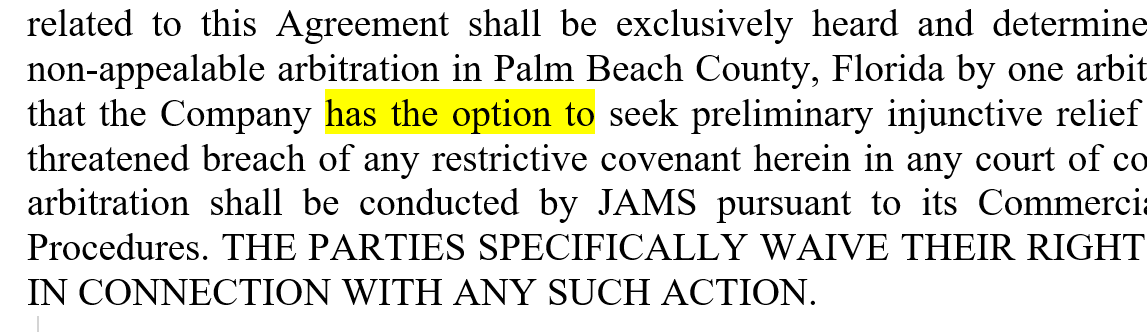
In chapter 3 (Categories of Contract Language) of A Manual of Style for Contract Drafting, table 3 (Language of Discretion: May) showcases 16 ways to say may with more words and less clearly.
Friends, it’s time to introduce you to a 17th way. It’s in the extract in the image above: has the option to. It’s from a consulting agreement on EDGAR. To use the example in table 3, instead of saying Acme may appoint one or more subcontractors, you’d say Acme has the option to appoint … .
Like the 16 other alternatives to may, that’s lame. A basic principle of contract drafting is that contract language should be consistent. Another is that contract language should be concise. (Those are two of the 12 principles stated in chapter 1 (The Characteristics of Optimal Contract Language).) So say may instead everywhere you wish to express that meaning.
But what if someone is being granted an actual option? (According to Merriam-Webster’s definition, an option is “a contract conveying a right to buy or sell designated securities, commodities, or property interest at a specified price during a stipulated period.”) Here’s an example: Landlord hereby grants Tenant the exclusive right and option to lease the Fourth Expansion Space (the “Option”).
In that context, using language of performance with option seems OK. And it has the advantage of allowing you to use adjectives, in this case exclusive. On the other hand, using right as well is redundant.
***
New to the categories of contract language? Go here for the “quick reference” chart that’s in A Manual of Style for Contract Drafting. My online course Drafting Clearer Contracts: Masterclass devotes two hour-long sessions to the categories of contract language. Among other things, we consider how to fix the verb-structure dysfunction in a big-company set of standard terms. And on their own time, participants take a challenging 30-question quiz on the subject.