
“Britain’s vilest killers will die behind bars under a ‘life means life’ crackdown ordered by Rishi Sunak,” the Sunday Express reports today.
“Sentencing rules will be unveiled in the King’s Speech this autumn, leaving enough time for them to become law before the next general election.”
But the paper’s political editor says there is “the potential for a dispute with the Council of Europe human rights group over the plan to change the law”.
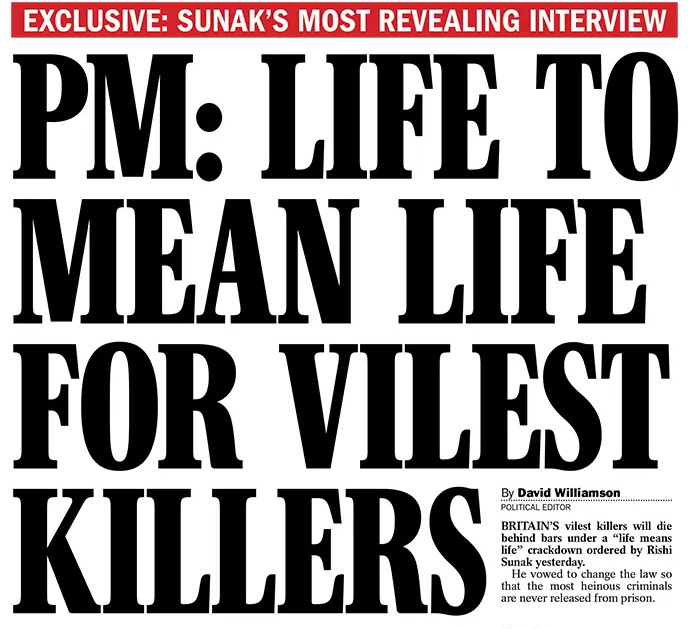
Other papers picked up the story after Downing Street issued a press release last night.
Using rather more adjectives than one might have expected in an official announcement, it begins:
Society’s most depraved killers will face life behind bars with no chance of being released under tough plans announced by the prime minister.
Making sure that life means life, judges will be required to hand down mandatory whole life orders to the monsters who commit the most horrific types of murder.
“This will place a legal expectation on judges to hand down whole life orders except in extremely limited circumstances,” the government adds. “By putting this on a legal footing, judges will have greater confidence to hand out whole life orders without a risk of challenge in the courts of appeal.”
That suggests some confusion in Downing Street. While no judge likes to be overturned on appeal, trial judges are not scared or anxious about passing sentence in accordance with the law.
Rather more informatively, the justice secretary Alex Chalk is quoted as saying that “a whole life order will now be the expectation for murderers where the killing involves sexual or sadistic conduct”.
The government gives two examples: Jordan McSweeney, 29, given a minimum term of 38 years for the murder of Zara Aleena and Koci Selamaj, 36, given a minimum of 36 years for the murder of Sabina Nessa.
Both men secured reductions in their minimum terms by pleading guilty, in each case sparing their victims’ relatives the rigours of a trial and sparing prosecutors the risk of a perverse acquittal.
But there would be no incentive to plead guilty if there was no possibility of a shorter tariff. Not surprisingly, Lucy Letby, 33, whose lawyers knew she would receive a whole life order if she had admitted even some of the murder charges she faced, pleaded not guilty.
Human rights
The Express says that “the prospect of confrontation with European institutions over the rights of prisoners is unlikely to worry Conservative MPs who want the government to take a tougher line on crime ahead of the next election”.
In fact, the European Court of Human Rights was persuaded in 2017 that whole life orders were lawful. That was because a strong Court of Appeal, led by Lord Thomas of Cwmgiedd, had found that :
the law of England and Wales … does provide to an offender “hope” or the “possibility” of release in exceptional circumstances which render the just punishment originally imposed no longer justifiable.
The law
All murderers must be sentenced to life imprisonment. The court must either set a minimum term or direct that the early release provisions do not apply. In setting a minimum, the court must choose the appropriate starting point before increasing or reducing it to take account of aggravating and mitigating factors.
Under the Sentencing Act 2020, the starting point is a whole life order if the offender was 21 or over at the time of the offence and “if the court considers that the seriousness of the offence (or the combination of the offence and one or more offences associated with it) is exceptionally high”.
Cases that would normally fall within definition include the murder of two or more people, where each murder involves sexual or sadistic conduct.
What the government may have in mind is changing the law so that the starting point for a single murder involving sexual or sadistic conduct would be a whole life order.
Changing the law
Any offender sentenced to a long prison term is a suicide risk. That must be all the more so for someone given a whole life order. And prisoners who know they cannot be punished further for murdering prison officers or other prisoners must be particularly difficult to manage.
If there is to be an “expectation’ that a whole life order will become the starting point for a single sexual or sadistic murder, judges will no doubt consider whether the same result can be achieved by an extremely long minimum term. It is only after that term has been completed that the Parole Board would decide whether the prisoner could be safely released on licence.
So the courts will look carefully at any new law that parliament may pass.