
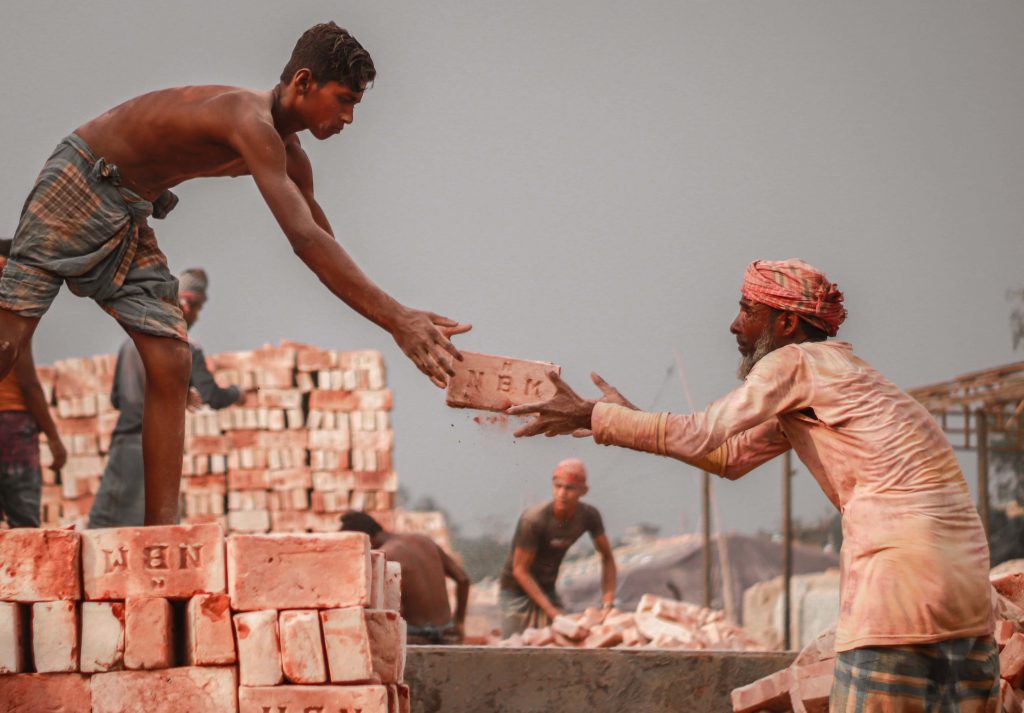
The International Labour Organization (ILO) is a United Nations agency that the Treaty of Versailles established in 1919. In 1947, it laid down the frameworks of labor welfare as services, amenities, and facilities which can be established in or close to the undertakings of enabling the persons employed to perform their work in healthy and peaceful surroundings and to avail of facilities that improve their health and moral. It is the only tripartite U.N. agency and a social engineering project that aims to safeguard the rights of labor and ensure that freedom, equity, and dignity of conditional work are observed globally.
At present, 187 states are members of the International Labour Organization. It is the common point for the governments, workers, and employers of ILO’s Member States to evaluate and accordingly set labor standards, policies and create programs that promote decent work for laborers. The basic objectives of the ILO’s functioning are placed upon tripartism, which aims to provide proper employment and to live with the protection and provisions for the life and health of workers, and to the child welfare and maternity respective with the assurance of quality education. It accomplishes its objectives through these three main bodies:
- International Labour Conference
It is an annual meeting of governments’, workers’, and employer’s delegates of the International Labour Organization member States. The objective of this conference is to discuss and critically analyze the broad policies of the organization, establish, and adopt international labor standards and elect the governing body of the States
- Governing Body
It is the executive body of the International Labour Organization and is responsible for making policy decisions, setting the agenda for the International Labour Conference, adopting a budget, and electing the General Director. It is composed of 56 titular members, out of which 28 are selected by the governments and 14 each by the employers and workers. Ten of the titular government seats are non-elected, and permanent seats are held by the States that have foremost industrial importance (India is one of these nations).
- International Labour Office
It is the permanent secretariat of the International Labour Organization and is responsible for the organization’s administration and implementing technical cooperation activities in addition to awareness, advocacy, and numerous informative sessions.
Conventions and Recommendations

The welfare of each of us is dependent fundamentally upon the welfare of all of us.
Theodore Roosevelt
The principals in the ILO are the set-ups of the International Labour Standards in the form of Conventions and Recommendations. Conventions are not only international treaties but also legal instruments that create obligations on the countries that ratify them. At the same time, Recommendations are non-binding set-out guidelines orienting national policies and actions.
Sometimes, a Convention sets out the basic principles to be undergone through the ratification of countries, while the related Recommendation amplifies the Convention by providing more detailed guidance on how to apply it. Once the consideration for convention ratification is adopted, Member States are required to submit it to their competent authority (Parliament) within 12 months for consideration under Article 19(6) of the drafted Constitution of ILO. When ratified, a Convention for that nation enters into force one year after the date of ratification. Proceedings for representation and complaint can also be initiated against any countries for breaches of a Convention that they have ratified.
The approach of India concerning International Labour Standards has always been positive where the ILO instruments have provided guidelines and useful frameworks for the evolution of legislative and administrative measures for the protection and advancement of the interest of respective labor. The influence of the ILO Conventions has set some standards of reference for the labor legislation and practices in India, rather than as a legally binding set of rules, which is very much significant. Ratification of a Convention legally presses binding obligations on the counties. Therefore, India has been careful in ratifying Conventions as it is only done when they are completely satisfied that their laws and practices conform with the relevant ILO Conventions. India has so far ratified around 41 Conventions of the ILO, which are existing and functioning much better than in other countries.
The ILO’s top 8 fundamental conventions are as follows –
Freedom of Association & Right to Organise Convention, (No.87), 1948
This fundamental right set forth the right of workers and employees to establish and join organizations of their choosing without their employees’ approval, to freely form and organize their organizational constitutions and rules, and also to establish and join federations. It imposes a duty on Members of the ILO to ensure that workers and employers must exercise the right to organize freely, without any undue and illegal interference from administrative authorities.
Right to Organise and Collective Bargaining Convention, (No.98), 1949
This fundamental convention aims at providing adequate protection to the workers and employees against acts of anti-union discrimination concerning employment. For instance, imposing non-membership of Unions as a precondition to employment. It aims to push voluntary negotiation between employers and workers’ organizations and calls for the creation of machinery for facilitating the same.
Forced Labour Convention, (No. 29), 1930 and the 2014 Protocol
This convention is one of the 1st international instruments which can be credited with the reduction in forced or compulsory labor at the global level. It penalizes the exaction of forced labor and imposes an obligation on ratifying States to ensure that the identical are strictly enforced. Ratifying States are also required to confirm that coverage and enforcement of legislation about forced labor apply to all workers regardless of nature of work and the economic sector. This includes taking all measures necessary to eliminate all sorts of forced labor as well as identification and rehabilitation of all victims of such labor.
Abolition of Forced Labour Convention, (No.105), 1957
This fundamental convention extends the general prohibition provided for within the above convention by prohibiting the use of forced labor as a means of political coercion, education, punishment, mobilizing labor for economic development, labor discipline, as punishment for participation in strikes, and as a way of discrimination based upon racial, religious, national, or social.
Minimum Age Convention, (No.138), 1973
This convention imposes an obligation on ratifying States to attain a national policy that aims to ensure the effective abolition of child labor. It also regulates States to set the minimum age for employment or work at 15 years and hazardous work at 18 (16 under certain strict conditions), keeping in mind the level of physical and mental development of the youth. It provides the possibility of initial setting of the minimum age at 14 (12 for light work) where the economy and educational facilities are insufficiently developed.
Worst Forms of Child Labour Convention, (No.182), 1999
For this Convention, the term ‘child’ is defined as any person under the age of 18. The ratification of this convention is required to take immediate measures to eradicate the worst types of child labor. This term denotes practices like trafficking, slavery, serfdom, use of child soldiers, etc.
Equal Remuneration Convention, (No.100), 1951
This convention requires ratifying States to promote the application of the equal remuneration principle for work of equal value, which implies the rates of remuneration for similar work are established without discrimination on the basis of sex.
Discrimination (Employment & Occupation) Convention, (No.111), 1958
This convention defines discrimination as any distinction, exclusion, or preference that is made on the basis of color, sex, race, religion, national extraction, political opinion, or social origin. It includes other distinctions that have the effect of nullifying or impairing equality of opportunity to eliminate any discrimination in these fields through legislation, educational programs, and cooperation between employees’ and workers’ organizations.
Forced Labour Convention (No. 29) 1930, Abolition of Forced Labour Convention (No.105) 1957, Equal Remuneration Convention (No.100) 1951, Discrimination (Employment Occupation) Convention (No.111) 1958, Minimum Age Convention (No.138) 1973, Worst Forms of Child Labour Convention (No.182) 1999, are the six conventions that have been ratified by India. Whereas Freedom of Association and Protection of Right to Organised Convention (No.87) 1948 and Right to Organise and Collective Bargaining Convention (No.98) 1949 are the two conventions that have not been ratified by India.
Conclusion
The International Labour Organization (ILO) brief on the COVID-19 crisis and the informal economy states that there will be a rise in relative poverty for informal workers and their families of over 56% in lower and low-income countries due to lockdown and precautional measures. With these statistics, it aims to attain a major improvement in labor standards in developing countries and to safeguard labor standards through different policy approaches.
This would not only involve changes within the current paradigm of “globalization,” which might involve different international game rules to promote growth, employment, and development but will also involve developing a new framework to condition the behavior of multinational corporations, whose mobility features a significant impact on key labor standards. Such a change in strategy would bring economic benefits for economies and reduce opposition to developed countries’ increased inclusion within the global economy. The policymakers assess the magnitude of the imperfections within the labor market being studied. They will consider employees ‘and business owners’ interests while recognizing main actors and veto players furthermore. Since there is no “one-size-fits-all” formula for successful labor regulation, policymakers will be required to go beyond theoretical literature and consider local characteristics to devise viable welfare enhancement policies.
Originally Published on October 16, 2021, 12:00 pm
The post International Labour Organization and Labour Welfare – A Critical Analysis appeared first on KnowLaw.