
The Serious Fraud Office (SFO) is both an investigator and a prosecutor. In that sense it’s entirely different from the Crown Prosecution Service, which was set up to prosecute cases that are investigated by the police.
Until now, both organisations have always been headed by lawyers. The Director of Public Prosecutions, who heads the Crown Prosecution Service, must have a legal qualification. No such requirement applies to the director of the SFO. I presume that was because parliament intended that the SFO director would be just as much an investigator as a prosecutor — if not more so.
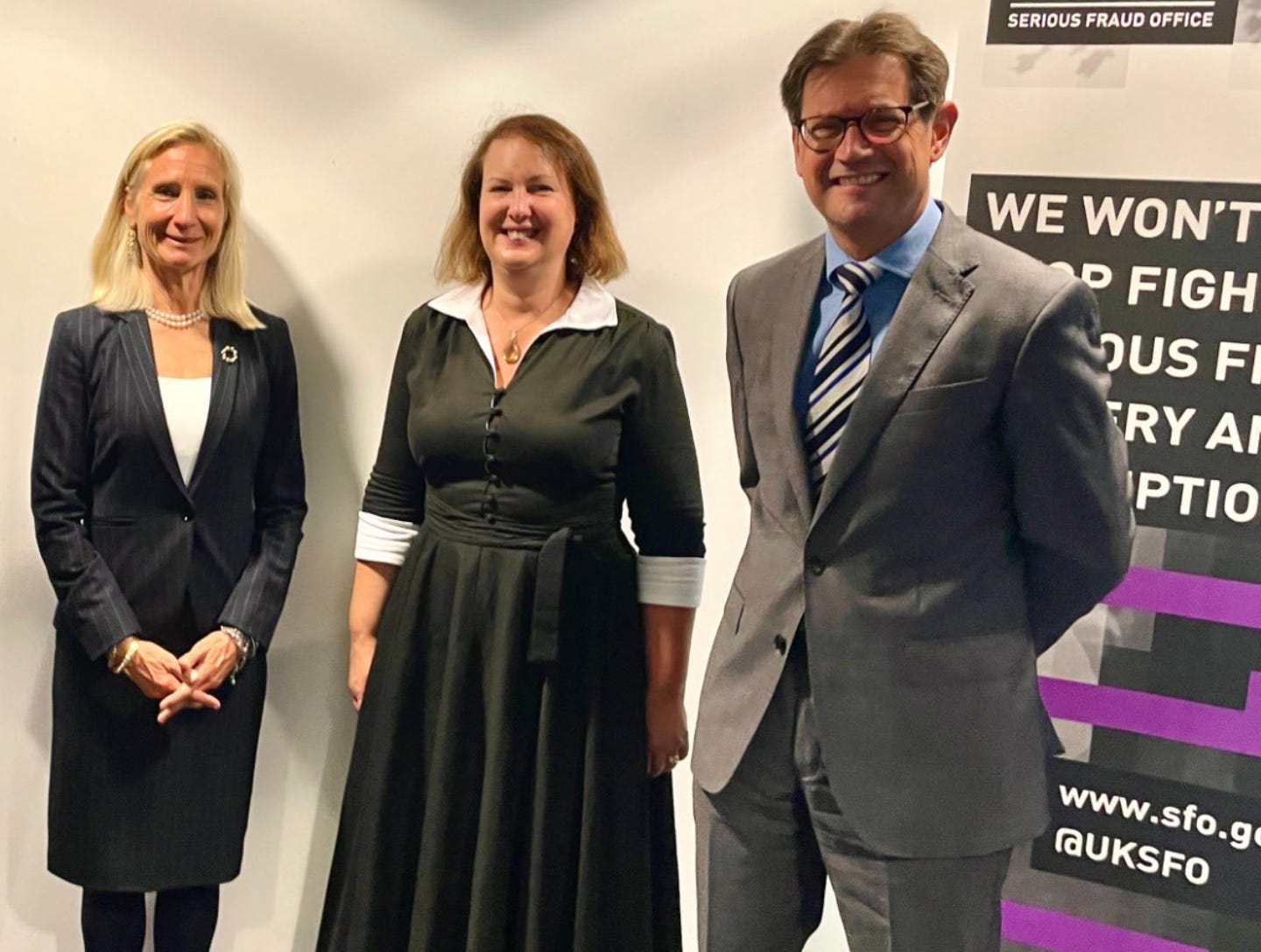
Yesterday, the attorney general Victoria Prentis KC announced that she had appointed the first non-lawyer to be made director of the SFO. Nick Ephgrave QPM will replace Lisa Osofsky at the end of September.
Ephgrave was an assistant commissioner of the Metropolitan Police from February 2019 to September 2022. Before that, he was chief constable of Surrey. He first joined the Met in 1990, having previously worked as a physicist in the NHS. After leaving the police earlier this year, he continued to broaden his criminal justice experience by serving on the Criminal Procedure Rule Committee and the Sentencing Council.
Nick’s years of experience as a leader in law enforcement and across the wider criminal justice system make him the ideal candidate to drive the SFO forward in its continuing fight against economic crime.
I am honoured to be the next director of the SFO.
The SFO plays a unique and pivotal role in the UK’s response to economic crime. I look forward to building on its recent successes and driving forward work to deliver long-lasting improvements to its operations.
I have known all Ephgrave’s predecessors since John Wood was appointed in 1988 — some better than others — and I don’t think any of them would claim to have been a stand-out success.
Perhaps that is because investigating and prosecuting serious fraud is extremely challenging, unless you happen to have been given the sort of powers exercised by the US Department of Justice. Appointing someone who has worked in the US — like Osofsky — is no substitute for giving prosecutors the ability to make offers that no defendant could ever refuse. But nobody would want to see that sort of pressure applied here in the UK.
Andy Verity’s new book Rigged shows how easy it is to “flip” potential defendants into witnesses who will willingly tell prosecutors whatever they want to hear when asked to choose between returning to their families in the UK and spending decades in a high-security US prison. Little wonder that defendants are desperate to be tried in London rather than extradited to the US.
The Criminal Justice Act 1991 allows the SFO director to designate lawyers on his staff as prosecutors of serious fraud. Ephgrave will have worked closely with lawyers at the Crown Prosecution Service throughout his career and delegating cases to his team should not lead to any difficulties. Even lawyers need independent advice and I expect Ephgrave will want to appoint a senior legal adviser.
Thus equipped, he should be in just as good a position to tackle serious fraud as any of his predecessors. Let’s hope his experience as a senior police officer will make him a great deal better.
Updates
Update 6 July: The Criminal Cases Review Commission has referred the case of Tom Hayes to the Court of Appeal. After a lengthy and complex investigation, it concluded that “there is a real possibility that the Court of Appeal will… overturn Mr Hayes’ conviction”.
In 2015, when Hayes was sentenced to 14 years in prison after being convicted under the common-law offence of conspiracy to defraud, the SFO announced that he was “the first individual to be charged and stand trial in the UK as a result of the SFO’s ongoing criminal investigation into the manipulation of Libor”, the global benchmark interest rate used to set a range of financial deals.
After Hayes’s sentence was reduced on appeal, he served five-and-a-half years in prison. There is a harrowing account of his case in Verity’s book, mentioned above. Verity argues that there was no dishonesty involved in setting Libor and nobody was defrauded.
That’s borne out by a judgment from a US court last year overturning the convictions of two other former traders convicted in similar circumstances. As a consequence, all US charges against Hayes were dropped.
Further update 6 July: Sir David Green CB KC, who was director of the SFO from 2012 to 2018, told me about the challenges his successor now faced.
Green, who is now a partner at Cohen & Gresser where he defends complex fraud and other white-collar cases, said:
It’s an interesting appointment: we have never had a copper in charge of the SFO before.
He will need the services of a very good lawyer as a principal legal adviser — someone very experienced and used to dealing with fraud and white-collar crime.
It will be interesting to see what effect there is on the culture of the SFO — the balance between investigators and prosecutors. It may be that this appointment is intended to address in the longer term the fundamental problem with the SFO, which is that it lacks critical mass in terms of personnel and funding.
People have tried to resolve this before. While I was director, Theresa May — for her own reasons — wanted to roll the SFO into the National Crime Agency’s economic crime command. It may well be that the best answer is in fact to extract the economic crime command from the NCA and put it into the SFO; and this appointment may help to effect that.
The new director will need to make the SFO a more attractive place to work so that it can attract the best candidates, and have the courage to take on big and scary cases which he won’t always win. He has also got to have the ability to build supportive alliances with academics, politicians, journalists, City lawyers and international organisations like the UN and the OECD.