
Getting the courts of England and Wales online will take longer, cost more and deliver less, the influential House of Commons public accounts committee reported last week.
Here’s the committee’s verdict on the reform programme launched in 2016 by HM Courts and Tribunals Service (HMCTS), an executive agency of the Ministry of Justice:
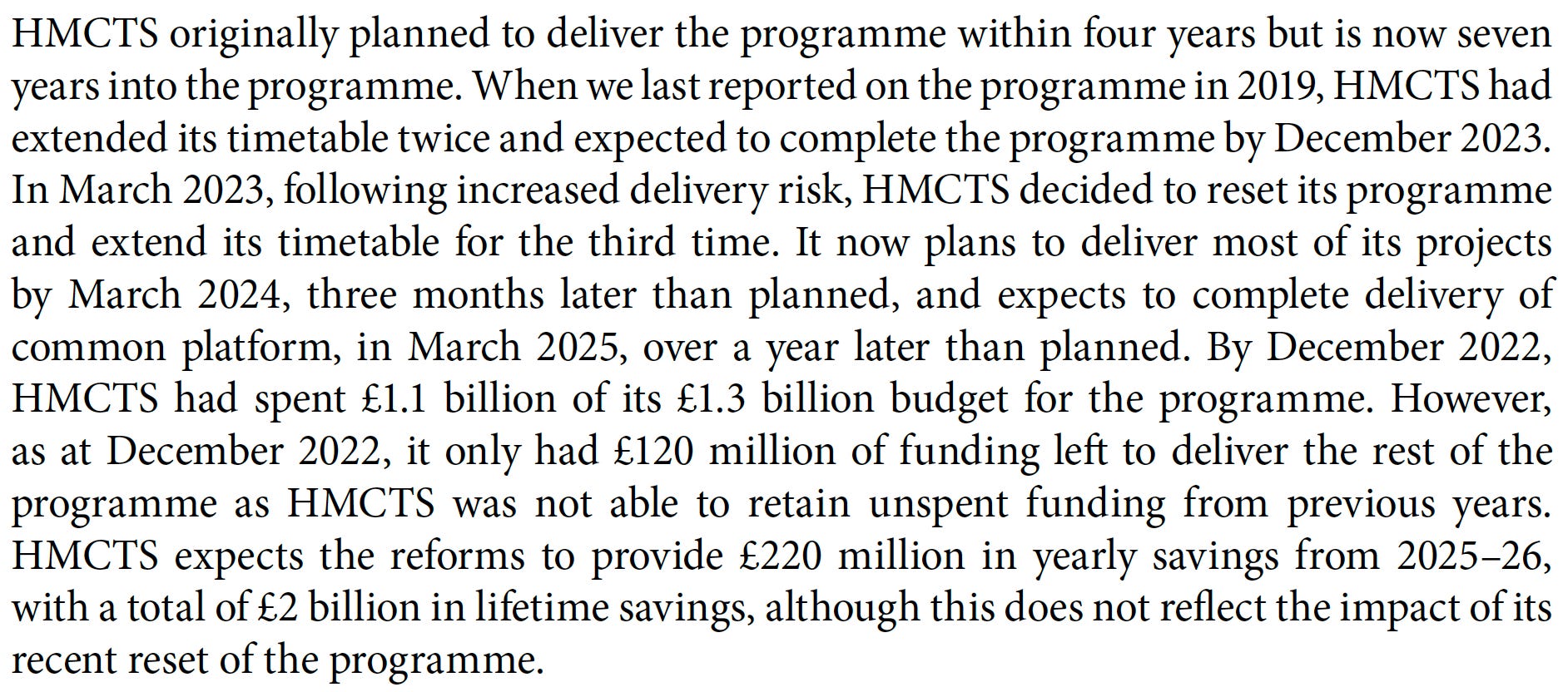

I have been following this reform programme for nearly a decade now. A “single integrated system which would allow electronic case management” was first promised by the Ministry of Justice in March 2014, when the lord chancellor was Chris Grayling.
Though I annoyed some judges by describing it as “selling off courts to buy computers”, I really wanted it to work. Naively, I believed the hype about it being designed to meet the needs of the users.
As I wrote:
“Gone are the days of single, large scale, beginning-to-end government IT projects handed to multinational IT consultancies,” Kevin Gallagher, the HMCTS digital director, said in June 2016. Instead, each step in every process is tested separately. If one section does not work as intended, it can be redesigned without jeopardising the entire project.
This process is described as “agile development” or “fail fast and fix”. The aim is to make each unit small enough to be changed cheaply and easily as necessary.
That was then. And this is the public accounts committee’s verdict now on the common platform, a new digital case management system for criminal courts that was meant to allow access to all parties involved in a case — including the Crown Prosecution Service, which has an entirely separate computer system:
HMCTS’s approach to implementing the common platform has remained detached from the needs of those who use the courts system. For example, court staff such as legal advisers have had to deal with common platform technical and functionality issues in an already stressful court environment.
It has not done enough to listen and respond to users’ concerns, leaving staff and courts to suffer the consequences. HMCTS’s lack of data and research means that it has a limited understanding of whether reformed services are delivering the expected benefits, the total cost of its reforms to the taxpayer or the impact on other services.
Its research so far is insufficient and the evidence that does exist is concerning. The common platform has already placed an unacceptable additional burden on the courts and HMCTS clearly has a lot to do to make it a success.
The law’s delays
The reform programme dates from 2016. As long ago as 2018, the public accounts committee was predicting that the courts service had bitten off more than it could chew.
The committee said five years ago:
HM Courts and Tribunals Service’s £1.2 billion programme to modernise the courts is hugely ambitious and on a scale which has never been attempted anywhere before. Transforming the courts and tribunals system in this way will change how people access justice by digitising paper-based services, moving some types of cases online, introducing virtual hearings, closing courts and centralising customer services. Such sweeping changes will be extremely challenging to deliver.
The performance of HMCTS to date shows that it has much to learn if it intends to do everything it plans. Despite extending its timetable from four to six years, HMCTS has already fallen behind, delivering only two-thirds of what it expected to at this stage, and it still has not shared a sufficiently well developed plan of what it is trying to achieve.
The pressure to deliver quickly and make savings is limiting HMCTS’s ability to consult meaningfully with stakeholders; and risks it driving forward changes before it fully understands the impact on users and the justice system more widely. HMCTS needs to ensure that the savings expected from these reforms are genuine rather than the consequence of shunting costs to other parts of the justice system such as the police, prison service or Crown Prosecution Service, all of which have their own pressures to manage.
Without a better grip on these wider issues, there is a significant risk that HCMTS will fail to deliver the benefits it expects.
The “pressure to deliver quickly and make savings” can only have come from ministers.
A crash landing?
Dame Meg Hillier MP, chair of the public accounts committee, said on Friday:
Our courts were already stretched thin before the pandemic and the backlogs now faced pose a real threat to timely access to justice. These are services crying out for critical reform, but frustratingly HM Courts and Tribunals’ attempts appear in some cases to be actively hindering its own staff’s ability to carry out their jobs. In particular, the roll-out of the common platform digital system was a blow upon a bruise for pressured court users.
We would expect HMCTS to appreciate by now that complex reform such as this cannot be properly implemented while failing to engage with those impacted. But our report paints a picture of a service now rushing to introduce its plans following multiple delays. HMCTS has now burnt through almost its entire budget for a programme of reform only a little over halfway complete.
The government told us that the complexity of managing some of these reforms was like “redesigning the jet engine while it is in flight”. It must explain how it intends to land the plane.
A government response to the committee’s report will be published in due course.