
The former Conservative prime minister Sir John Major KG CH has criticised government proposals that he said would allow a minister to veto the release of prisoners.
Under the Victims and Prisoners Bill, to be debated by MPs next Monday, the secretary of state would have the power to call in the case of a prisoner convicted of a specified serious offence and decide whether or not that prisoner should be released on licence. According to notes issued with the bill, that decision could be taken by a junior minister or even a senior official. There would be a limited right of appeal.
The bill was introduced by Dominic Raab, who resigned from the government last month. It is now the responsibility of his successor, Alex Chalk KC.
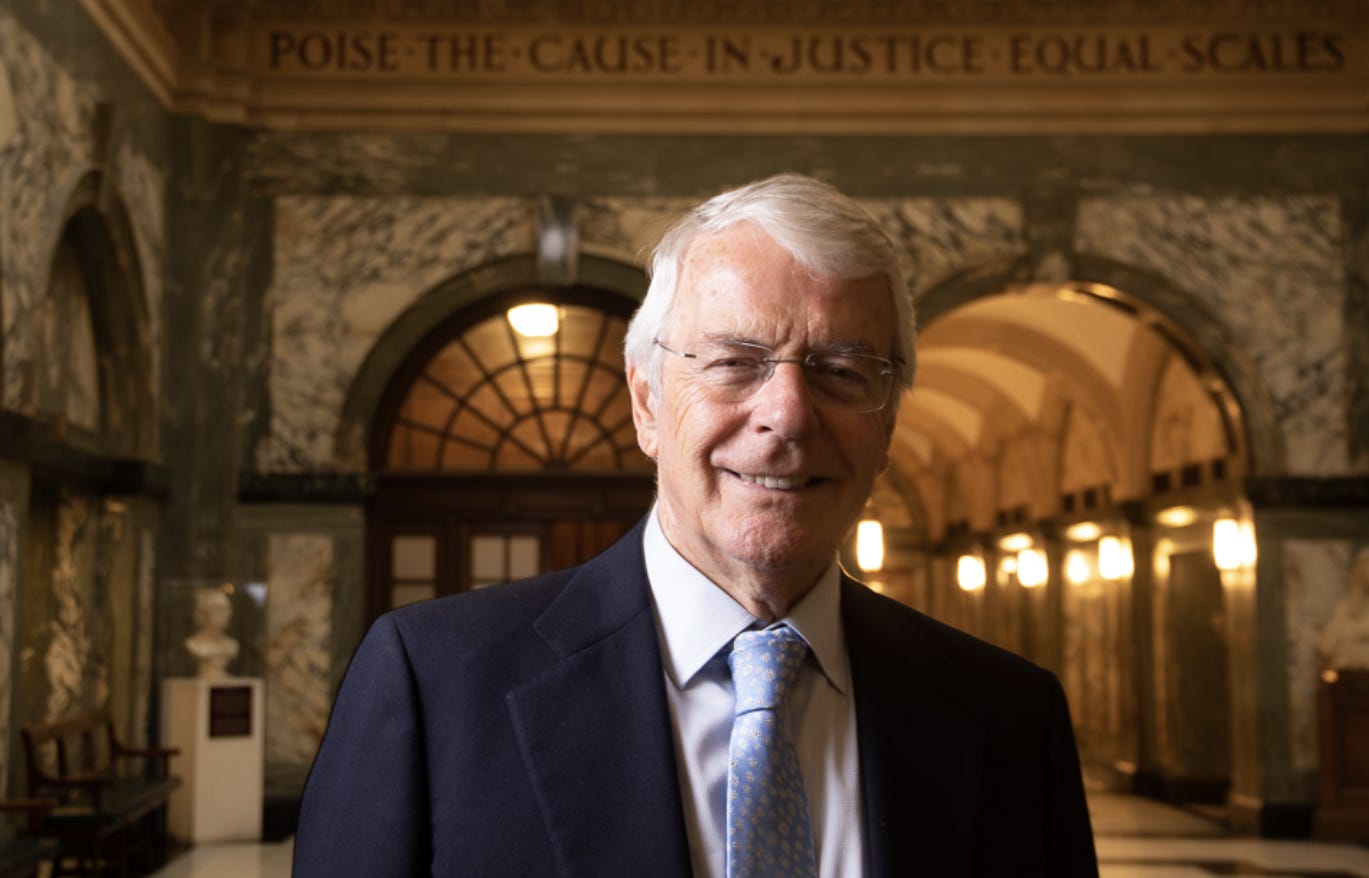
In a speech to the Prison Reform Trust at the Old Bailey last night, Major said he could not see how or why the justice secretary would be able to reach a “more just decision” than the Parole Board — the independent body that currently decides whether a prisoner can be safely released.
He continued:
Any single government minister — however able or well-meaning — would be far more vulnerable to public campaigns and under pressure to make a harsher decision to appease them. This is a very slippery slope.
I do not think that any politician should have that power and I hope the new justice secretary will reconsider or — if he does not — that parliament will deny it.
Major, 80, admitted that many of the problems facing prisons were long-standing and he accepted his share of the blame. But other problems had more recent origins:
In the thousands of decisions to be made each year, there is no way that ministers could possibly match the experience and knowledge of the 350 Parole Board members.
It is therefore surprising — and worrying — that, over the last year, recommendations by the Parole Board to transfer prisoners to an “open” prison have suddenly, and sharply, been rejected by the justice secretary.
In 2021/22, 94% of the Parole Board recommendations were accepted. But thereafter that fell to 11%. It is hard to believe that does not result from an unannounced change of policy that is instituting a harsher regime.
IPPs
Major also urged Chalk to reverse Raab’s policy on IPP prisoners. There are nearly 2,900 of them, detained indefinitely under a power abolished 11 years ago.
Last September, the Commons justice committee recommended that they should all be resentenced. That proposal was rejected by Raab in February.
Major disagreed:
I believe that, without any further delay, justice should be served by government agreement to the justice committee’s recommendation of a re-sentencing exercise — backed by the establishment of an expert committee to guide on the practicalities —for everyone still serving an IPP sentence.
Prison works
“Stern sentences for violent crimes are necessary, and the instinct to protect the public is laudable, said Major, “but we should beware that excessive zeal to be tough on crime does not lead us into unwise policy.”
Picking up a phrase popularised by Michael Howard who had served as his home secretary, he continued:
We are told “prison works” and — to the extent it holds the worst of criminals in custody, it does — but I do not believe our justice system is well served if it also imprisons those who could better be punished by non-custodial sentences.
Major discussed five further concerns. In his own words:
-
we over-use prison and under-value alternative sentences;
-
too many vulnerable people — including the mentally-ill — are jailed;
-
education and rehabilitation in prison is inadequate;
-
much of the prison estate is out-of-date and unsuitable;
-
too many accused are remanded in prison pre-trial.
“I was brought up to believe that we in Britain had one of — if not the — most just and civilised penal codes in the world,” Major concluded. “Some of what I have learned in preparing this speech has truly shaken that belief.”