
The rule of law is non-negotiable, Rishi Sunak told the lord chief justice last month. At his annual press conference yesterday, Lord Burnett of Maldon said he had been extremely encouraged by the prime minister’s commitment.

I had asked the senior judge of England and Wales — who’ll be retiring in the summer — about the challenges he had been facing in defending the rule of law.
Burnett made no mention of the justice secretary Dominic Raab in his reply, though he acknowledged having read in the newspapers about “hypothetical threats to the rule of law in some areas of government policy”.
He continued:
I have long been concerned that the rule of law is taken for granted by most people in this country, if they think about it at all. That’s why we’ve been doing so much work in schools and communities, for example.
But I’m entirely confident of the commitment of the prime minister and his senior ministers to the rule of law. I had a very productive meeting with him only a couple of weeks ago, when we started off with a discussion about the rule of law. I think I’m not breaching any confidences in saying that. He made it clear that it was absolutely non-negotiable. And that’s extremely encouraging.
I asked Burnett if we could infer that he had told Sunak of current concerns about the rule of law. Had the chief justice expressed his own concerns?
I can’t divulge precisely what I said to the prime minister and what he said to me. And I don’t speak in quite that sort of language. But it was a common ground that was established at the outset of our discussions — which then of course flowed into all sorts of other areas — that the rule of law is non-negotiable.
Judges acting up
Asked about delays in criminal trials, Burnett confirmed that in the last recruitment round there had been a shortfall of 16 circuit judges. To fill in the gap, nearly 30 district judges — who normally try cases in urban magistrates’ courts — had been authorised to sit with juries in the Crown Court. It’s the first time this power has been used since it was introduced in 1981.
In an attempt to reduce the backlog, part-time judges had been encouraged to sit for more days and some circuit judges had been called back from retirement.
Everybody out?
This week, a major trade union opened a branch specifically for judges. The GMB union — whose initials used to stand for general, municipal and boilermakers — said the branch included “union members who work in the judiciary system, which is traditionally a sector without trade union representation”.
Stuart Fegan, a senior organiser at the union, said he had written to Burnett expressing concern about an allegedly “toxic work environment”.
His letter said:
Our members have informed me that initiatives advertised internally, purporting to address wellbeing, are at best tokenistic with recent published diversity policies not containing any plan to improve workplace experience or culture…
A significant number of judges have reported feeling suicidal because of treatment at work. I understand this is particularly prevalent on the Midland circuit, where we have many GMB judges seeking advice. A significant factor appears to be largely absent management [operating] outside of required standards with the perception of impunity.
How, I wondered, would Burnett be responding? His answer was brief and to the point: he couldn’t say until he had considered the letter in detail.
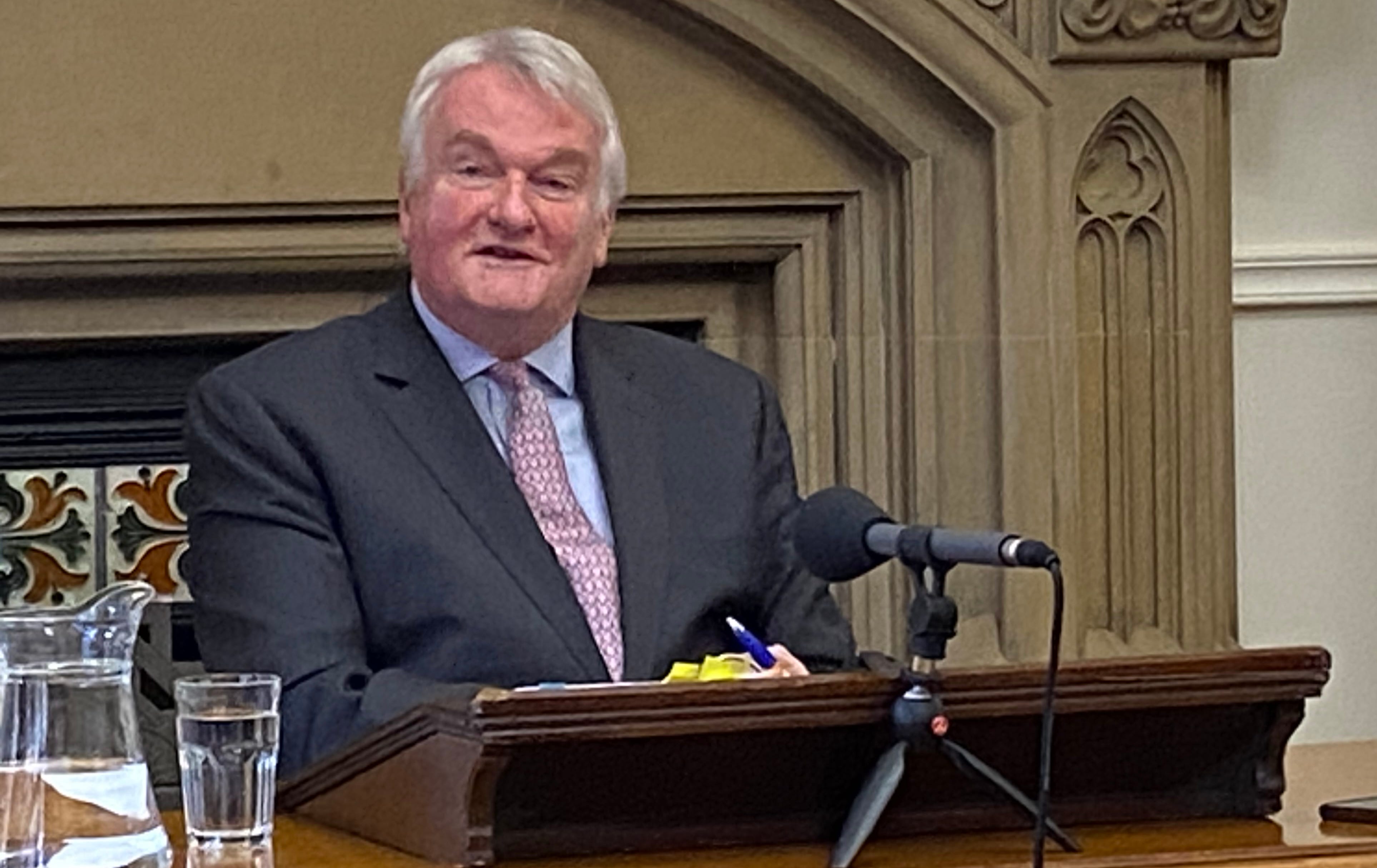
Another reporter followed up by asking what the judiciary was doing to protect the welfare of its members.
This time, Burnett had plenty to say. A new survey had found there was “a small proportion of judges” who felt they had been the subject of inappropriate behaviour — sometimes from other judges, sometimes from lawyers and sometimes from litigants.
But he continued, the senior judiciary was doing a “huge amount” to protect the welfare of judges. He regarded the work being done to identify and deal with “what might generally be called inappropriate behaviour” as very forward-looking and, he thought, quite far-sighted.
Burnett said:
The basic premise is that first we have completely transformed the welfare offering for judges. We started from the premise that we couldn’t assume that, uniquely amongst all organisations in this country and the world, we might not have some isolated problems. And so we set out to try to find out what what they were.
We did a welfare survey, 18 months or so ago, where we asked expressly about behaviour that was inappropriate — of all sorts. We have followed that up through the judicial attitudes survey, where where we’ve asked the same types of questions. The details of that will all be published in a few months’ time.
As a result of what we have discovered through those surveys, we have initiated training for leadership judges. By leadership judges, I don’t mean just the very senior judges here [in London] — but the designated family judges, the designated civil judges and the resident judges who between them lead in family, civil and crime in all the big towns and cities in the country.
We’ve initiated training for them to understand better the difficulties of this nature and to ram home that it is their responsibility to deal with behaviour of this sort if it’s happening in their courts or areas that they’re responsible for.
We have also set in train a mechanism to train all salaried judges in this respect, starting later this year.
I’m sorry, you’ve got me going now; you’ll probably regret it.
We established a whistleblowing procedure 18 months ago… which is similar to that which exists in in other parts of the public sphere, but also in private companies. And we’ve also completely revamped the grievance procedures to enable judges to raise issues without necessarily making formal complaints about behaviour.
We have also put out a public-facing statement of behaviour, very similar again to that which every organisation, big organisation, nowadays has crafted for its own particular needs.
I think we really have been more active in this field than pretty much any other organisation. And I’m also conscious of the fact that, whatever we do, we will never satisfy some people. That’s just the reality of life.
As a general observation, I think it’s important to listen to those who shout loudest and take account of the quality of what they say. But just because somebody shouts loudly, you don’t completely change your whole way of doing things — to satisfy the loud shouters.
You can listen to Burnett’s remarks about judges’ welfare by clicking the button below:
Comment
Over the years, I have often referred to the lord chief justice of the day as the judges’ shop steward. That’s one job Burnett clearly has no wish to hand over — least of all to a trade union leader.
A full transcript of the lord justice’s press conference will be available shortly.