
Clare Montgomery KC will not be applying for the top job at the Serious Fraud Office (SFO) when Lisa Osofsky completes her five-year term as director this summer.
“I don’t think it’s within the grasp of any mere mortal to turn around an institution that has so many structural and systemic problems,” the KC said last month. Instead, she believes the SFO should be merged into the Crown Prosecution Service, ceasing to operate as a stand-alone investigator and prosecutor of serious fraud.
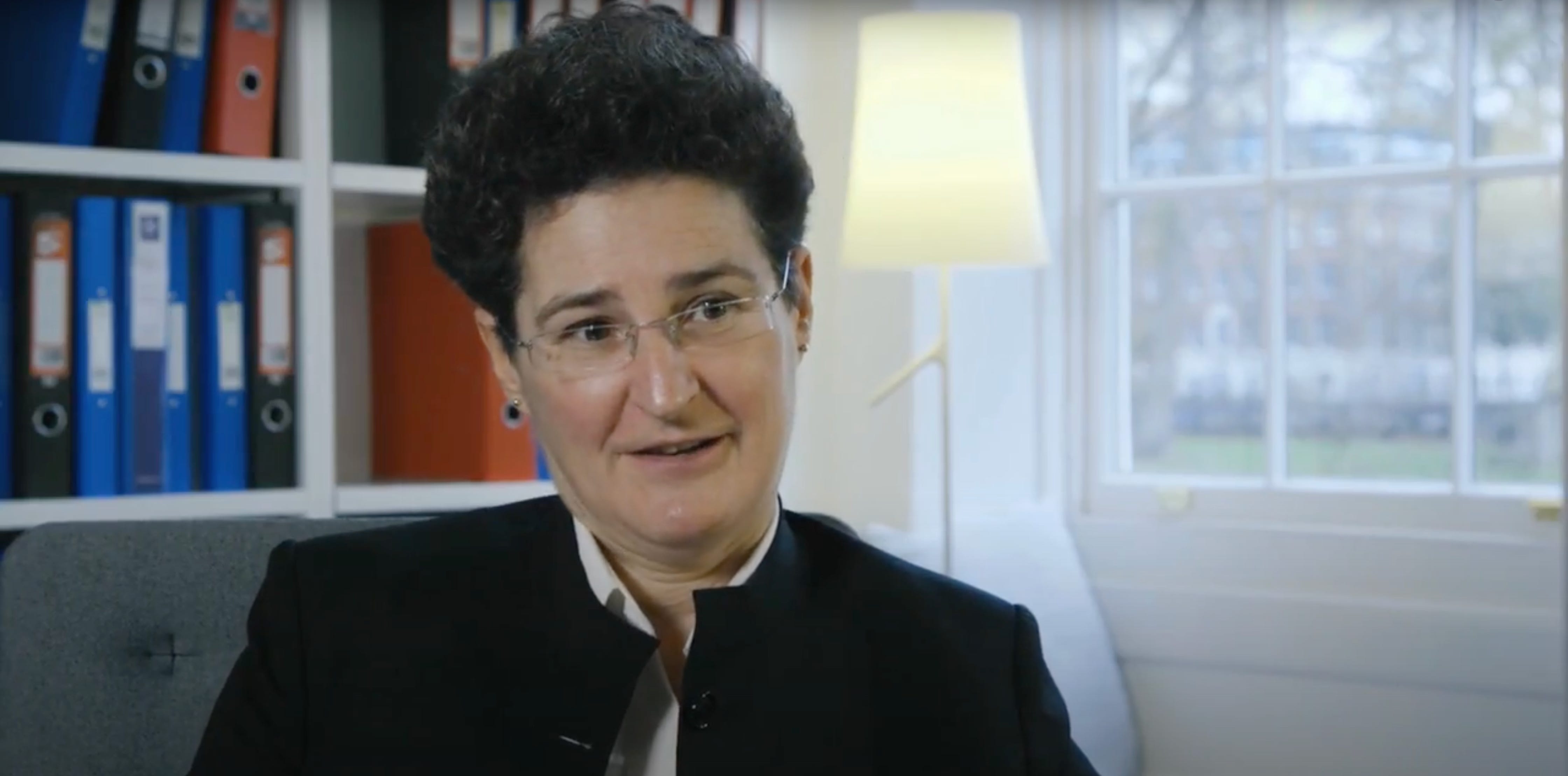
There is no doubt that the job of running the SFO would be hers for the asking. So would a seat on the bench, leading rapidly to the highest levels of the judiciary.
But that doesn’t interest her either. Although Montgomery sits as a part-time judge, she loves representing her clients and enjoys the collegiality of life at the bar. As an advocate, she is utterly formidable. “The only way to describe her is one down from God,” says the latest legal directory superlative quoted on her chambers website. “She can do anything.”
“That just goes to show people will say anything in the directories,” she replied firmly when the line was quoted back to her. “None of it is true.”
Montgomery, 64, was in conversation with two colleagues at Matrix Chambers, Lord Macdonald of River Glaven KC and Tim Owen KC on their podcast Double Jeopardy:
Launched six months ago, the podcast has attracted guests who might not otherwise be willing to answer challenging questions for an hour. Montgomery’s revealing comments, based on front-line experience in the most demanding of fraud cases, are of great concern.
There has been a constant decline in the the level of interest in prosecuting fraud from about 1990 onwards, she told Macdonald and Owen. Other crimes had taken priority:
Fraud just isn’t that exciting and, insofar as it has excited any interest, it’s mainly at the margins — in areas like proceeds of crime in relation to sanctions; or in relation to occasionally providing assistance to foreign governments. All of that does get attention, and some sort of resources at the investigative level, but in terms of actually having police officers interested in fraud it has been subject to a decline now where I don’t believe they have any interest in prosecuting fraud anywhere.
The sort of localism that’s been introduced by crime commissioners directing activities by local forces has reinforced that. So that now, fraud is absolutely at the bottom of anyone’s agenda.
That applies at all levels, she explained. But the heaviest burden was borne by those least able to assert their rights. Wealthy victims of fraud can afford to sue for damages; they can also bring private prosecutions. “They don’t want [the case] dealt with as a criminal matter because that will just interfere with their ability to secure recovery and negotiate with the person who’s defrauded them.”
By contrast, low-level frauds — people losing their £10,000 life savings — were being largely ignored. “You get the occasional show trial in that area. But the reality is that 99% of fraud at that level is not even investigated, still less prosecuted.”
Surely the SFO has had some successes, both in securing convictions and obtaining deferred prosecution agreements under which potential defendants root out corporate corruption and agree to pay heavy fines?
“I’m not saying nothing is happening,” explained Montgomery:
My concern is that nothing of any substance is happening that would actually deter a professional fraudster or even… somebody willing to do dishonest things in the course of business — not necessarily because they’ve set out to be a criminal but because they’re sufficiently selfish and self-interested not to care about the rights of others.
I were inclined to live my business life in that way, I don’t think I’d be very scared of anything that’s available to bring me to book.
Owen asked Montgomery for her thoughts on an article in The Times about Elizabeth Holmes, a US entrepreneur facing 11 years in prison for defrauding investors with her Theranos blood testing start-up. “Her lengthy sentence shows the willingness of America to tackle corporate crimes in a way that other countries, including Britain, have struggled to emulate,” the article had said.
Did Montgomery agree? How did she think the UK compared with the US?
“We come second by quite a long way,” she replied. There were significant structural differences between the two jurisdictions:
Corporate responsibility is much easier to establish in the United States. All you effectively need is somebody acting on behalf of the company, whatever their standing in the company. That would be enough potentially to engage corporate liability. So companies have a much greater incentive to cooperate with the Department of Justice once their business is under scrutiny.
Secondly, by and large, the Department of Justice is evidence-led. They do not start with a grand case theory where they think: we have to get the company and the chief executive officer. They start with: well, what have we got? And normally it’s low-level people. But what they’re able to do is to structure much more attractive deals with those low-level people because the power lies in the Department of Justice to do so.
So they can call in somebody who’s in middle management and give them the opportunity to be “queen for the day”. I’ve never really understood the root of the phrase but it means they can come in; they can say what it is they’d be able to say to help the Department of Justice; and the department can then decide whether they want to use it, without prejudice. So it’s a free hit for both sides to work out whether it’s in their interest to try and do a deal.
Critically, they are able to do that deal on their own, without need for any extravagant process around it. And the reason I picked that out as being a significant structural difference is that the Serious Organised Crime and Police Act 2005 — which set up a structure for either offering a deal which involves no plea of guilty or, alternatively, offering a deal where there is a plea of guilty but there’s a significant reduction in sentence — has created this incredibly bureaucratic structure in the UK, which is hopeless for serious fraud.
Its effect has been that the best the SFO can offer a middle manager who wants to cooperate is that he has to plead guilty and take his chance that the judge will send him to prison — because normally he’s pleaded guilty to quite a serious offence, even if his role in it is relatively minor.
And I can’t think of any circumstances in which I would advise a person to take that sort of personal risk, for the uncertainty it will engender and the period of time it’ll take. These people have to wait, typically, for the trial of whoever they’ve implicated to take place — or for there to be a decision that won’t be a trial. So their lives are on hold for two, three, four years. They are completely uncertain as to what the outcome is going to be. And the whole process is designed to put off anyone who had any inclination to cooperate. And I think it is utterly counterproductive.
Montgomery pointed out that these arrangements had been designed for supergrasses — informers like Bertie Smalls who shopped gangs of armed robbers to the police and “turned out to be making up half of it”. But she said the SFO’s inability to offer a deal that might prove attractive in a serious fraud case was “catastrophic”.
The final structural difference she mentioned was that prosecutors in the US were in a position to make a deal that they could generally deliver. Defendants were not left to worry about what sentence the court would pass:
In the end you are able to reach a deal and the Department of Justice are willing to be pragmatic and commercial about it — whereas the SFO, rightly or wrongly, are bound by the Code for Crown Prosecutors. There are a set of principles, considerations they have to go through. They cannot bind the judge. And so the whole thing must go to the judge, whether it’s on a deferred prosecution agreement where the scrutiny may be less or whether it’s on a plea of guilty where the scrutiny may be more.
That meant prosecutors in the UK had no opportunity to winnow down the cases they were going to bring, as they would in the United States.
Macdonald, a former director of public prosecutions, challenged Montgomery at this point. “We have always felt that people should be making free, unfettered choices when it comes to pleading guilty or not guilty,” he said. “We have always had a worry that innocent people will feel bullied and that will lead to unjust outcomes.”
“That’s a fair criticism,” she acknowledged. But such rights had to be paid for. “If you’re going to have a system which places such significance on control of the power of prosecutor and protection of individual freedoms, then you’re going to have to resource it appropriately. And the problem is we don’t do that.”
The Crown Prosecution Service was launched in 1986 following a decision that the police should no longer bring their own prosecutions as well as conducting investigations. By contrast, the Serious Fraud Office was launched in 1988 as a unified organisation that would detect, investigate and prosecute complex fraud. That followed the recommendations of a committee chaired by Lord Roskill, a former judge.
Montgomery told Macdonald and Owen that she had initially approved of the way the Serious Fraud Office was set up:
I used to be a strong supporter of the idea that the SFO was essential and the structure was good and effective. And I have to say gradually, over a lifetime’s work watching them, I’m not not convinced by that — not because I don’t think there is virtue in the Roskill model of having investigators and lawyers sitting in the same room: I think there is. But I think having it in a separate structure has led to cases falling in the gaps.
I know they shouldn’t because it should be clear what’s in SFO territory, what’s in Crown Prosecution Service territory and what’s in Financial Conduct Authority territory — and all the other possible players who might prosecute a case. But the reality is that there is a reluctance to take on a case which another agency has rejected.
Often, if a case goes to the SFO and they say “no, we’re not interested”, the Crown Prosecution Service are not going to be interested either. And the Financial Conduct Authority will say, “well, that’s not for us really; it’s not really our thing”. And you end up with quite a few cases that fall between the cracks.
I dont see any need for there to be cracks. I would rather it all went back to the Crown Prosecution Service and [they] were given the section 2 powers in a specialist fraud unit.
Montgomery stressed that her plan was not aimed at abolishing the SFO — merely recreating it without the gaps.
Finally, her colleagues wanted to know whether she supported having juries in fraud cases. In 1986, the Roskill committee had recommended — controversially and by a majority — that juries in fraud trials should be replaced by two assessors.
It said:
We have no doubt that most ordinary jurors experience grave difficulties in following the arguments and retaining in their minds all the essential points at issue, particularly in a long hearing of a complex character. This creates the serious risk either that the jury will acquit a defendant because they have not understood the evidence or will convict him because they mistakenly think they have understood it when they have in fact done little more than apply the maxim “there’s no smoke without fire”.
That recommendation was rejected. Montgomery believes it was the right decision:
I have always been a supporter of juries for complex fraud cases. I think [jury trial] has many virtues.
Firstly, particularly in the area of fraud at a level of political or corporate influence, it provides reassurance that the judgement is being rendered by ordinary people and not by the peers of the supposed offender who might otherwise want to protect them.
Secondly, I think that it requires prosecutors to concentrate on the really important points in the case and not to overload the evidential picture in a way that is positively beneficial for the interests of justice generally. And so I think it produces more coherent, better-shaped cases, perforce because the jury have to be able to understand what’s being said…
And then, thirdly, I think there is an issue about commercial honesty. There are many things that happen in the commercial world that commercial peers might think is okay but the jury will have a different view on. Because dishonesty is quintessentially a matter that has to be judged at a core level, not with specialist knowledge, it’s really vital that we have that barometer of where morality lies being decided by those people who are best placed to decide it — rather than some special pleading as to what is or isn’t acceptable in the market for x or y…
Most people recognise that, by and large, the jury gets it right in even in incredibly complex cases.
You can listen to the full interview with Clare Montgomery KC here — together with other podcasts in the series.