
Welcome to Original Jurisdiction, the latest legal publication by me, David Lat. You can learn more about Original Jurisdiction by reading its About page, and you can email me at davidlat@substack.com. This is a reader-supported publication; you can subscribe by clicking here.
I was born in Far Rockaway, New York, to immigrants from the Philippines. Although my parents have been U.S. citizens for decades now, they did not have American citizenship or green cards at the time of my birth; as doctors doing their medical residencies, they were here on work visas. But because I was born in the United States, I became a U.S. citizen through birthright citizenship, regardless of my parents’ citizenship when I was born.
As a birthright citizen myself, I was not a fan (to put it mildly) of Executive Order No. 14160, Donald Trump’s attempt to end our nation’s decades-long understanding of birthright citizenship. Although the order wasn’t retroactive, its issuance at least raised the possibility that my U.S. citizenship could be taken away in the future. And as a proud U.S. citizen, who sees myself as no less American than a Mayflower descendant, I was offended by the EO’s implication that birthright citizens like me are somehow “less than” people born in the United States to U.S. citizens.
I mention this because I’ve always tried to be open and transparent about my biases and priors. So readers of this post about Trump v. Barbara, the birthright citizenship case decided yesterday by the U.S. Supreme Court, should know that I’m far from objective.
I try to be more analytical than opinionated in my writing these days, and that’s my approach here. The most brilliant minds in the legal profession have been arguing the merits of birthright citizenship for years, and it would be presumptuous of me to claim I have anything valuable to contribute to that doctrinal debate.1 But to the extent that my normative views on the underlying legal issues might be coloring my descriptive and predictive writing about the Court, readers should be aware of that possibility—and can discount or dismiss my analysis accordingly.
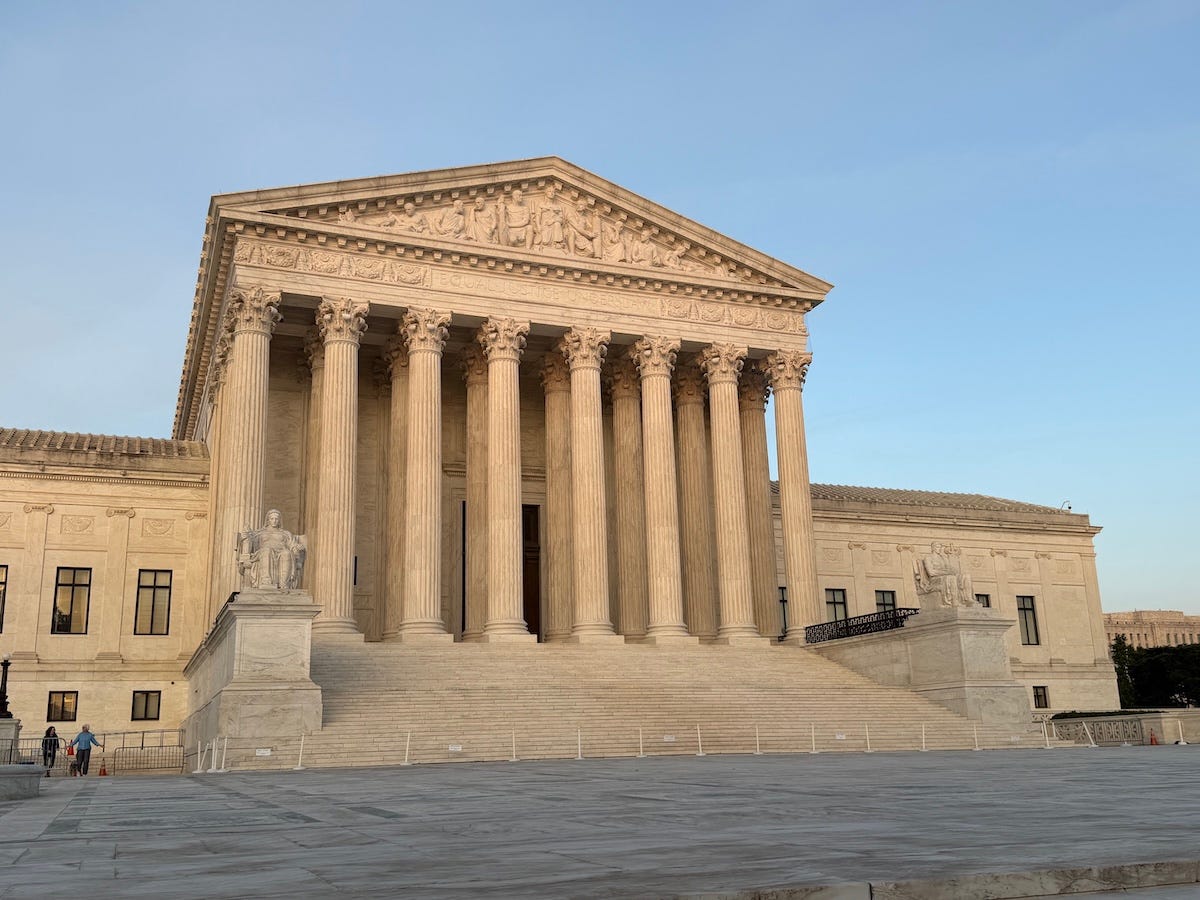
Turning to the substance of Trump v. Barbara, here’s what the case is about, from the characteristically clear opening to Chief Justice John Roberts’s majority opinion:
At issue in this case is whether the Constitution guarantees citizenship to children born of parents unlawfully or temporarily present in the United States.
The [Citizenship Clause of the] Fourteenth Amendment provides: “All persons born or naturalized in the United States and subject to the jurisdiction thereof, are citizens of the United States and of the State wherein they reside.”
On January 20, 2025, President Trump issued Executive Order No. 14160, titled Protecting the Meaning and Value of American Citizenship. The Order provides that children born of persons unlawfully or temporarily present in the United States are not “subject to the jurisdiction” of the United States—and thus do not qualify for citizenship under the Fourteenth Amendment or the Immigration and Nationality Act (INA), which uses the same language.
Several parents filed suit, some on their own behalf, others on behalf of (and in the name of) their children. They argued that the Executive Order violates the Fourteenth Amendment and the INA. The District Court agreed. It provisionally certified a nationwide class of children who would be denied citizenship by the Order and preliminarily enjoined the Order’s enforcement. We granted certiorari before judgment.
Affirming the district court, the Barbara Court held, 5-4, that the order violates the Citizenship Clause of the Fourteenth Amendment. Here’s a quick overview of the 189 pages of opinions (or 194 pages counting the syllabus):
-
As most of us predicted, Chief Justice John Roberts wrote the opinion of the Court, which was joined by Justices Sonia Sotomayor, Elena Kagan, Amy Coney Barrett, and Ketanji Brown Jackson. The five-justice majority held that “[c]hildren born in the United States to parents unlawfully or temporarily present are ‘subject to the jurisdiction’ of the United States and are citizens at birth under the Fourteenth Amendment’s Citizenship Clause.”2
-
Justice Jackson, joined in part by Justice Sotomayor, wrote a concurrence—at 20 pages, not much shorter than the 26-page majority opinion—“to respond to some of the themes in the principal dissent” by Justice Clarence Thomas. Pushing back against his claim that the Fourteenth Amendment “was designed and understood to secure equal rights for the freed blacks,” not to “guarantee[] citizenship to persons who were not domiciled in the United States,” Justice Jackson argued that his view “elides the entire point of the Second Founding: The Reconstruction Amendments were an anticaste, antisubordination reset for the Nation, not a mere spot treatment for the dark stain of slavery.”
-
Justice Brett Kavanaugh wrote a 10-page opinion, concurring in the judgment in part and dissenting in part. He dissented from the Court’s constitutional holding, opining that “the Executive Order does not violate the Fourteenth Amendment.” But he concluded that it “does contravene a federal statute, 8 U. S. C. §1401(a)”—the Immigration and Nationality Act of 1952, which “has long been interpreted to adopt Wong Kim Ark’s general rule of birthright citizenship.”3
-
Justice Thomas, joined by Justice Neil Gorsuch, wrote the principal dissent—which weighed in at 91 pages (those poor Thomas clerks!). In the dissenters’ view, “many potential applications of the President’s Order are consistent with the original public meaning of the Citizenship Clause,” which simply does not “recogniz[e] a constitutional right to citizenship for the children of all foreign birth tourists and illegal aliens.”
-
Justice Alito wrote a 39-page solo dissent. Opening his opinion by declaring Barbara to be “one of the most important decisions in the history of the Court,” he asserted that “the Fourteenth Amendment confers citizenship on only those children who, at birth, owe allegiance solely to this country.”
-
Justice Gorsuch wrote a three-page solo dissent. He contended that “children born to temporary visitors in this country, whether here lawfully or unlawfully, are not citizens”—and “[b]ecause the executive order is lawful at least to this extent, respondents’ facial challenge must fail.”4 But he also raised this question: “Is a child born here to parents who have long chosen to make this Nation their permanent home not a citizen under the Fourteenth Amendment solely because his parents’ presence violates statutory law?” Justice Gorsuch didn’t answer that question—leaving open the possibility that he might support birthright citizenship for the children of undocumented immigrants “who make their permanent home here,” legally or not (as opposed to so-called “birth tourists”).
To sum up:
-
By a 5-4 vote, the Court ruled that the order is unconstitutional under the Fourteenth Amendment.
-
By a 6-3 vote, the Court ruled that the order is unlawful.
-
There might be up to 7 justices who would rule against an order denying birthright citizenship to the children of undocumented immigrants who intend to stay in the United States on a long-term basis.
Having set the table, let’s turn to my takeaways.
1. Trump v. Barbara was never realistically going to come out the other way.
Although I strongly oppose Trump’s birthright-citizenship order, I believe the constitutional questions are significant and substantial. There’s a reason why the split of the justices was closer than many predicted (as discussed below).
Speaking pragmatically, though, and given the current composition of the Court, Barbara really couldn’t have come out the other way—i.e., with the Court upholding the constitutionality of the order (or, to be technical about it, rejecting a facial challenge to the order). It would be, quite simply, too much: too big a departure from the status quo and too aggressive an assertion of the Court’s power, with practical consequences that would be too dramatic and disruptive.
The argument against birthright citizenship reminded me a bit of the argument in favor of disqualifying Donald Trump from the ballot under Section Three of the Fourteenth Amendment. As a matter of constitutional law, these arguments enjoy some support. But as a matter of constitutional politics, it was clear from the outset that they, much like “fetch” from Mean Girls, were simply not going to happen.
What do I mean by “constitutional politics”? Here’s what I wrote when discussing the concept in the context of the effort to disqualify Donald Trump:
The decision will be based on what [Georgetown law] professor Stephen Vladeck calls “constitutional politics,” which is distinct from constitutional law. Constitutional law isn’t irrelevant to constitutional politics, but it’s also not controlling; constitutional politics reflects additional factors like practical consequences, prudential judgments, the reputation and legitimacy of the Supreme Court, and what the justices are willing to spend in terms of political capital.
Upholding the order would have had massive practical consequences. According to an amicus brief filed in Barbara by 141 social-sciences professors, “The Order, if implemented, would strip 4.8 million future U.S.-born children of citizenship by 2045 and 12.8 million by 2075, with impacted children representing approximately 255,000 U.S. births per year.” It’s hard to imagine the Supreme Court wanting to own that—and to spend the required political capital to do it.
Critics of the Court contend that it has no problem with aggrandizing its own power.5 But even these critics must acknowledge that every Court, including this one, has lines it won’t cross. And it was clear all along that upsetting a decades-old understanding of birthright citizenship, in a way that could affect millions, was one such line.6
In his dissent, Justice Alito attempted to address the “bridge too far” concerns that some of his colleagues might have had:
Congress can and should address [the] situation [of the millions of children of undocumented immigrants]. The Fourteenth Amendment dictates who must be a citizen, but it does not address who may be a citizen by Act of Congress. Congress has conferred citizenship on many people who are not made citizens by the Fourteenth Amendment, including children born abroad to American citizen parents. These people and the millions of immigrants who have been naturalized are no less American than those who are fortunate enough to be born here.
For these reasons, the original meaning of the Fourteenth Amendment does not require inhumane results, and we should not adopt an erroneous interpretation of the Fourteenth Amendment simply out of fear of the consequences of “rocking the boat” or as a reaction to current immigration policy.
In the end, though, six justices decided not to “rock the boat”—as most of us expected.
2. The margin of victory turned out to be closer than many expected.
Most legal commentators believed before the oral argument that Barbara would come out against the Trump administration, 7-2, and many adhered to that view even after the argument. So please indulge me as I take a victory lap (as I also did in the tariffs case), based on the vindication of my post-argument, pre-opinion predictions:
I’m honestly at a loss when it comes to [ascertaining the views of] Justices Gorsuch, Kavanaugh, and Barrett, who all asked thoughtful, probing questions of both sides. I think there’s a possibility that one of them will vote with the Trump administration, making for a 6-3 vote, and it’s also possible that two of them go that way—meaning that the ACLU would still prevail, but by a close, 5-4 vote.
This is pretty much exactly how the case came out: 6-3 on the overall legality of the order, but 5-4 on its constitutionality.
That 5-4 margin was too close to comfort for some—like my former Above the Law colleague Elie Mystal, who urged Democrats to remain vigilant against efforts to roll back or abolish birthright citizenship:
Democrats, meanwhile, are likely to treat this bare win in Barbara just like they treated Roe: as a settled victory that requires no more legislation or defense. They are likely to throw Barbara back in the face of court reformers—as if a 5-4 ruling that the 14th Amendment means what it says is some kind of enduring victory—and media pundits are likely to use Barbara as an example of the court “standing up to Trump,” even though the dissents literally told Trump what to do next to accomplish his unconstitutional goals.
I agree with Elie that defenders of birthright citizenship must stay alert. At the same time, I believe Barbara is a win worth celebrating—congrats to the ACLU and its national legal director, Cecillia Wang, who argued the case—precisely because the margin was so close.
[UPDATE (11:22 p.m.): For more on this subject, see this New York Times article by Amy Qin, The Birthright Decision Was Surprisingly Close, Some Legal Scholars Say.]
3. The concept of “domicile” dominated the dissents.
In my post-argument recap, I observed that “[t]he concept of ‘domicile’ was surprisingly dominant” when the case was argued. And now that we have the Barbara decision, we can see how domicile loomed large in the opinions as well.
In a very interesting SCOTUSblog post, Breaking Down the Birthright-Citizenship Decision, Adam Feldman analyzed which concepts were most mentioned in the opinions. For the dissents, domicile came in #1, with 35.8% of concept mentions. Even for the majority opinion, domicile was also #1, with 31% of concept mentions (because the Chief spent time responding to the dissenters’ reliance on domicile).
So what exactly is “domicile,” and why is it relevant to birthright citizenship? From Justice Thomas:
Americans, consistent with their settler ethos, believed that citizens were the people who called a place home. Accordingly, domicile—a person’s legal home—played a key role in both state and national citizenship in America….
The Citizenship Clause was consistently interpreted not to apply to the children of foreign temporary visitors, who were by definition not domiciled in the United States.
What explains this interpretation? According to Justice Thomas, linking domicile to the words of the Citizenship Clause, “Children born to temporary visitors owed allegiance to another government—the country of their domicile—so they were not subject to the jurisdiction of the United States” (emphases added).
Note Justice Thomas’s reference to “allegiance,” which both the majority and the dissenters recognize as a key concept. As Chief Justice Roberts stated, both sides agree that “citizenship turns on allegiance.”
Here’s where they disagree: what gives rise to allegiance? In Justice Thomas’s view, allegiance flows from domicile. In Chief Justice Roberts’s view, the Citizenship Clause essentially adopted the view of citizenship reflected in the English common law, under which allegiance turned on where you were born. According to this “jus soli, or right of the soil” theory, you owed a “natural allegiance” to where you were born and to the sovereign of that place—here, the United States (subject to certain exceptions, such as children born in the U.S. to foreign diplomats and children of members of the Indian tribes).7
4. It’s unclear if this will end up being the beginning or the end of efforts to redefine birthright citizenship.
Trump was very invested in his birthright-citizenship order. Reflecting his strong feelings, he made history by becoming the first sitting president of the United States to attend a Supreme Court argument in person.
How did Trump react to the decision in Trump v. Barbara? His Truth Social post was fairly restrained (by his standards):
The Supreme Court upheld Birthright Citizenship, which is too bad for our Country, but we can easily make it up in Congress through Legislation, with the support of the President, that has now been determined during this process. No long and unwieldy Constitutional Amendment is necessary! Congress should start TODAY to work on ending expensive and unfair to our Country, Birthright Citizenship. They will have my Complete and Total Support!
Alas, the president is incorrect in declaring that no constitutional amendment is necessary (setting aside the theoretical but remote possibility of the Court itself overruling Barbara). Multiple allies of Trump and supporters of his order—including lawyers by training, such as Senator Mike Lee (R-Utah) and Governor Ron DeSantis (R-Fla.)—explained that amending the Constitution would be required to end birthright citizenship in its current form.8
Might we see an attempt at such a constitutional amendment? Of course, amendments require a great deal of popular support.9 And at least if polling is any guide, there simply isn’t that level of support for changing birthright citizenship. Polls suggest that 55% to 65% of Americans support birthright citizenship.
Even narrowing birthright citizenship through an amendment could be challenging. Here’s what polling suggests about the different categories of birthright citizenship:
-
Children born in the U.S. to parents who are in the country legally on work visas (my situation): 75% support automatic citizenship, 24% oppose.
-
Children born in the U.S. to parents who are in the country legally on tourist visas: 58% support automatic citizenship, 41% oppose.
-
Children born in the U.S. to parents who are in the country illegally: 49% support automatic citizenship, 49% oppose.
In terms of other implications, Sarah Isgur and David French raised this question on Advisory Opinions: could opposition to birthright citizenship replace opposition to Roe v. Wade as the new litmus test for prospective Republican judicial nominees, especially possible Supreme Court picks? In Elie Mystal’s view, the answer is yes: “From where I sit, birthright citizenship is now poised to replace abortion as the litmus test for future Republican judicial appointments, with Barbara replacing Roe as the case Republicans insist must be overturned.”
So those are some thoughts on Trump v. Barbara. Readers, what do you think? Please take my poll below and share your views in the comments (which are open to all readers, not just paid subscribers).
Although I don’t participate in the doctrinal debate, I certainly follow it. My favorite scholars on birthright citizenship include Professors Akhil Amar and Vikram Amar, who wrote about Barbara for SCOTUSblog, and Professor Ilya Somin, who covered Barbara for the Volokh Conspiracy.
Yes, I’m quoting the syllabus—which isn’t officially part of the opinion of the Court, but I quote it having independently confirmed its accuracy (just as it’s okay to rely on AI output after verifying its correctness).
For more on this statutory argument, see point #4 in my write-up of the Trump v. Barbara argument, noting the possibility that “the case will be resolved based on a statutory rather than constitutional ground.”
As explained by Justice Gorsuch, a facial challenge can succeed “only if ‘no set of circumstances exists’ in which the order may be applied lawfully”—so it’s a tough row to hoe.
See, e.g., Professor Maria Glover’s MS NOW essay, published earlier today.
As noted by Justice Clarence Thomas in his dissent, “President Franklin D. Roosevelt’s administration adopted the view that the Citizenship Clause applied to the children of temporary visitors.” So regardless of the original understanding of the Citizenship Clause, the validity of birthright citizenship has been the understanding of the American people for more than 80 years.
Domicile plays a role in Justice Alito’s dissent, but a smaller one—mainly in the context of discussing United States v. Wong Kim Ark (1898), the central authority in Barbara (as shown in Adam Feldman’s textual analysis). There’s a lot of language in Wong Kim Ark that supports the majority’s position in Barbara, but in Justice Alito’s view, “the holding of the case was limited to a child born in the United States to parents who were not citizens but had established ‘a permanent domicil and residence’ here.”
In light of the constitutional holding of Barbara, I see little to no point in trying to come up with a new and improved executive order or even a congressional statute.
For what it’s worth, my personal view is that more attempts to propose amendments should be made. I believe the conventional wisdom of “amendments are impossible” has become something of a self-fulfilling prophecy. In our age of mass media, social media, and virality, the ability to build national support for a truly popular proposed amendment is probably greater than it has been in years.
Thanks for reading Original Jurisdiction, and thanks to my paid subscribers for making this publication possible. Subscribers get (1) access to Judicial Notice, my time-saving weekly roundup of the most notable news in the legal world; (2) additional stories reserved for paid subscribers; and (3) the ability to comment on posts. You can email me at davidlat@substack.com with questions or comments, and you can share this post or subscribe using the buttons below.