
The following is a guest post by Trisha Baillon, an intern with the Digital Resources Division of the Law Library of Congress. She studied international relations and Russian at Seton Hall University.
Prior to the Great Depression, live theater was an incredibly popular form of entertainment in the United States. This was particularly common in New York City, where hundreds of productions were attended. Despite competition from the rising motion-picture industry, live theater remained extremely popular as Broadway attracted international theater companies as well as numerous famous actors and playwrights throughout the 1920s. However, once the Great Depression hit the country, theater became a luxury few could afford, and subsequently, actors, playwrights, and other theater industry employees fell into unemployment. In 1935, President Franklin D. Roosevelt (FDR) established the Works Progress Administration through Executive Order 7034, resulting in a federally funded administration with the intention to provide relief for unemployed Americans. This was a component of the Emergency Relief Appropriation Act of 1935 (49 Stat. 115), itself part of President Roosevelt’s New Deal Programs. These programs aimed to alleviate financial hardships for Americans during the Great Depression.
Included in the Works Progress Administration was the Federal Project One, which was made up of five projects related to providing federal funding for the arts in America. The Federal Theatre Project (FTP) was one of these programs. Its purpose, as stated in the 1935 Manual for Federal Theatre Projects, was the “re-employment of theatre workers now on the relief rolls,” which would ease financial hardships for theater workers, while bringing entertainment to Americans across the country. One of the main purposes of the Federal Theatre Project was to make live theater accessible to communities around the country that did not have the opportunity to engage with it before. Hallie Flanagan, the director of the Federal Theatre Project, established 13“theatre regions” that would make up a national network allowing for exchanges of writing, resources, and more. Flanagan’s main contributions came through her time directing the Federal Theatre Project, in which she oversaw the operations that brought theater all over the country and produced many unique and influential shows. For the first time, live theater had a truly national reach as “[p]erformances toured to virtually every corner of the nation—coast to coast—often traveling to rural areas where live theater was seldom seen, with some shows performed outdoors using portable stages.”
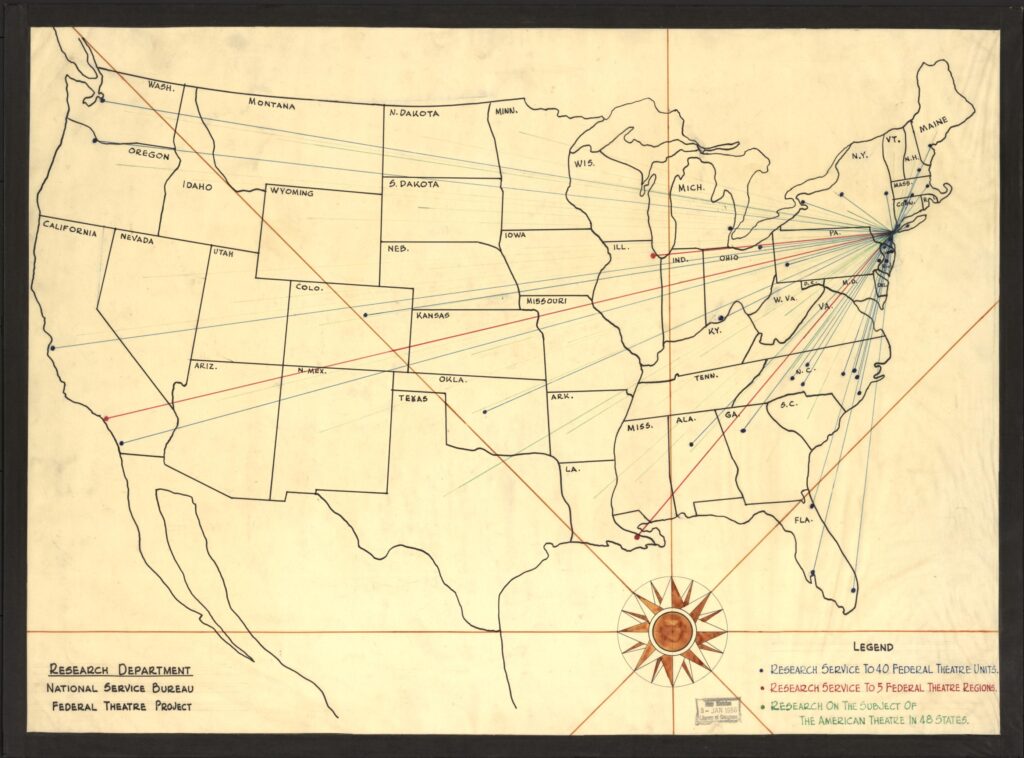
One of the most important elements of the Federal Theatre Project was the choice of productions put on by various theaters and touring groups. In another instructional document regarding play rentals, non-royalty, and choice of plays, it was outlined that approving the plays produced would be delegated to the State Directors or the Assistant to the National Director in charge of a specific region. During its time, the Federal Theatre Project produced many types of plays that covered a wide range of styles and topics, from adaptations of Shakespeare plays to contemporary shows commenting on the current state of society. Some of the productions combined elements of traditional theater and modern interpretations, such as the production of Macbeth in Harlem put on by the “Federal Theatre Project’s Negro Unit,” which was an organization dedicated to employing Black actors, playwrights, and other employees in the theater industry. The show, nicknamed “Voodoo Macbeth,” took place in Haiti and recontextualized the show by centering the narrative around the Haitian slave revolt, a directorial choice aimed to appeal more to the African American communities in New York and to emphasize the voices of the entirely Black cast. This would eventually become one of the most well-known shows from the Federal Theatre Project, representing the nature of many productions that aimed to push the boundaries of live theater.

Despite every production going through the aforementioned approval processes, many caused controversy. Multiple plays produced by the Federal Theatre Project commented on social issues or drew inspiration from events affecting people across society, such as Ethiopia, which dramatized events leading to Benito Mussolini’s invasion of Ethiopia. Ethiopia was also considered to be the first “Living Newspaper,” which was a form of play that was made up of scenes based on newspaper articles. However, production was canceled due to the portrayal of foreign leaders.
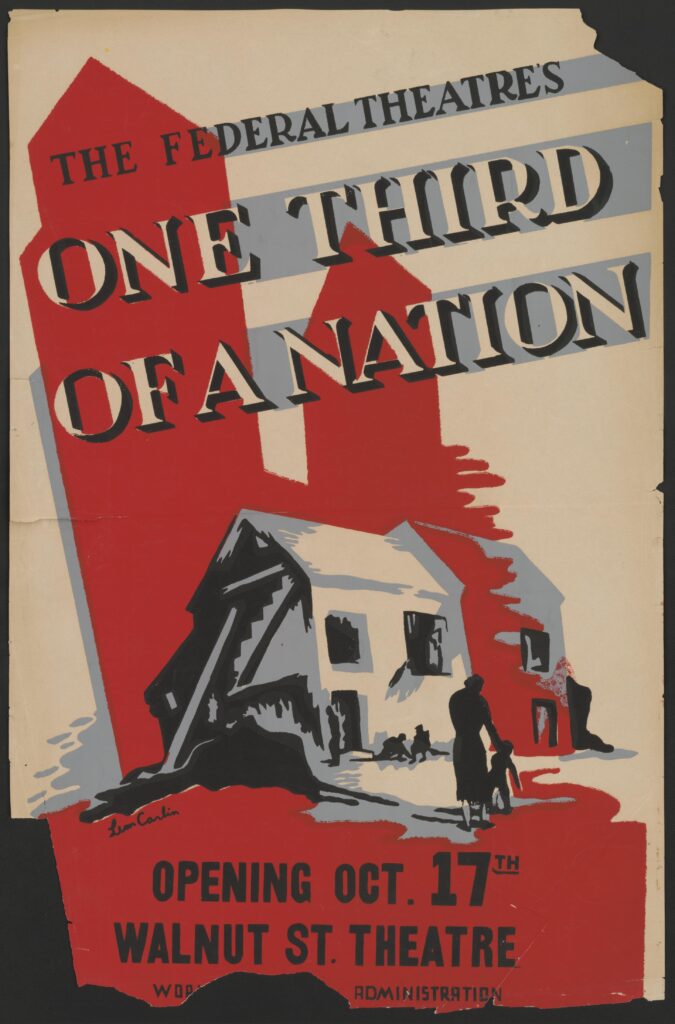
Many other plays also addressed relevant social events of the time, with varying degrees of success. An example can be seen in One-Third of a Nation, which was centered around social, economic, and racial issues in America, specifically the housing crisis in New York City. The title was a reference to FDR’s second inaugural address, as he stated, “I see one-third of a nation ill-housed, ill-clad, ill-nourished.” This show would become the most successful of the Living Newspapers as it ran 237 productions. However, a musical that also addressed social issues of the time, The Cradle Will Rock, was shut down before opening night by New York authorities. The musical included strong pro-labor messages that drew upon the labor action movements occurring at the same time.
Due to the rising tensions surrounding the nature of the Federal Theatre Project productions, the project became a political issue. At the time, the Federal Theatre Project became a target for concerns about its productions being considered un-American propaganda, which was further explored in the 1938 Investigation of Un-American Propaganda in the United States. Director Hallie Flanagan appeared in front of the committee on December 6, 1938, and was subsequently questioned about her personal affiliations with communism and the accused radical productions from the Federal Theatre Project.
Shortly after this, the funding for the Federal Theatre Project ceased, which ended the project. Although the Federal Theatre Project was short-lived, it provided much-needed relief for theater workers and made theater more accessible throughout the United States during a time of extreme hardship. Additionally, it has preserved an era through a dramatized lens that will enable us to reflect on and study the Great Depression and other events of the time from another perspective.
Despite the suspension of the Federal Theatre Project after four years of operation, new efforts to provide artistic funding persisted. In 1965, Congress established the National Endowment for the Arts (NEA) (Public Law 89-209). This organization has continuously provided federal funding for theater and other arts, allowing Americans to partake in and experience artistic endeavors in a wide range of areas, facilitated by government grants. You can still research the vast history of the Federal Theatre Project here at the Library, and in the records of the Works Progress Administration at the National Archives.
Subscribe to In Custodia Legis – it’s free! – to receive interesting posts drawn from the Law Library of Congress’s vast collections and our staff’s expertise in U.S., foreign, and international law.