
This week’s Judicial Notice is sponsored by

Burford Capital helps companies and law firms unlock the value of their legal assets. With a portfolio of over $7 billion and listings on the NYSE and LSE, Burford provides capital to finance high-value commercial litigation and arbitration—without adding cost or risk or giving up control. Clients include Fortune 500 companies and Am Law 100 firms, who turn to Burford to pursue strong claims, manage legal costs, and accelerate recoveries. Learn more at burfordcapital.com.
Shana Tova. To all who celebrated, I hope you had a joyous Rosh Hashanah. I’m really happy for you, I’mma let you finish—but my mother-in-law makes the best latkes of all time!
In addition to their hosting a wonderful Rosh Hashanah dinner, I have another reason to be thankful to my parents-in-law: they watched our two boys while Zach and I traveled down to D.C. for the inaugural SCOTUSblog Summit. I’m admittedly biased—since Zach, as executive editor of SCOTUSblog, was intimately involved in its planning—but the event was a huge hit. Numerous attendees and participants told me after the Summit that they learned a ton, had a great time, or both.
I enjoyed moderating a panel about business litigation at the Supreme Court, featuring the chief legal officers of three Fortune 25 companies: Rachel Brand of Walmart, Brent McIntosh of Citi, and Jennifer Newstead of Meta. It was also a pleasure to meet Justice Amy Coney Barrett and her husband, former federal prosecutor and current SouthBank Legal partner Jesse Barrett, in person. (I spoke with Justice Barrett back in 2022 for a story I wrote about the passing of one of her mentors, the legendary Judge Laurence H. Silberman (D.C. Cir.)—but that was a phone interview.)
Thanks to everyone who participated in or attended the SCOTUSblog Summit, as well as the sponsors whose generosity made it possible: the Pacific Legal Foundation, a public-interest law firm that has been defending Americans’ liberties since 1973, and eight law firms with top-flight appellate and Supreme Court practices: Cooley, Haynes Boone, Hecker Fink, Latham & Watkins, Paul Weiss, Skadden Arps, Weil Gotshal, and Williams & Connolly. Another highlight of the Summit for me was catching up with leading litigators from these firms, appellate advocates whose names you’d recognize—but I will spare you further name-dropping.
Now, on to the news.
Lawyer of the Week: Lindsey Halligan.
Last week, I discussed how Donald Trump planned to appoint Lindsey Halligan, one of his White House aides, as U.S. attorney for the Eastern District of Virginia. The post became vacant after Erik Siebert, the acting U.S. attorney, resigned or was fired (depending on whom you believe), after he refused to bring criminal cases against Trump’s political enemies—most notably, former FBI director James Comey.
Enter Lindsey Halligan, 36. As noted in publications ranging from The New York Times to The Washington Post to The Wall Street Journal (gift links), she’s a former personal lawyer to Trump with no prosecutorial experience. After graduating from the University of Miami School of Law in 2013, she joined the Fort Lauderdale office of Cole, Scott & Kissane, a large Florida law firm specializing in insurance litigation, where she made partner in 2018. CSK is an Am Law 200 firm with $5.1 million in profits per equity partner—but it has around 600 lawyers, generating $280 million in revenue, and only three equity partners (so you do the math).
How did Lindsey Halligan enter Trump’s orbit? She met him in November 2021, at an event at the Trump International Golf Club in West Palm Beach; having just come from court, she was wearing a suit, and she attracted his notice. The following year, she started representing him as a lawyer. When the FBI showed up at Mar-a-Lago with a search warrant in August 2022, Trump needed a lawyer on the scene, ASAP—so an adviser reached out to Halligan, who was about 45 minutes away, and she represented Trump onsite during the raid.
In the weeks and months that followed, Halligan was involved in a lawsuit seeking to freeze the review of classified files recovered from Mar-a-Lago—which Judge Aileen Cannon (S.D. Fla.) found meritorious, but the Eleventh Circuit, not so much. Halligan also defended Trump on television, making a favorable impression on the TV-obsessed Trump. So when he returned to the White House, Trump brought her up to D.C., naming Halligan as special assistant and senior associate staff secretary.
And then, on Monday, Trump appointed her as interim U.S. attorney for the Eastern District of Virginia—one of the nation’s most important prosecutorial offices, known for handling high-stakes national security cases. A dozen years out of law school, Halligan has limited federal-court exposure; scant criminal-defense background, consisting of internships with the Innocence Network and the Miami-Dade County public defender’s office, plus her Trump work; and no prosecutorial experience.
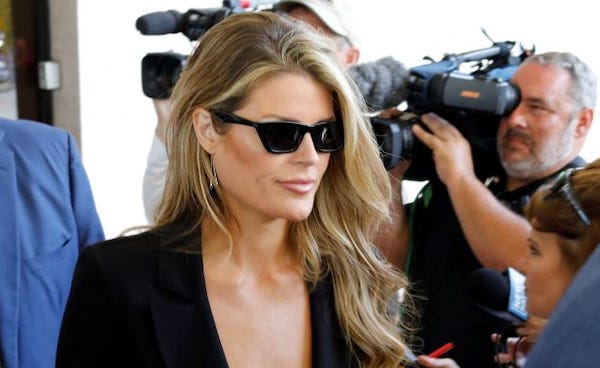
So Halligan is not, shall we say, “qualified”—at least in conventional terms, like credentials, background, and experience—and if I were a U.S. senator, I wouldn’t vote for her if Trump nominated her to serve as the long-term U.S. attorney. But in the words of Meridith McGraw, C. Ryan Barber, and Lydia Wheeler of The WSJ, Halligan boasts the exact qualities that Trump prizes: “loyalty above a long résumé, a camera-ready appearance, and a commitment to taking on what she perceives as the excesses of the left.” (“Camera-ready” strikes me as a politically correct way of describing someone as “attractive”—and as noted by The Journal and The Post, Halligan competed in Trump-owned beauty pageants, winning third runner-up in the 2010 Miss Colorado USA Pageant.)
And Halligan has a “qualification” that Siebert, an experienced prosecutor and 15-year veteran of the E.D. Va., lacked: a willingness to indict Jim Comey. So on Thursday, she walked into the federal courthouse in Alexandria, Virginia, intent on doing just that.
It wasn’t a resounding triumph. Only 14 out of 23 grand jurors voted to indict Comey, barely clearing the 12-vote threshold—and on a third count, alleging perjury, the grand jury refused to indict. And there were some hiccups along the way, per The Times: at one point, Halligan went into the wrong courtroom, and when she did get into the proper courtroom, she stood on the wrong side of the judge.
But at the end of the day, Halligan got the job done. On Thursday, she walked out of the federal courthouse with a two-count, two-page indictment that charged James B. Comey, Jr., with (1) making a false statement to a U.S. senator during a Senate Judiciary Committee hearing, in violation of 18 U.S.C. § 1001, and (2) obstructing a congressional proceeding, in violation of 18 U.S.C. § 1505. Congratulations?
One other complication: there’s an argument that Halligan wasn’t validly appointed, articulated over at National Review by Ed Whelan. For possible defenses of Halligan’s authority, see the government briefs in United States v. Garcia (defending the appointment of Bill Essayli in Los Angeles) and United States v. Giraud (defending the appointment of Alina Habba in New Jersey).
This is another contention that Team Comey could raise in defending against the prosecution, on top of claims of selective or vindictive prosecution. And because Halligan is handling this case personally, with only her name on the indictment, a successful challenge to her appointment could create significant problems for the prosecution. (This discussion has focused on Halligan; I discuss the substance of United States v. Comey in more detail below, under Litigation of the Week.)
Other lawyers in the news:
-
James Comey isn’t the only former DOJ leader being targeted by Trump. In a Truth Social post on Friday, Trump declared Lisa Monaco, deputy attorney general in the Biden administration, to be “a menace to U.S. National Security”—and urged Microsoft, which recently hired her as president of global affairs, to “immediately terminate” her employment. (The Trump administration revoked Monaco’s security clearances back in February.)
-
Who will be defending Jim Comey in his criminal case? He’s hired what The National Law Journal described as “a high-powered criminal defense team”: former U.S. attorney (N.D. Ill.) and Skadden partner Patrick Fitzgerald—a longtime friend, since they worked together as young prosecutors in the Southern District of New York—and former federal defender Jessica Carmichael, a partner at Carmichael Ellis & Brock in Alexandra, Virginia.
-
Erik Siebert, whose departure as U.S. attorney paved the way for Lindsey Halligan, was one of many federal prosecutors who have been fired or pressured into quitting by the Trump administration. Another was profiled last week by The New York Times (gift link): Michele Beckwith—who was fired not just as acting U.S. attorney in Sacramento (E.D. Cal.), but as a federal prosecutor, period—after she reminded Gregory Bovino, a Border Patrol official, that he can’t arrest people without probable cause while enforcing immigration laws. How rude of her!
-
In other firing news, Will Rosenzweig was fired as an assistant U.S. attorney in Miami (S.D. Fla.), after anti-Trump blog posts that he wrote before he was an AUSA came to the attention of the powers that be at the DOJ. Rosenzweig is the third federal prosecutor in that office to be fired by Attorney General Pam Bondi for Trump-related issues, according to The Miami Herald. (On the broader trend of employees being fired for speech, check out this excellent Times guest essay (gift link) by Greg Lukianoff of the Foundation for Individual Rights and Expression.)
-
Speaking of former AUSAs, John Kucera, now a partner at Boies Schiller, owned up to a significant AI screw-up in a brief filed with a California state appeals court. He acknowledged it was a big deal, apologized profusely, filed a proposed corrected brief, and didn’t throw any colleagues under the bus. I thought he handled it well—or as well as it could have been handled without a time machine.
-
In my opinion, Kucera dealt with the situation better than Robert Carey, Michella Kras, and their colleagues at Hagens Berman. They filed briefs with ChatGPT-created errors, which they blamed on a contract attorney, then filed “corrected” briefs containing more AI errors. When Judge Fred Slaughter (C.D. Cal.) called them out, Kras tried to minimize one erroneous parenthetical as “probably inartful,” adding that “we’re not perfect.” This didn’t sit well with Judge Slaughter, who lived up to his name and lambasted them for their “unacceptable” actions.
In memoriam:
-
A longtime partner at Williams & Connolly, Robert B. Barnett was no ordinary lawyer. A counselor, confidante, and negotiator of blockbuster book deals for the Clintons, the Bushes, and the Obamas, Bob Barnett passed away at 79.
-
Barnett clerked for the Supreme Court—as did Professor Jerome Cohen of NYU Law, a leading scholar of Chinese law and China’s (disturbingly opaque) legal system. Cohen passed away at 95.
-
In addition to teaching and writing, Cohen practiced for a number of years at Paul Weiss—but not as many years as tax lawyer Alfred Youngwood, who spent more than 40 years at the firm and led it as chair for about a decade. Youngwood passed away at 87.
May they rest in peace.
Judge of the Week: Justice Amy Coney Barrett.
Friday marked the fifth anniversary of Justice Amy Coney Barrett’s SCOTUS nomination. And over the past five years, Justice Barrett has become, in my view, The Most Interesting Justice on the Supreme Court.
It appears I’m not alone in being fascinated by ACB. Last week, her new memoir debuted at #3 on The Times bestseller list—one spot ahead of Charlie Sheen, and one spot behind Elizabeth Gilbert. Congratulations, Your Honor!
And with a snazzier book title, Justice Barrett could have bested Gilbert. Instead of Listening to the Law: Reflections on the Court and Constitution, how about Eat, Pray, Judge? The famously Catholic jurist does plenty of praying and judging; as for eating, the New Orleans native claims to enjoy gumbo, jambalaya, and bread pudding soufflé. I say “claims to enjoy” because having seen Justice Barrett sans robe, I don’t see much evidence of indulgence; she’s quite svelte, and Julia Roberts could totally play her in the movie (if Justice Barrett, a youthful-looking 53, is okay with being played by Roberts, 57).
But it could also be the case that Justice Barrett stays fit through exercise. What’s her regimen? In a delightful interview at the SCOTUSblog Summit, skillfully conducted by Judge Patrick Bumatay (9th Cir.), Barrett said that what she misses most about her life before One First Street is her old CrossFit gym in South Bend, Indiana. For more highlights from the interview, see SCOTUSblog (by Kelsey Dallas) and Courthouse News (by Kelsey Reichmann, via Howard Bashman’s How Appealing). See also Politico (by Josh Gerstein), discussing Justice Barrett’s explanation for why she doesn’t explain her recusals in greater detail: to the extent that some recusals are based on personal ties (as opposed to things like stock ownership), she doesn’t want to expose family or friends to unwanted public attention.
In other news about judges and the judiciary:
-
Which judge has the pleasure of presiding over United States v. Comey? That would be Judge Michael Nachmanoff (E.D. Va.), who served as a federal defender and magistrate judge before his 2021 appointment to the district court. Judge Nachmanoff hasn’t done anything in the case yet—arraignment isn’t until October 9—but Trump has already started complaining about Nachmanoff on social media, calling him “a Crooked Joe Biden appointed Judge.”
-
Move over, Judge James Ho, now there’s someone (red) meatier? In a talk at Case Western Law, a rival SCOTUS shortlister, Judge Bumatay, advocated what he called “bloodthirsty originalism.”
-
Judge Pauline Newman continues to fight the good fight against her (highly dubious) suspension from the Federal Circuit. She recently petitioned for en banc review of a D.C. Circuit ruling that declined to reinstate her to the bench, based on a precedent that precluded granting her relief but was questioned by the panel opinion—which her longtime lawyers at the New Civil Liberties Alliance characterized as an “implicit invitation” to seek rehearing en banc.
-
Judge Margaret Garnett (S.D.N.Y.) is not happy with the Trump administration’s frequent comments declaring the guilt of Luigi Mangione, the Maryland man accused of killing UnitedHealthcare CEO Brian Thompson. Judge Garnett ordered the government to respond to allegations from Mangione’s lawyers, Karen Friedman Agnifilo and Marc Agnifilo, that the government’s media and social-media statements are violating their client’s Fifth and Eighth Amendment rights.
-
Turning to the state courts, the members of the Texas Supreme Court expressed their “tentative opinion” that the American Bar Association should be stripped of its role in accrediting law schools in Texas (i.e., deciding which schools can send graduates to sit for the state bar exam).
Job of the Week: an opportunity at a top antitrust boutique.
Lateral Link is assisting in the expansion of a leading antitrust boutique, a Chambers-ranked firm in both New York and Washington, D.C., that regularly wins Antitrust Group of the Year. The ideal candidate will have 2-6 years of either litigation or deal-side/merger experience—from a large law firm, the Department of Justice, or the Federal Trade Commission—and excellent academic credentials. Because associates at the firm are leanly staffed on matters, they receive substantive experience and accelerated professional growth, as well as top-of-the-market compensation. If you are interested in and qualified for this excellent opportunity, please submit your résumé to Vered Krasna at vkrasna@laterallink.com.