
This week’s Judicial Notice is sponsored by

Burford Capital helps companies and law firms unlock the value of their legal assets. With a portfolio of over $7 billion and listings on the NYSE and LSE, Burford provides capital to finance high-value commercial litigation and arbitration—without adding cost or risk or giving up control. Clients include Fortune 500 companies and Am Law 100 firms, who turn to Burford to pursue strong claims, manage legal costs and accelerate recoveries. Learn more at burfordcapital.com.
We live in northern New Jersey, 45 minutes outside New York City (and half an hour from where the World Cup final took place), and last week was… not very pleasant here. It was hot and humid, and our air quality was pretty terrible as a result of the Canadian wildfires. If you’re dealing with similar conditions, I feel your pain.
On a happier note, Chase celebrated his third birthday. His grandparents got him way too many gifts—because grandparents gonna grandparent—and we also had a nice pizza-and-cupcake party for him at school.
In terms of writing, I wasn’t as prolific as I had hoped. I published the Original Jurisdiction version of my recent Bloomberg Law column about Cooley’s big push into litigation—with the usual supplemental footnotes, including one posing a question about Supreme Court clerkship bonuses that perhaps some of you can answer—but I had planned to publish more. I’m hoping to make it up to you in the coming week, with three posts in the hopper (in addition to next weekend’s Judicial Notice).
Lat’s Lifehack of the Week: get a banana stand. Our two boys enjoy bananas, but they would often go bad on us. My new best friend Claude informed me that you’re supposed to hang bananas, just as they do in supermarkets. So we hopped online, coughed up $16, and acquired a handsome banana stand. Problem solved!
Now, on to the news.
Lawyer of the Week: Todd Blanche.
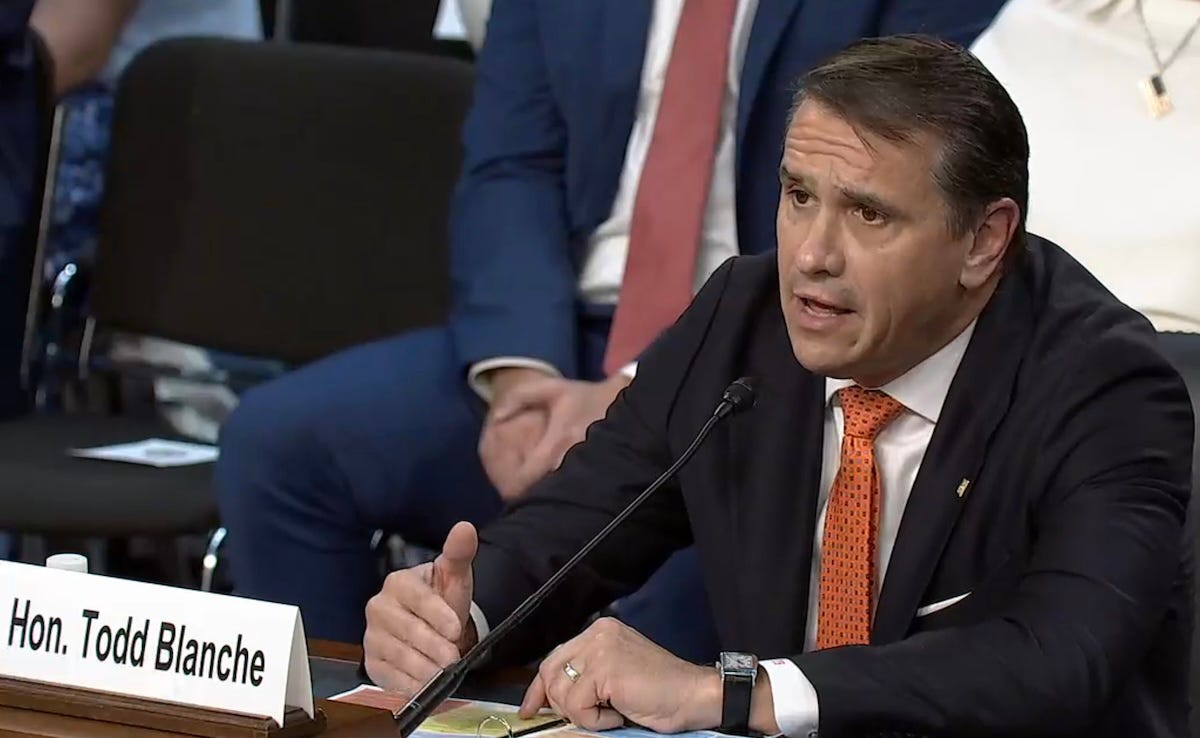
Last Wednesday, Acting Attorney General Todd Blanche, 51, appeared before the Senate Judiciary Committee for his confirmation hearings to serve as U.S. Attorney General. There weren’t many surprises: the Democrats harshly criticized Blanche and Donald Trump—whom Blanche represented as a criminal defense attorney before Trump’s return to the White House, and whose bidding he has done during his time at the Department of Justice (e.g., by authorizing the prosecutions of Trump’s political enemies)—while Republicans gave Blanche a warmer reception. For collected coverage, see Howard Bashman’s How Appealing.
But it wasn’t a total cakewalk for Blanche with the Republican senators—who must unanimously support his nomination in order for it to get out of committee, given the unified Democratic opposition. Senator John Kennedy (R-La.) pressed Blanche on the closeness of his relationship with Trump, asking the nominee whether he considered the president to be his friend. This led to what Professor Barbara McQuade described as “[p]erhaps the most revealing moment” of the hearing, in which Blanche responded, “I’m his lawyer”—oops—before immediately correcting himself and saying, “[I] was his lawyer.”
Senators John Cornyn (R-Tex.) and Thom Tillis (R-N.C.), who haven’t committed to vote for Blanche, asked tough questions about the $1.8 billion “Anti-Weaponization Fund,” Trump’s mass clemency for January 6 participants, and the Justice Department’s handling of the Jeffrey Epstein files. Tillis asked Blanche to meet with Epstein victims, which Blanche had declined to do up to that point—and the next day, Blanche met with Epstein victims for about an hour.
I suspect that on one level, Senators Cornyn and Tillis, who have had rocky relationships with Trump over the years, would love to “stick it to him” and torpedo the Blanche nomination. But in the end, I’m guessing they’ll vote for him (and Tillis is already telegraphing that, describing himself as leaning yes).
Why? Here’s the case for confirming Blanche, as made by former attorney general Bill Barr and former Senate Judiciary Committee lawyer Michael Fragoso: (1) Blanche is smart, competent, and experienced (not always the case with Trump nominees); (2) he’s doing the best that can be reasonably expected, given Trump’s view of the DOJ; (3) there’s no guarantee that any future AG nominee would be better than Blanche; and (4) as acting AG, Blanche can discharge the duties of AG pretty much indefinitely, so there’s not much practical point to voting against him. And so, in the words of the Wall Street Journal editorial board (gift link), Blanche is simply “a lawyer doing his best to deal with an impossible client”—and “a permanent Attorney General might have more stature to reject the wild ideas that are sure to come.” [UPDATE (7/20/2026, 3:48 p.m.): For the case against confirming Blanche, see Bill Dyer’s post in the comments.]
Other lawyers in the news:
-
Former SEC chair and current U.S. Attorney Jay Clayton (S.D.N.Y.), nominated to serve as Director of National Intelligence, had a similarly contentious confirmation hearing on Wednesday. But I’m guessing that he will be confirmed in the end as well, since one could do a lot worse. (The acting DNI is Bill Pulte, director of the Federal Housing Finance Agency, whom the Associated Press described as “a housing official with no known intelligence experience… who used his previous administration perch to target perceived adversaries of the president.”)
-
There continues to be upheaval among the ranks of U.S. attorneys. In the Eastern District of Virginia (Alexandria), the Trump administration named Theo Stamos, a longtime state and local prosecutor, as first assistant U.S. attorney—and the acting U.S. attorney, in the absence of a permanent U.S. attorney (whether Senate-confirmed or judicially picked). In the Western District of Washington (Seattle), the judges of that district selected former federal prosecutor Roger Rogoff as U.S. attorney—and Trump immediately fired him.
-
Kathryn Ruemmler, former general counsel and chief legal officer of Goldman Sachs, testified at a closed-door hearing of the House Oversight Committee about her six years of interactions with the late Jeffrey Epstein—and described him as “a masterful liar.”
-
If you were a reader of Gawker and/or Above the Law in the 2006-2008 period, you’ll want to click on this article from Town & Country (and if you weren’t… sorry, you just had to be there): “Julia Allison and Noah Feldman’s Wedding Brought Together Burning Man and Harvard.”
In memoriam:
-
Johnny Brown—a longtime attorney for Miami-Dade County Public Schools, and the father of Justice Ketanji Brown Jackson—passed away at 80.
-
Trial lawyer Arthur Shartsis, cofounder of the San Francisco-based law firm Shartsis Friese, passed away at 80.
May they rest in peace.
Judge of the Week: Justice Todd Eddins.
Meet Justice Todd Eddins, 62, of the Hawaii Supreme Court. Before joining the Aloha State’s five-member high court in 2020, he served as a trial judge for three years. Prior to taking the bench, he worked as a public defender and criminal defense lawyer in private practice, handling 125 jury trials and winning several notable acquittals.
As you might expect of a former public defender, Eddins is liberal—and not a fan of the conservative U.S. Supreme Court. In State of Hawaiʻi v. Wilson (2024), he wrote an opinion rejecting defendant Christopher Wilson’s constitutional challenge to his firearms prosecution—and laced into the high court’s Second Amendment jurisprudence, arguing that it “disables the states’ responsibility to protect public safety, reduce gun violence, and safeguard peaceful public movement.” In his view, “a federally mandated lifestyle that lets citizens walk around with deadly weapons during day-to-day activities” can’t be reconciled with Hawaii’s “spirit of Aloha.”
Eddins’s condemnation of the Court, especially his invocation of the “spirit of Aloha,” generated some criticism—from Sarah Isgur and David French of Advisory Opinions, Professor Jonathan Turley, and three SCOTUS justices. After losing before the Hawaii Supreme Court, Christopher Wilson asked the U.S. Supreme Court to step in—and although SCOTUS denied certiorari, Justices Clarence Thomas, Samuel Alito, and Neil Gorsuch issued statements respecting the cert denial that threw plenty of shade on Justice Eddins and his colleagues (while explaining that, for various procedural reasons, the Court shouldn’t get involved at this early stage of the proceedings).
It turns out that Wilson was just a warm-up act. In Granillo v. State of Hawaiʻi, Justice Eddins wrote an opinion granting a new trial to a defendant who had been convicted of kidnapping and sexual assault based on scientifically discredited forensic evidence—and Eddins devoted around nine pages of his 91-page opinion to attacking recent rulings of the U.S. Supreme Court.
Justice Eddins wrote a majority opinion for three justices, while Justice Lisa Ginoza wrote a concurrence in the judgment—in which she agreed a new trial was required, but based on different reasoning that cited certain federal cases. This led Eddins to assert that Ginoza was relying on the U.S. Supreme Court’s understanding of due process (a claim she denied, for the record). And so to delegitimize her position, Eddins sought to delegitimize SCOTUS:
We interpret the Hawaiʻi Constitution on its own terms. The United States Supreme Court’s construction of the federal Due Process Clause does not define the protections of our state’s due process clause. This court “reason[s] independently, untethered from the Supreme Court’s analysis of the United States Constitution.” State v. Wilson, 154 Hawaiʻi 8, 14 (2024).
The Court that now defines federal due process does not honor the work of 1954 [when Brown v. Board of Education was decided]. It revives the work of 1857 [when Dred Scott v. Sandford was decided]. The work of 1896 [when Plessy v. Ferguson was decided]. The Constitution must be interpreted “according to its true intent and meaning when it was adopted.” Dred Scott v. Sandford, 60 U.S. 393, 405 (1857).
And he goes on—for another eight or so pages. As Justice Ginoza drolly noted in a footnote, “Although it is apparent, it is also worth noting that the majority voices disdain for recent United States Supreme Court rulings on issues that are not pertinent to this case.”
Not surprisingly, Justice Eddins’s opinion in Granillo generated blowback. Fox News collected comments from conservative commentators like Iowa Solicitor General Eric Wessan, who called it “an unhinged attack on the legitimacy of the Supreme Court,” and Jonathan Turley, who opined that it was “devoid of judicial restraint and decorum.” In National Review, Carrie Severino described it as “a nine-page broadside against the U.S. Supreme Court” that was “ugly” in tone—as well as “littered with negative parallelisms, a common hallmark of AI-generated text.”
But Justice Eddins had his defenders. In a story for Slate titled “One Judge Has the Guts to Put the Horror of This Supreme Court Term in Context,” Mark Joseph Stern praised the Granillo opinion as a “well-timed excoriation” of a Supreme Court that “has veered so far off track that even the harshest language can feel inadequate to capture the damage wrought by its most recent Term.” According to Stern, “It is a shame that so few are brave enough to speak candidly about the constitutional wreckage left by the Republican-appointed supermajority.”
What do you think? Read (or skim) the relevant section of the opinion (pp. 72-80), then take my reader poll:
In other news about judges and the judiciary:
-
By issuing such a vociferous attack against the U.S. Supreme Court, which has the power to review decisions of the Hawaii Supreme Court, Justice Eddins was arguably asking to get benchslapped. Judge Lawrence VanDyke (9th Cir.) also requested some benchslaps—for his colleagues. Dissenting from the denial of rehearing en banc in Knife Rights, Inc. v. Bonta, in which the Ninth Circuit turned away a Second Amendment challenge to California’s switchblade regulations, LVD condemned his colleagues’ treatment of that amendment as “a second-class right”—then argued that to address the problem, “The Supreme Court should consider summarily reversing some of our wayward Second Amendment decisions. To put it more colloquially, it’s time for some benchslaps.”
-
In their recent congressional testimony about the Supreme Court budget, Justices Elena Kagan and Amy Coney Barrett were asked about a proposal to transfer responsibility for the upkeep of certain federal courthouses from the General Services Administration, which is part of the executive branch, to the judiciary itself. They understandably declined to opine on the issue, which was outside the scope of their testimony. But I’m not so judicious, so I will offer my two cents: GSA should transfer control of all federal courthouses to the judiciary, and the judiciary should receive the funding it needs to bring crumbling courthouses up to code. First, it makes sense as a matter of separation of powers, as underscored by the controversy over Trump’s Biglaw executive orders (which could have been read as barring lawyers from the targeted firms from entering federal courthouses—property controlled by the executive branch, even though they’re where the judicial branch does its work). Second, GSA has been doing a terrible job as the federal judiciary’s landlord, at least based on the reporting of Mattathias Schwartz for The New York Times (gift link).
In nominations news:
-
Last week, the Senate confirmed three judicial nominees: Sullivan & Cromwell partner Matthew Schwartz (2d Cir.), Florida Fourth District Court of Appeals Judge Jeffrey Kuntz (S.D. Fla.), and executive assistant U.S. attorney Arthur “Rob” Jones (S.D. Tex.). Schwartz represented Trump in two appeals, while Kuntz ruled in Trump’s favor on a jurisdictional issue in Trump’s lawsuit against the Pulitzer Prize Board.
-
The Senate Judiciary Committee voted five nominees out of committee, sending their nominations to the Senate floor. Two of the nominees, assistant U.S. attorney Michael Martin (E.D. Mich.) and Faegre Drinker partner Antonio Pozos (E.D. Pa.), received support from some of the Democrats on the Committee.
-
My fellow judiciary junkies might be interested in Judicial Finder. It’s a free, nonpartisan resource covering more than 20,000 judges, federal and state—including appointment histories, senator-by-senator roll calls for every recorded confirmation since 1989, and each seat’s succession chain, running back to 1789.
Job of the Week: an opportunity for a products-liability litigator in Atlanta.
Lateral Link is partnering with an Am Law 100 firm that is expanding its class-action and products-liability practice in Atlanta, seeking litigators with 3-5 years of experience. The ideal candidate will have significant complex litigation experience from a large law firm or reputable litigation boutique and strong analytical, research, writing, and oral advocacy skills. Prior class-action or products-liability/mass-tort litigation experience preferred. The firm welcomes interest from attorneys already in Atlanta as well as those looking to relocate to the area. To be considered, please send your résumé and law school transcript to Marion Wilson at mwilson@laterallink.com.