
This week’s Judicial Notice is sponsored by

BriefCatch is trusted by over 22,000 legal professionals, 50 Am Law 200 firms, and 70+ courts. Built directly into Microsoft Word, it delivers real-time insights to help you write with precision, clarity, and confidence. And with RealityCheck, BriefCatch now verifies that citations are accurate and authorities are used correctly. To learn more, schedule a meeting with an expert—or try it out for free with BriefCatch Express.
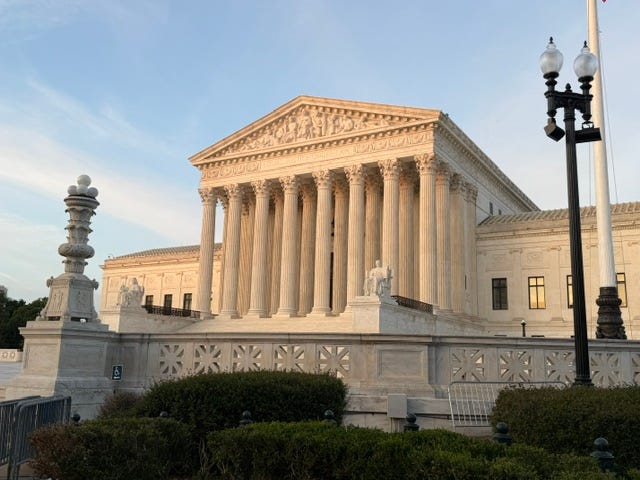
Zach and I spent last week as most legal journalists did: waiting for the U.S. Supreme Court to close out the home stretch of October Term 2025. The justices handed down big rulings last Tuesday and Thursday (discussed below), but we’re still missing some blockbusters—including Trump v. Barbara, the birthright citizenship case. So please join us at SCOTUSblog for live blogging of the remaining decisions, starting at 9:30 a.m. on Monday (and on at least one other—not yet announced—day after that).
Shortly after the Court released its Thursday rulings, I joined Josh Barro on one of my favorite podcasts, Serious Trouble. We discussed one of the SCOTUS decisions from that day, Monsanto Co. v. Durnell—but spent much of the episode talking about Biglaw in the age of Donald Trump. Thanks to Josh for inviting me on the show.
Now, on to the news.
Lawyer of the Week: Konstantinos Ligris.
In the age of social media, nominees to top government posts routinely field questions about ill-advised statements they previously made online. Most of the time, they do a combination of explaining and apologizing, and they get confirmed in the end. But sometimes the social-media postings are bad enough to derail a nomination. Will that be the case for Konstantinos “Kosta” Ligris?
I’m not quite sure why Ligris, a tech entrepreneur and former real-estate lawyer with no apparent law enforcement experience, is qualified to serve as assistant attorney general for the Office of Justice Programs—a DOJ component charged with supporting state and local law enforcement. And given OJP’s mission, it can’t help that Ligris once tweeted that the “typical cop” is “dumb as dirt.”
Alas, this tweet isn’t an outlier. As reported by Courthouse News, The National Law Journal, and The Daily Beast, Ligris appears to have made numerous problematic postings on social media—hundreds of which he has deleted, but not before they were preserved for posterity. And many of Ligris’s posts insulted members of the Senate, which will decide the fate of his nomination:
-
He referred to Senator Alex Padilla (D-Ca.)—a member of the Judiciary Committee, which must sign off on Ligris’s nomination before it can go to a floor vote—as a “thug.”
-
He called Senator Amy Klobuchar (D-Minn.), another member of the Judiciary Committee, a “top-rated propaganda peddler” and “partisan hack.”
-
In the spirit of bipartisanship, he attacked Republican Senators as well, declaring Senator Susan Collins (R-Me.) a “fraud” and opining that Senator Lisa Murkowski (R-Alaska) “sounds almost as dumb as Kamala [Harris].”
When Ligris was questioned about the posts at his confirmation hearing by Senator Dick Durbin (D-Ill.), in a painful colloquy that you can watch in this clip (via Aaron Rupar’s X feed), the nominee declared himself “not familiar with some of the contexts or retweets,” but said he’d be “happy to take a look at them.” It will be interesting to see what he has to say for himself after he does.
Will Ligris win confirmation? On the one hand, his qualifications appear weak—he’s an aspiring assistant attorney general with scant experience as an attorney—and his social-media history is a liability. On the other hand, this administration has gotten controversial nominees confirmed to far more important posts, so I wouldn’t rule it out.
Other lawyers in the news:
-
The confirmation process should unfold more smoothly for Adam Candeub, who will be nominated to serve as assistant attorney general for the DOJ Antitrust Division (per Bloomberg). Candeub is a Michigan State law professor currently serving as general counsel of the Federal Communications Commission.
-
Speaking of DOJ confirmations, former attorney general William “Bill” Barr argued in favor of confirming Todd Blanche as attorney general, in an opinion piece for The Wall Street Journal (gift link).
-
As expected, former national security adviser John Bolton pleaded guilty to unlawfully retaining sensitive national security information. His sentencing is scheduled for October 28.
In memoriam:
-
John DeBoy, a litigation partner at Covington & Burling in Washington, D.C., passed away at 51, after battling cancer.
-
Former Prince William County Commonwealth’s Attorney Paul Ebert—sometimes called “the sniper and the snipper prosecutor,” a reference to his unsuccessful prosecution of penis snipper Lorena Bobbitt in 1994 and his successful prosecution of D.C. sniper John Allen Muhammad in 2003—passed away at 88, after suffering from Parkinson’s disease.
-
Clive Davis—who graduated from Harvard Law School, practiced at two law firms, and worked as an in-house lawyer at Columbia Records, before becoming a top music executive—passed away at 94.
-
Former New Jersey congressman Frank Guarini, who graduated from NYU Law School and practiced law before entering politics, passed away at 101.1
May they rest in peace.
Judge of the Week: Justice Ketanji Brown Jackson.
If he hadn’t snagged this honor last week, Justice Samuel Alito would have been the obvious pick for Judge of the Week in this edition of Judicial Notice. Of the 10 merits opinions the Court issued last week, he authored majority opinions in three: a pair of important immigration decisions, Mullin v. Doe and Mullin v. Al Otro Lado, and Wolford v. Lopez, holding a Hawaii gun law unconstitutional under the Second Amendment.
If you joined last Thursday’s SCOTUSblog live blog, you also know Justice Alito got into a bit of drama with Justice Sonia Sotomayor. After he summarized his majority opinion in Al Otro Lado, she dissented from the bench—an unusual move, signifying strong disagreement with the majority opinion. After she was done, he said—before proceeding to his next opinion, Mullin v. Doe—“There is much that I would have added to my bench statement had I known there would be a dissent read.”
Justice Alito’s retort “cause[d] heads to turn in the courtroom,” as reported by Mark Walsh, and led journalists to discuss afterward what he meant by “had I known there would be a dissent read.” The logical inference would be that Alito didn’t have much (or any) notice that Sotomayor would be giving an oral dissent. But on Friday, a spokesperson for the Court denied this: “Justice Alito was notified in advance by Justice Sotomayor’s chambers that she would be reading a dissent from the bench. It was a misunderstanding on Justice Alito’s part.”
The subject of dissents brings us to the latest Judge of the Week, Justice Ketanji Brown Jackson. Alito wrote the most majority opinions last week, while Jackson wrote the most dissents—a total of five across the 10 opinions. She wrote lead dissents in four—Monsanto Co. v. Durnell, Wolford v. Lopez, Blanche v. Lau (an immigration case involving lawful permanent residents aka green card holders), and Landor v. Louisiana Department of Corrections and Public Safety (a religious-liberty case brought by a Rastafarian whose hair was cut when he was in prison)—plus a solo dissent in Al Otro Lado (where she also joined Sotomayor’s lead dissent).
Last June, I wondered whether Justice Jackson had “wrested the gavel away from Justice Sonia Sotomayor as ‘Justice of the Resistance.’” A year later, there’s more evidence to support answering that question in the affirmative. As we saw last week, Jackson is a prolific and passionate dissenter—and as we’ve seen during her time on the Court, she’s willing to dissent even in cases where her fellow liberals join the conservatives. In the current Term, she dissented solo in two 8-1 cases, Chiles v. Salazar (Colorado’s ban on conversion therapy) and Fernandez v. United States (compassionate release for criminal defendants).
In the 10 opinions issued last week, many of them touching on “culture war” issues like immigration and guns, eight broke along 6-3 lines—Republican appointees versus Democratic appointees. For folks who contend that there’s a difference between law and politics and that the Supreme Court is (mostly) “doing law,” these latest decisions are… not helpful. As Sarah Isgur quipped on Advisory Opinions, “the end of this Term is just blowing up the thesis of my book” (the bestselling Last Branch Standing, arguing against the notion of a 6-3, politically polarized Supreme Court).
It’s worth noting, however, that not all of Justice Jackson’s dissents concern hot-button political issues. In Durnell, the case against Monsanto involving its Roundup weedkiller, she was joined in dissent by Justice Neil Gorsuch—and her arguments focused on how to properly interpret the federal law regulating insecticides, not policy considerations or abstract notions of justice. So whether or not she’s the “Justice of the Resistance,” it’s fair to say this about Justice Jackson: she’s an independent thinker, unafraid of charting her own path.
In nominations news:
-
The Senate confirmed two district-court picks, Acting U.S. Attorney John Marck (S.D. Tex.) and Ohio Chief Deputy Solicitor General Michael Hendershot (N.D. Ohio)—by votes of 52-45 and 50-44, respectively.
-
We’re probably not getting a Supreme Court vacancy anytime soon. But that hasn’t stopped SCOTUS possibilities from jockeying for position, as reported by Jacqueline Thomsen for Bloomberg Law.
Job of the Week: an opportunity for a midlevel litigation associate in Los Angeles.
Lateral Link is assisting the Los Angeles office of a premier law firm in its search for a midlevel litigation associate. The group handles sophisticated IP, entertainment, and complex commercial litigation, representing leading companies in the video game, film, television, and music industries. Associates work closely with experienced trial lawyers and receive meaningful responsibility across a diverse mix of matters. The practice is growing, driven by increasing demand and recent strategic additions to the firm’s IP platform. If interested, please email Sean Hamrin at shamrin@laterallink.com.