
When you get assigned a judge in the Central District of California, the Local Rules are only the starting point.
Then comes the real scavenger hunt.
You have to find the judge’s standing order. Read it. Figure out the chambers-copy rules. Check the motion schedule. Confirm the formatting requirements. See whether you can email the courtroom deputy. Then hope nothing changed since the last time you appeared in that courtroom.
That research project happens in every case. Usually under time pressure. And getting it wrong — wrong notice period, wrong chambers copy, wrong ex parte procedure — can mean your filing gets stricken.
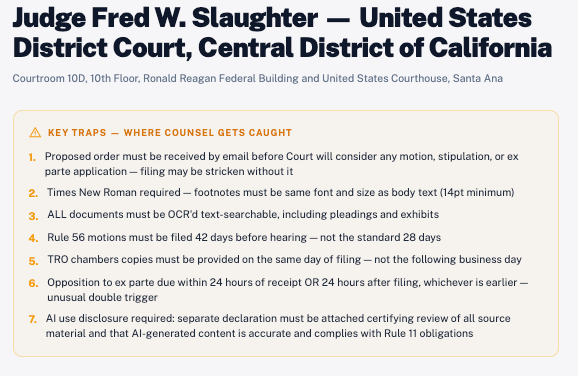
So we built a sourced profile for every CA-CD district judge.
Not a blog summary. Not “tips.” A structured reference page with each requirement linked back to the page in the judge’s own standing order.
A few examples:
-
Three CA-CD district judges now require formal AI-use disclosures. Judge Kenly Kiya Kato’s standing order specifies automatic sanctions: $500 for the first violation.
-
Judge Sunshine Sykes defaults to Zoom for civil motions. In a district that still runs heavily in person, her courtroom is the exception.
-
Judge Andre Birotte Jr. discards chambers copies if you send them. Judge Dale Fischer won’t consider an ex parte application if you don’t send chambers copies.
-
Same court. Opposite rules. Both enforceable.
None of this is hidden. The standing orders are even online.
But they are scattered across dozens of judge pages, written in different formats, and updated on different schedules.
CA-CD Magistrate Judges are next. More federal courts are coming.
The rules were always public. Finding them in one place — sourced to the page — is the part that takes a system.
Start with your judge → lawsnap.com/courts/ca-cd/