
This is the second installment of a two-part guest post by Theanne Liu Svedman, a former fellow with the Law Library of Congress. You can read part one here: A Deep Dive into Library Resources on Phillips v. Martin Marietta Corp. Pt. 1.
Outside of the Law Library’s collections, the Library’s Manuscript Division also holds materials related to this case and other Supreme Court cases, namely the collections of many U.S. Supreme Court justices. Because the Phillips opinion and concurrence are relatively short, I was interested in learning whether documents in the Manuscript Division would reveal any additional information about the justices’ rationales.
Thurgood Marshall Papers
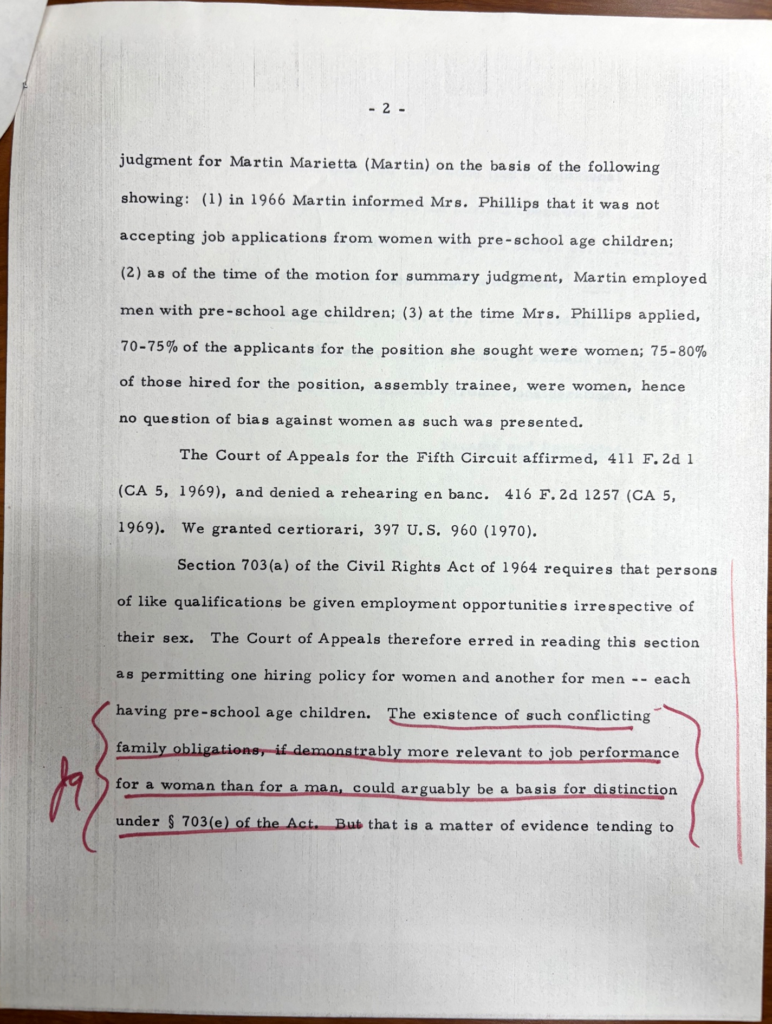
Because the Phillips decision was issued per curiam, I wanted to first review Justice Marshall’s papers to get any insight about the drafting of his concurrence. The most relevant file in Justice Marshall’s papers was located in Box 68, which contained the opinions of the October 1970 term. This file revealed that the Chief Justice drafted the Court’s opinion. In one draft opinion circulated among the justices, Justice Marshall marks up the paragraphs about the bona fide occupational qualification:
The folder also contains what appears to be a final draft of Justice Marshall’s concurrence, revised only slightly in the final U.S. Reports opinion for stylistic consistency, with changes such as “preschool” to “pre-school” in the final publication.
Another interesting record in the Marshall papers is correspondence from Justice Blackmun to Chief Justice Burger and other justices, specifically discussing the bona fide qualification occupation exception in 703(e):
The case has a somewhat peculiar posture for me. The exception which is embraced in § 703 of the Act is phrased in positive terms and provides for justified discriminatory qualification, e.g., in a proper case, sex. Yet, in a sense, what we are concerned with here is a negative, that is, a justified discriminatory disqualification, namely, motherhood for a time. I realize that qualifying one defined group has the same end result as disqualifying the oppositely defined group. Superficially, however, and at first glance, and because so much depends on the accuracy of the definitions, the two seem to exude different odors.
What this nit-picking on my part comes down to is that I feel the less we say by way of explanation, the better. . . .
Harry A. Blackmun Papers
I was intrigued by this memo from Justice Blackmun, so I wanted to research his thinking further. Justice Blackmun’s papers are also in the Manuscript Division’s collections and contain a folder for the Phillips case. Justice Blackmun’s papers include typed and handwritten notes and thoughts about the case, notes from the oral argument, per curiam opinion drafts, and his correspondence about the bona fide occupational qualification that was found in Justice Marshall’s papers.
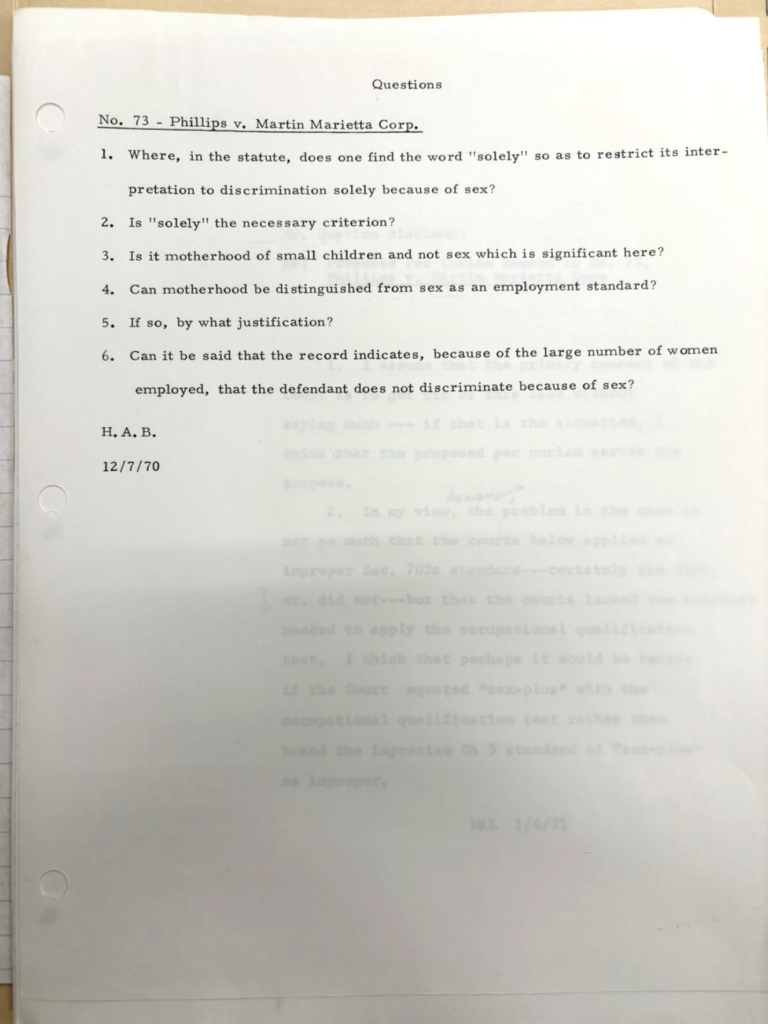
In this document, Justice Blackmun has typed out questions he had about the Phillips case, dated December 7, 1970, which was two days before oral argument on December 9, 1970. It is unclear if these are questions he intended to ask the parties during oral argument, or just questions he wanted to consider in the case for his own purposes.
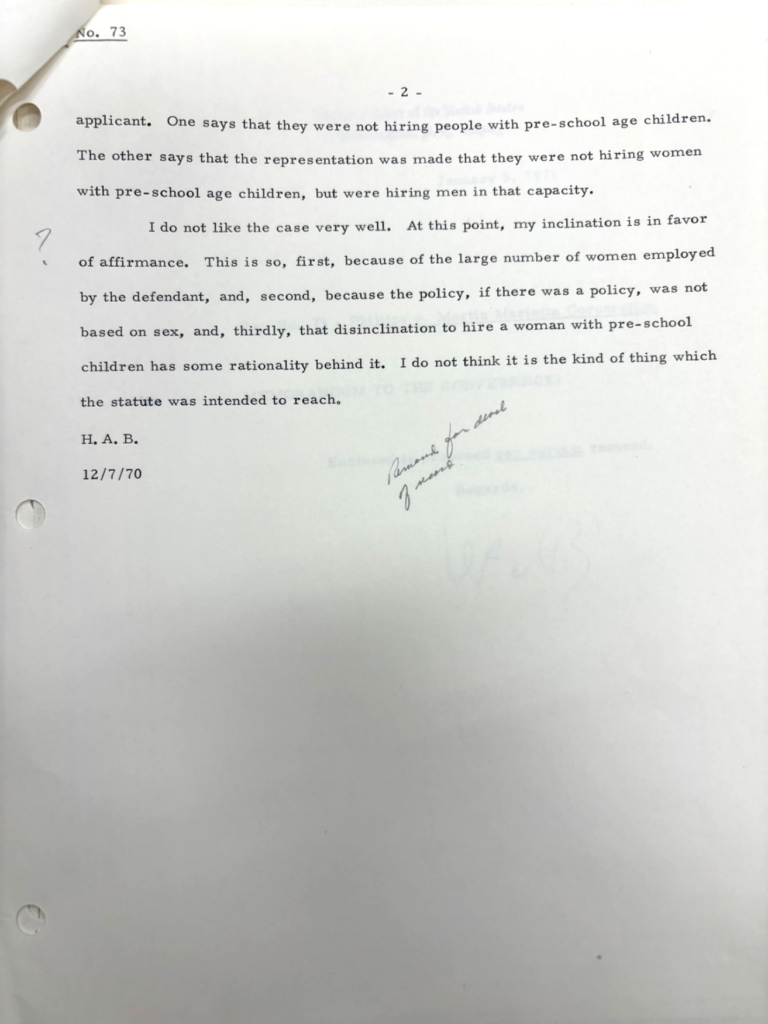
This next document is a December 7, 1970, memorandum written by Justice Blackmun discussing his thoughts on the Fifth Circuit Court of Appeals’ decision, specifically his skepticism of the “sex plus” rationale and “preference” for the case to be decided on the bona fide occupational qualification exception. He states that his inclination at this point in the case is to affirm the Fifth Circuit’s decision based on the large number of women that Martin Marietta employed, that the policy not to employ mothers of pre-school-aged children was not based on sex, and even if it was based on sex, there was some rationality behind the policy.

As Justice Blackmun later joined the per curiam opinion reversing the Fifth Circuit, we know that he ultimately changed his mind. His notes following the December 9, 1970, oral argument show that on December 11, all the justices agreed the lower court was wrong, and on December 18, the Chief Justice proposed a per curiam opinion.
My review of the papers of Justice Marshall and Blackmun in the Manuscript Division collections was incredibly interesting and provided further context on how the Court grappled with the enforcement of Title VII in its first few years and its interpretation of the text of the law and considerations of what limited exceptions should apply. It also taught me how interdisciplinary researching Supreme Court cases can be, and made me appreciate the variety of resources we have at the Library of Congress.
Subscribe to In Custodia Legis – it’s free! – to receive interesting posts drawn from the Law Library of Congress’s vast collections and our staff’s expertise in U.S., foreign, and international law.