

Hannah Kiddoo Frevert is communications director at The Missouri Bar.
For the last 85 years, Missouri’s Non-Partisan Court Plan has continued its tradition of attracting high-quality judges in the least political way, ultimately giving the people the final say.
 Commonly known as The Missouri Plan, it aims to select judges based on merit, not politics or popularity, and keep the selection process transparent and open to the public.
To better understand why the plan works and why it continues to be right for Missouri, it’s important to know why it was adopted in the first place.
Political influence before The Missouri Plan
Prior to The Missouri Plan’s adoption, Missouri judges were selected in the same fashion as those in other states, by general election.
In the 1930s, Missourians became increasingly frustrated by the excessive role of political influence and monetary leverage in judicial elections and decision-making. Judges were removed from the bench with great frequency as voters were swayed by national politics. Political machines like that of “Boss” Tom Pendergast would buy votes, packing the Supreme Court of Missouri, along with other state and local offices, with appointees of his own political persuasion.
In 1937, a bipartisan group of more than 80 people met and formed the Missouri Institute for the Administration of Justice. Their proposal? A new way to select Missouri judges, based not on popularity or influence, but on merit.
When the proposal landed on the 1940 Missouri ballot, it passed by a majority of 90,000 votes. Skeptics were quick to suggest that voters simply didn’t understand the law, and they pushed for it to return to the ballot in 1942. That time, it was retained by a majority of about 180,000 votes and was adopted into the Missouri Constitution.
This novel nonpartisan way of selecting judges quickly proved to be a success. In 1948, Supreme Court of Missouri Judge Laurance M. Hyde, a key player in the plan’s adoption, noted that the nonpartisan system “combines the best features of both the appointive and elective systems but provides safeguards lacking in either.”1
Following the plan’s adoption, the Supreme Court of Missouri got its docket on a current basis for the first time in 50 years, an achievement that Hyde credited to judges having more time to focus on the cases before them rather than spending months campaigning.
 The plan’s inner workings
Today, The Missouri Plan governs the selection and retention of all appellate court judges in the state, as well as trial judges in the City of St. Louis and Jackson, Clay, Platte, St. Louis, and Greene counties.
Significantly, The Missouri Plan has proven to be a model for the nation as more than 30 states have used it to create a similar structure for their own judicial selections.
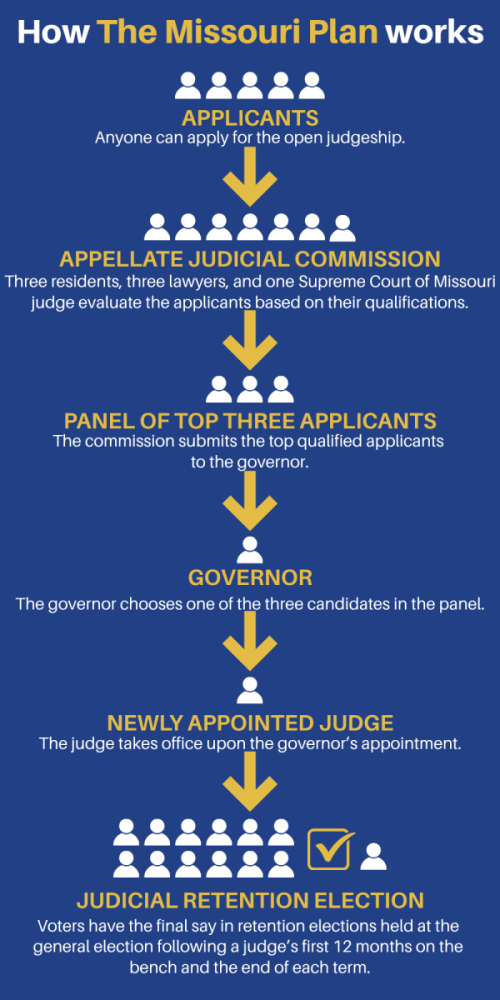
The Missouri Plan’s approach to judicial selection is especially unique in that all Missouri residents can be involved in the process. When a vacancy arises in a court that uses The Missouri Plan, eligible individuals are encouraged to apply and be interviewed by a nominating commission.
The Appellate Judicial Commission, which selects nominees to fill Supreme Court of Missouri or Missouri Court of Appeals openings, consists of a judge of the Supreme Court of Missouri, three lawyers, and three non-lawyer members. The circuit judicial commissions, which select nominees for openings on a circuit court that uses The Missouri Plan, includes the chief judge of the Court of Appeals district in which the vacancy occurs, two lawyers, and two non-lawyer members. In both types of commissions, the lawyers are elected by bar members and the non-lawyers are appointed by the governor.
Members of the public are invited to attend these interviews, where the candidates are evaluated based on the character and experience they bring to the bench, as well as their professional strengths and legal analysis skills. The commission selects the top three candidates for the open judgeship and passes along its recommendations to the governor, who appoints one of those candidates to the role.
During the general election following their first 12 months on the bench and at the end of each term, judges stand before the voters in a retention election.
Voter education efforts
Before voters are asked to decide whether a judge should or should not be retained, they are encouraged to consider the findings of Missouri’s Judicial Performance Review Committee. The committee is composed of lawyers, retired judges, and residents of Missouri.
In its first iteration, the committee surveyed Missouri lawyers, asking if they felt specific judges should or should not be retained. This information was then conveyed to voters.
To even better inform Missourians, there have been modifications to the review process in subsequent years, in line with best practices outlined by the Institute for the Advancement of the American Legal System. Today, the committee completes an anonymous evaluation of each judge up for retention, reviewing written opinions and surveys completed by lawyers and jurors who, when applicable, have worked with the judge. 
Lawyers play an essential role in the judicial reviews of judges up for retention in Missouri. In advance of each review cycle, lawyers who have practiced in front of the judge are asked to share their experiences, noting the judge’s preparedness, efficiency, professionalism, impartiality, and other factors.
Jurors, similarly, can share about their judicial interactions. At the conclusion of a trial, jurors are invited to provide feedback about a judge’s patience, ability to make the legal issues easy to understand, and equal treatment of all parties, among other considerations.
Based on all these materials, the Judicial Performance Review Committee then recommends whether a judge should or should not be retained, and its findings are publicly available through YourMissouriJudges.org.
Empowerment through civic education
Now, 85 years in, The Missouri Plan continues its tradition of attracting high-quality judges in the least political way and ultimately giving the people the final say.
As the 2026 judicial retention elections draw near, lawyers are invited to present to community groups, classrooms, local bar organizations, and other institutions to help voters better understand the role of The Missouri Plan in our appellate and metro court systems.
To help coordinate these efforts, The Missouri Bar is creating a network of lawyer-leaders embedded in their communities who are willing to help educate residents about The Missouri Plan and the judicial retention process. Lawyers interested in volunteering and presenting can complete a form at MoBar.org/lawyer-leader.
Community groups or classroom teachers interested in having a lawyer present about the judicial selection process can fill out a form at MissouriLawyersHelp.org/Request-a-speaker.
Learn more about The Missouri Plan at YourMissouriJudges.org.
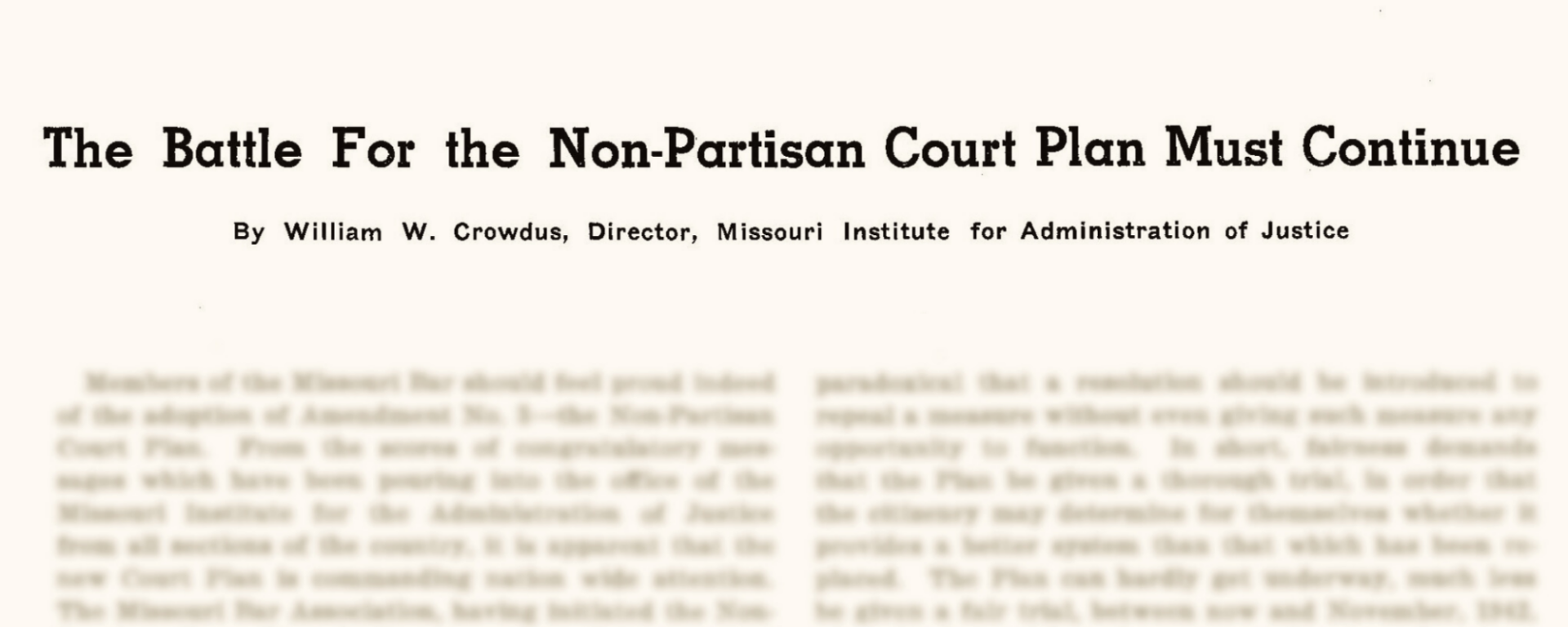
Following the adoption of Missouri’s Non-Partisan Court Plan, the Missouri Bar Journal published several pieces, such as the one above from 1940, regarding the importance of The Missouri Plan.
Endnotes
1 Laurance M. Hyde, The Missouri Plan for Selection and Tenure of Judges, 39 JOURNAL OF CRIMINAL LAW AND CRIMINOLOGY, 3 (Sept.-Oct. 1948).