
-
Former patients allege that an AI tool recorded their visits without their consent.
-
The defendant healthcare facility points to written records showing consent, but the patients say that language was just boilerplate inserted by the AI tool.
-
If your organization is using AI to record sensitive conversations, how will you prove that consent was actually obtained?

What happens when the same AI scribe that records a patient visit is also the system that documents the patient’s consent?
Former patients of a health care facility allege that they never consented to having an AI tool record their visits, but that nonetheless the AI tool said that they did.
Whether or not the allegations are ultimately proved, the case highlights a practical question for any organization using AI recording tools: is your consent record tied to an actual human workflow, or is it being generated by the same system whose conduct you may later have to defend?
The Pattern
The risk applies anywhere an AI tool listens, records, or transcribes sensitive conversations:
-
Law firms: Was the client told the meeting was being captured by an AI note-taking or transcription tool?
-
HR and workplace investigations: Did the employee or witness understand the conversation was being recorded and processed?
-
Financial and advisory settings: Was the customer informed, and does the firm’s record of consent match reality?
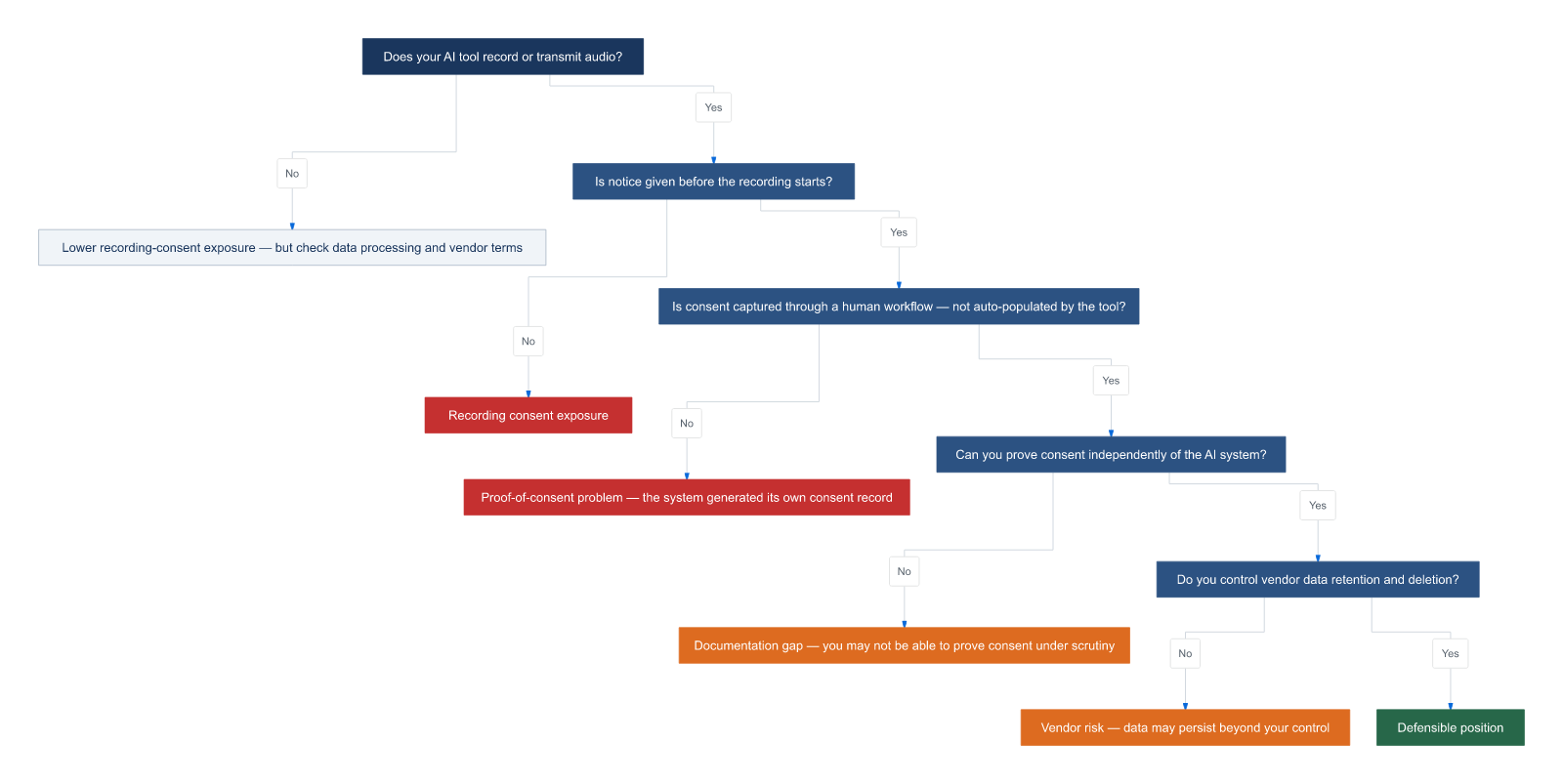
The specific legal rules vary, but the operational question is the same: what is the actual workflow for notice, consent, and record keeping? The question is not just “did you get consent?” but “can you prove it?”
That is why “auto-populated consent” is such a dangerous phrase. If your chart, note, or system says consent was obtained, someone may eventually ask you to show exactly how.
What to Ask
Before deploying any AI tool that records or transcribes conversations, ask:
-
Does the tool actually record audio, or only process speech in real time?
-
Who gives notice, when, and how is consent captured?
-
Does the record reflect a real workflow, or just default language inserted by the system?
The Point
The risk is not just unauthorized recording. It is a system that may also be drafting the record of consent you are counting on to defend the recording.
Go Deeper
Fisher Phillips has published a practical six-step compliance guide for organizations deploying AI tools that record conversations, including vendor contract provisions.
The case is Saucedo v. Sharp Healthcare, 25CU063632C (San Diego County Sup. Ct. Nov. 26, 2025). Case page (but not the complaint) available on the San Diego County Superior Court website here.
On Our Radar
-
Trump Administration releases AI legislative framework (Mar 21). The White House published a seven-pillar policy framework urging Congress to pass federal AI legislation — including preemption of state AI laws. If it gains traction, it could reshape the compliance landscape for organizations currently navigating state-by-state requirements. National Law Review
-
Colorado moves to replace its AI bias audit law before it takes effect (Mar 20). The state’s AI Policy Working Group proposed scrapping the Colorado AI Act’s governance requirements in favor of a transparency-focused framework — before the original law’s June 30 effective date. Employers who have been building compliance programs around the existing law should watch this closely. JD Supra
-
National Law Review: attorney accountability is the “missing layer” in legal AI (Mar 23). A new analysis argues that ABA Formal Opinion 512’s verification mandate is not enough — firms need structural accountability for AI-generated work product, not just individual lawyer diligence. National Law Review
-
The backlash against AI devices that are always watching (Mar 14). A WSJ report catalogues the growing privacy pushback against always-on AI hardware — including a class action against Meta alleging that workers reviewing smart glasses footage were exposed to nudity and private moments, contradicting the company’s privacy claims. As AI-powered recording moves from software into wearable devices, the consent questions raised in today’s post are about to get harder, not easier. WSJ
Trying to make sense of all this? I help law firms and companies navigate the legal side of AI implementation. Email me at adam@lawsnap.com or click here to schedule a short call.