
This week’s Judicial Notice is sponsored by

Burford Capital helps companies and law firms unlock the value of their legal assets. With a portfolio of over $7 billion and listings on the NYSE and LSE, Burford provides capital to finance high-value commercial litigation and arbitration—without adding cost or risk or giving up control. Clients include Fortune 500 companies and Am Law 100 firms, who turn to Burford to pursue strong claims, manage legal costs and accelerate recoveries. Learn more at burfordcapital.com.
I wrote much of this edition of Judicial Notice while on our flight back home from spring break in Costa Rica yesterday. We had a great time; after a few days at the beach in Guanacaste, we headed to the La Fortuna and Arenal area, where we enjoyed the hot springs, did some hiking, and saw plenty of wildlife. As usual after a vacation, our main challenge now is getting back into the work and school mindset.
We did deal with some work while away. On Tuesday, I participated in the (excellent) New York City Bar Association webinar about (insanely early) Biglaw recruiting of law students. And on Friday, Zach and I hopped online for the SCOTUSblog live blog (although it wasn’t terribly exciting—with all due respect to Justice Elena Kagan, author of the Supreme Court’s unanimous opinion in Olivier v. City of Brandon).
Now, on to the news.
Lawyer of the Week: Deborah Leslie.
In recent weeks, I’ve written about a (now former) federal prosecutor who found himself in hot water after possibly using AI to draft a court filing. The same problem might have affected a state prosecutor—and the moment went viral.
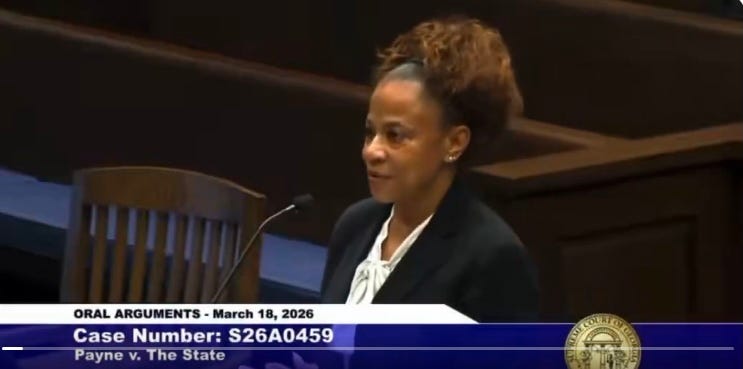
Unfortunately for Deborah Leslie of the Clayton County District Attorney’s Office, she got called out by Chief Justice Nels Peterson of the Georgia Supreme Court, for a filing that contained nonexistent cases. The exchange was caught on courtroom cameras and posted to X by Anna Bower—where it has, as of this writing, been viewed 5 million times.
The offending filing was a draft order denying a new trial that was filed by the prosecution and adopted by the trial court. At oral argument, Chief Justice Peterson pointed out to Leslie that the trial court’s order denying the defendant’s motion for a new trial, which was based on the prosecution’s proposed order, contained at least five citations to nonexistent cases, at least five citations to cases that didn’t support the proposition for which they were cited, and three nonexistent quotations.
What did Leslie have to say for herself? She acknowledged preparing a draft order, but said it was revised by the court prior to issuance—i.e., she threw the trial judge, Judge Jewel Scott, under the bus. But Chief Justice Peterson, who had clearly done his homework, immediately pointed out that “[t]hose nonexistent cases were cited in your initial brief opposing the motion for a new trial.” After rifling through her papers at the lectern, Leslie said, “I’m not aware of that, but I would be glad to research and provide the court with a supplement.”
Don’t worry about it, Ms. Leslie; Court TV did your work for you (much like an AI tool). After comparing the 37-page proposed order prepared by the state with the 33-page order ultimately issued by Judge Scott, Court TV found that the citations lined up. So Leslie can’t get out of this pickle by blaming the judge (although as Professor Carissa Byrne Hessick pointed out, Judge Scott isn’t blameless here either, since she apparently adopted the prosecution’s citations without verifying them independently).
In an age where you can use technological tools to catch hallucinated cases, AI fails are increasingly difficult to defend. But they will continue to happen, because AI assistants are not infallible. So if you make such a mistake, don’t deny or deflect; instead, acknowledge it openly and apologize (as did this Biglaw partner—and as did I, after using an embarrassing AI-generated image that I didn’t bother to review).
Other lawyers in the news:
-
If you need something from the Trump administration, your first phone call should be to Mike Davis. He claims to be “the best fixer in Washington, period”—and based on the reporting of The Wall Street Journal (gift link), he seems to have the track record to back this claim up.
-
In the wake of the many lawyers who have quit their jobs with the federal government (or have been fired), the Justice Department needs more than a few good men (and women). So the DOJ is waiving its longstanding policy requiring newly hired federal prosecutors to have at least one year of experience.
-
Speaking of lawyers leaving the Trump administration, Margaret “Meg” Ryan resigned as director of the enforcement division of the Securities and Exchange Commission (SEC). She stepped down after only six months in the position, without giving a reason; if you have info as to why, feel free to drop me a line.
In memoriam:
-
Robert S. Mueller III—who served as director of the FBI for 12 years, then later as the special counsel who investigated Russian interference in the 2016 presidential election—passed away at 81. He had a long and distinguished legal career that included, in addition to his most high-profile roles, service as a federal prosecutor in San Francisco and Washington, D.C.; leadership of the Criminal Division at the DOJ; and multiple stints in private practice at WilmerHale. I had the privilege and pleasure of meeting Bob Mueller, at a dinner in 2014, and came away impressed. (For a photo of me holding forth while Mueller listened intently—or at least pretended to—see this LinkedIn post by Bob Ambrogi.)
-
John J. Park, Jr.—who spent much of his legal career in public and government service, including with the U.S. Army JAG Corps and the Alabama Attorney General’s Office—passed away at 71.
May they rest in peace.
Judge of the Week: Chief Justice John Roberts.
Is Chief Justice John Roberts like Obi-Wan Kenobi? Does he grow more powerful the more you strike him down?
Adam Liptak—writing in The Docket, his legal newsletter for The New York Times (gift link)—highlighted a Truth Social post that Donald Trump issued about the Court last Sunday. It amounted to an extended diatribe against the justices for voting contrary to Trump’s interests in the 2020 election and again in the recent tariffs case—but in Liptak’s view, it amounted to “a gift” to the Chief and his fellow justices, since it “inadvertently made the case for the Court’s independence.”
In terms of his official title, Chief Justice Roberts is actually the chief justice not of the Supreme Court, but of the United States. As the leader of the entire federal judiciary, his job includes protecting judges from unwarranted hostility and threats—which are sadly on the rise, as five lower-court judges discussed at a virtual event.
During a Tuesday event at Rice University, Judge Lee Rosenthal (S.D. Tex.) asked Chief Justice Roberts how he deals with criticism. After noting that it comes with the job if you’re a judge, he added that sometimes “the criticism can move from the focus on legal analysis to personalities.” Such “personally directed hostility,” according to the Chief, “is dangerous—and it’s got to stop.” Chief Justice Roberts’s remarks generated extensive media coverage, collected at How Appealing by Howard Bashman (along with video—the key discussion begins around the 23-minute mark).
The Supreme Court has received criticism for not being sufficiently supportive of lower-court judges, especially when they rule against the Trump administration. So I think the Chief’s remarks—which didn’t call out Trump by name, but clearly implicate him and his supporters—are noteworthy. As Judge Rosenthal put it, “On behalf of trial judges everywhere, I want to personally thank you because while we know that you may not always agree with us, we always know that you have our backs, and that means a great deal. So, thank you—and I hope it continues.”
In other news about judges and the judiciary:
-
Sorry, he’s not sorry: in a speech delivered after his controversial “swinging dicks” dissent, Judge Lawrence VanDyke argued that his Ninth Circuit colleagues are the ones who should apologize, for “routinely impos[ing] their personal policy preferences on the law.” He then offered them a deal: “You stop breaking the norm of how our system was designed to work, and I’ll stop breaking those norms that promote collegiality and the perception of legitimacy.” For anyone who isn’t tired of this story—i.e., can’t get enough “dick,” à la Blanche Devereaux of The Golden Girls—check out Sarah Isgur and David French’s discussion on Advisory Opinions. (And for anyone who skimmed my story about that dissent too quickly, please note that this sentence was a joke: “Not to be outdone, Judge James Ho subsequently issued a Fifth Circuit opinion that opened as follows: ‘This is a case about huge, throbbing cocks.’”)
-
Judge Zahid Quraishi (D.N.J.) is quite upset over the leadership structure at my former workplace, the U.S. Attorney’s Office in New Jersey, currently being run by a “triumvirate” after the departure of Alina Habba—and he took it out on two assistant U.S. attorneys, Daniel Rosenblum and Mark Coyne, who appeared before him for a sentencing. After reading the transcript, my own view is that Judge Quraishi was unnecessarily harsh toward the two AUSAs, who didn’t come up with this (admittedly bizarre) scheme but are stuck defending it. (Disclosure: I’m not unbiased, since Mark Coyne is a friend and former colleague of mine.)
In nominations news, the Senate confirmed Anna St. John to serve as a judge on the U.S. District Court for the Eastern District of Louisiana, by a vote of 51-45. St. John currently serves as president and general counsel of the Hamilton Lincoln Law Institute, a nonprofit public-interest firm (mentioned in last week’s Judicial Notice for filing a proposed class action on behalf of a putative class of drivers who got stuck for hours in a massive traffic jam caused by a pro-Palestinian protest).
In memoriam: Judge E. Grady Jolly, who served on the Fifth Circuit for more than 40 years, passed away at 88. For personal reflections on Judge Jolly from a former clerk, see Ilya Shapiro’s tribute over at City Journal.
Job of the Week: an opportunity for an appellate litigator in Houston.
Lateral Link is working exclusively with the leader of a Chambers-ranked appellate group in Houston seeking a strong associate to join its team. This is a rare opportunity to join a highly respected, close-knit practice where associates take on meaningful responsibility early and work directly with partners on complex, high-level matters. The group is known for its collegial, mentorship-driven culture, offering a clear path to partnership. They seek an associate with two to seven years of experience, a federal trial- or appellate-court clerkship, outstanding academic credentials, and excellent research and writing skills. If you’re interested—or even just curious—please contact Wendy Boone at wendyboone@laterallink.com.