
Welcome to Original Jurisdiction, the latest legal publication by me, David Lat. You can learn more about Original Jurisdiction by reading its About page, and you can email me at davidlat@substack.com. This is a reader-supported publication; you can subscribe by clicking here.
As we get deeper into the academic year, it was only a matter of time before a free-speech controversy would erupt in legal academia. So maybe we shouldn’t be entirely surprised by what reportedly went down at NYU Law School. Here’s a succinct summary, from a tweet by the Foundation for Individual Rights and Expression (FIRE):
Doing the work for the would-be censors without even needing them to show up, NYU Law School’s reported decision to cancel the Federalist Society’s event with conservative legal scholar Ilya Shapiro is a textbook heckler’s veto.
After initially approving the request to host Shapiro on October 7, administrators allegedly moved the goalposts. They first asked that the event be relocated because they “anticipate an increased likelihood of demonstrations and protests connected to the anniversary of the October 7, 2023, incidents in Gaza.”
For the record, I’m not a fan of this administrator’s reference to “the October 7, 2023, incidents in Gaza.” First, I don’t think “incident” is the best word for referring to a terrorist attack in which 1,200 people were killed. Second, most of what transpired on October 7 took place in Israel (although yes, the Hamas soldiers retreated into Gaza after attacking Israel, some 250 hostages in tow).
Back to FIRE:
Then, after FedSoc agreed to the change, NYU canceled it outright. While NYU now describes this as a “rescheduling,” the reality is clear: by preemptively canceling a student-sponsored lecture due to expected opposition, NYU allows the threat of disruption to override students’ and speakers’ rights to listen and be heard. By also approving other events scheduled for the same time, NYU sends the message that only some views can be heard on campus. Universities cannot selectively disfavor one speaker while approving other major events on the same day.
NYU must reaffirm its commitment to free expression by ensuring that all student groups, regardless of viewpoint, can peacefully host events with invited speakers without facing censorship disguised as logistics.
I reached out to NYU Law School, which provided the following statement:
We did not cancel an appearance by Mr. Shapiro. When the students organizing the event requested a classroom on Oct. 7, they were informed that we could not accommodate them on that date, and we subsequently suggested alternative dates. Mr. Shapiro is welcome to come speak here at NYU Law and has appeared here in the past. We remain willing to work with students to find a time for him to do so in the future.
For a detailed account of what transpired, see this Washington Free Beacon article by Aaron Sibarium, who broke the story. His reporting—including documentary evidence, such as emails from NYU Law administrators and a screenshot from NYU’s event management system—suggests the following:
-
The NYU Federalist Society was initially allowed to schedule the event (or at least allowed to enter it into the law school’s event-management system).
-
An administrator emailed FedSoc, asking if the event could be rescheduled—and her email cited “security reasons,” “an increased likelihood of demonstrations and protests connected to the anniversary of the October 7, 2023, incidents,” and the possibility of “disruptions in the event of a protest or demonstration.”
-
After multiple email exchanges with the administration and a meeting with Dean Troy McKenzie, FedSoc ultimately was not allowed to proceed with the event.
So whether or not the event was technically “cancel[ed]” strikes me as a distinction without a difference. And Sibarium argues that there’s a certain irony in all this, in light of the substance of the event that was canceled not allowed to proceed:
NYU’s Federalist Society chapter had invited the conservative legal scholar Ilya Shapiro to discuss his new book Lawless: The Miseducation of American Elites. Shapiro, who is Jewish, has criticized anti-Israel protesters and taken schools to task over their handling of encampments. He has also been the target of multiple campus protests, including one at UC Hastings, where he was shouted down for nearly an hour straight….
Lawless argues that “institutional weakness” has created a climate of illiberalism at law schools, with spineless administrators courting radicalism and refusing to expel students who disrupt events. The irony was not lost on Shapiro, the director of constitutional studies at the Manhattan Institute, who said the decision to cancel his talk vindicates the thesis of his book.
“There could not be a more on-the-nose example of weak university officials in the face of a heckler’s veto than this farce,” Shapiro told the Free Beacon. “I’d be happy to give NYU’s dean a copy of my book so he can ‘do the work’ of learning how to be an effective and principled leader.”
For more about Lawless and Shapiro, check out my podcast interview of him.
Making the proverbial lemonade out of lemons, the Federalist Society and the Manhattan Institute (where Shapiro is a fellow) are getting a teaching moment out of this incident (and yes, this qualifies as an “incident”). From a tweet by Shapiro:
UPDATE: @FedSoc and @ManhattanInst are instead hosting an event near NYU campus on free speech/antisemitism, featuring judges Roy Altman (SDFL) and Lisa Branch (11th Circuit) alongside Nadine Strossen and me. Bookmark to watch the livestream Tues 1pm ET:
https://fedsoc.org/commentary/fedsoc-blog/campus-free-speech-after-october-7
If the original event with Shapiro had proceeded as planned, at NYU Law on October 7, would it have turned into a debacle? I actually don’t think so—and here’s why.
Burford Capital helps companies and law firms unlock the value of their legal assets. With a portfolio of over $7 billion and listings on the NYSE and LSE, Burford provides capital to finance high-value commercial litigation and arbitration—without adding cost or risk or giving up control. Clients include Fortune 500 companies and Am Law 100 firms, who turn to Burford to pursue strong claims, manage legal costs, and accelerate recoveries. Learn more at burfordcapital.com.
I speak at a lot of law schools—it’s only October, and I’ve already been to Columbia (twice), Duke, Fordham, and Penn State Dickinson—and I usually have a meal or drinks with students, before or after my talk. I frequently ask them about the speech climate on their campuses. Based on my own, disruption-free visits—look ma, no protests!—as well as my chats with students, the sense I have is that we’re actually in a better place than we were a few years ago. While tensions are high at some schools, there seems to be less enthusiasm nowadays for disruptive protests like shoutdowns.
And even if NYU Law administrators reasonably assessed that students were likely to protest an event with Ilya Shapiro, I still don’t think hosting him would have been particularly difficult to manage:
-
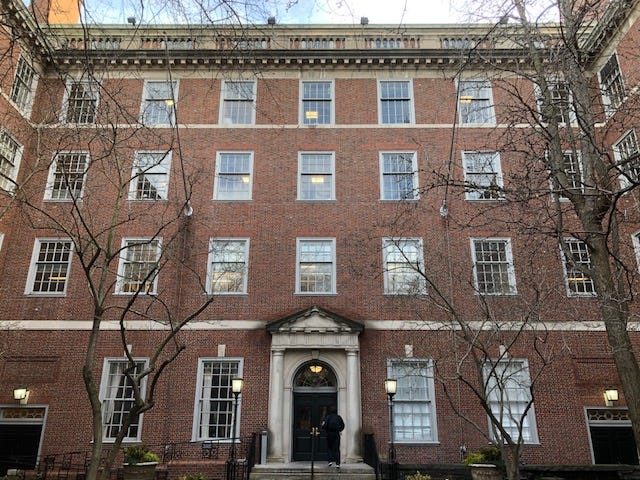
The event could have been held in an indoor space that lends itself to regulated access—such as Lipton Hall, in the basement of D’Agostino Hall (as one of the NYU Law administrators helpfully suggested to FedSoc).
-
The talk could have been limited to the NYU Law community, with identification required at the door. Yale Law School required IDs for the return visit of conservative litigator Kristen Waggoner of the Alliance Defending Freedom, in January 2023—and that event went smoothly, unlike her March 2022 event.
-
A law school faculty member or administrator could have opened the proceedings by reminding everyone of NYU Law’s free-speech policy—and by emphasizing that anyone violating that policy would be disciplined (with such discipline appearing on the student’s permanent record, shared with future employers and state bars).
-
Identifying violators could be facilitated by requiring identification, writing down the names of attendees, and recording video footage of the event (including any disruptions). It’s not uncommon for law-school events to be recorded—see, e.g., my 2016 appearance at NYU Law, with then-S.D.N.Y. Judge Alison Nathan (now on the Second Circuit) and Professor Barry Friedman.
So if I had to guess, I believe that the originally planned event with Shapiro would have turned out fine. Perhaps there might have been a walkout at the start—a common form of protest these days, and not one I have a huge problem with (because it allows the event to proceed, albeit after a brief interruption). Perhaps there might have been protesters quietly holding up signs during his remarks—but as long as the signs don’t obstruct anyone’s view, I’m fine with that type of protest too.
But again, I don’t think Shapiro would have been shouted down, as he (infamously) was at UC Hastings (now UC Law San Francisco) back in March 2022. And that arguably makes the situation more unfortunate: as FIRE put it, NYU Law wound up “[d]oing the work for the would-be censors without even needing them to show up.”
To be fair—and as I mention in Original Jurisdiction’s mission statement, I try above all to be fair—university administrators have tough jobs in 2025. And while I believe that Ilya Shapiro at NYU Law would have gone smoothly—because Ilya isn’t that incendiary as a speaker (he’s a con-law scholar), and (job-seeking) law students tend to be less crazy than wild-eyed undergraduates—I can imagine events that would raise genuine security concerns. After all, the horrific assassination of Charlie Kirk at Utah Valley University took place less than a month ago.
In situations raising very serious security issues—more like Charlie Kirk in an outdoor space, less like Ilya Shapiro in a basement—how should a university proceed? To what lengths must universities go to host extremely controversial speakers, ones whose visits might raise the possibility of violence? This isn’t an easy issue.
For a thoughtful and nuanced exploration, check out the first episode of Advisory Opinions that Sarah Isgur and David French recorded after the Kirk assassination. They mention examples like the University of Florida having to spend $500,000 on security when Richard Spencer came to campus and UC Berkeley having to spend around $4 million for almost a month of free-speech events in 2017.
How would we feel if NYU Law had to spend a six-figure sum to host Ilya Shapiro? Should organizations like FedSoc have to cover, or at least contribute to, such security costs? At first blush, that might seem reasonable, and it’s facially neutral as a policy. But in practice, one could argue that it amounts to a “tax” of sorts on groups that want to host controversial speakers. There are genuinely difficult issues in this area—and people of good faith can disagree on how they should be handled.
For now, though, I’d like to close by quoting the title of a recent, worthwhile New York Times guest essay (gift link) by Laura Ann Rosenbury, president of Barnard College (and a law professor and dean before Barnard): “Now Is the Time for Colleges to Host Difficult Speakers.” I hope that law-school administrators, at NYU Law School and beyond, take this message to heart.
Thanks for reading Original Jurisdiction, and thanks to my paid subscribers for making this publication possible. Subscribers get (1) access to Judicial Notice, my time-saving weekly roundup of the most notable news in the legal world; (2) additional stories reserved for paid subscribers; (3) transcripts of podcast interviews; and (4) the ability to comment on posts. You can email me at davidlat@substack.com with questions or comments, and you can share this post or subscribe using the buttons below.