
“What if AI hallucinates and I don’t catch it in time?”

You’re right to be cautious—but the solution isn’t watching AI like a hawk. If you have to spend more time monitoring AI than doing the work yourself, what’s the point?
The solution: Build systems where AIs check each other, so you never have a single point of failure.
5 Layers of Protection I Built Into Our Mining Regulation Tracker
When I built this system for mining clients, I didn’t trust one AI to get it right. Here’s what happens before any information reaches an attorney:
-
Layer 1: Multiple AIs, Same Task – Three independent models each review each regulatory bulletin. If one misreads deadline (“compliance required by March 2024”), the other two don’t—and the inconsistency gets flagged immediately.
-
Layer 2: Cross-Model Verification – One AI says “effective immediately,” another says “effective January 2026.” The system stops everything, highlights the conflict, and won’t proceed until manually verified.
-
Layer 3: Structured Data Extraction – Rules get broken into fields—“Agency: MSHA,” “Deadline: Sept 30, 2025.” If AI swaps “MSHA” with “OSHA,” or confuses federal vs. state regulators, the mismatch is obvious.
-
Layer 4: Yes/No Validation – Instead of trusting vague summaries, the system asks concrete questions: “Does this mention a compliance deadline?” “Is there an official regulation number cited?” Yes/no answers limit ambiguity and force precision.
-
Layer 5: Plain English Test – Vague AI output like “entities must implement adequate safeguards” gets rejected until rewritten as “Mining operations must install water monitoring equipment by January 15, 2026.”
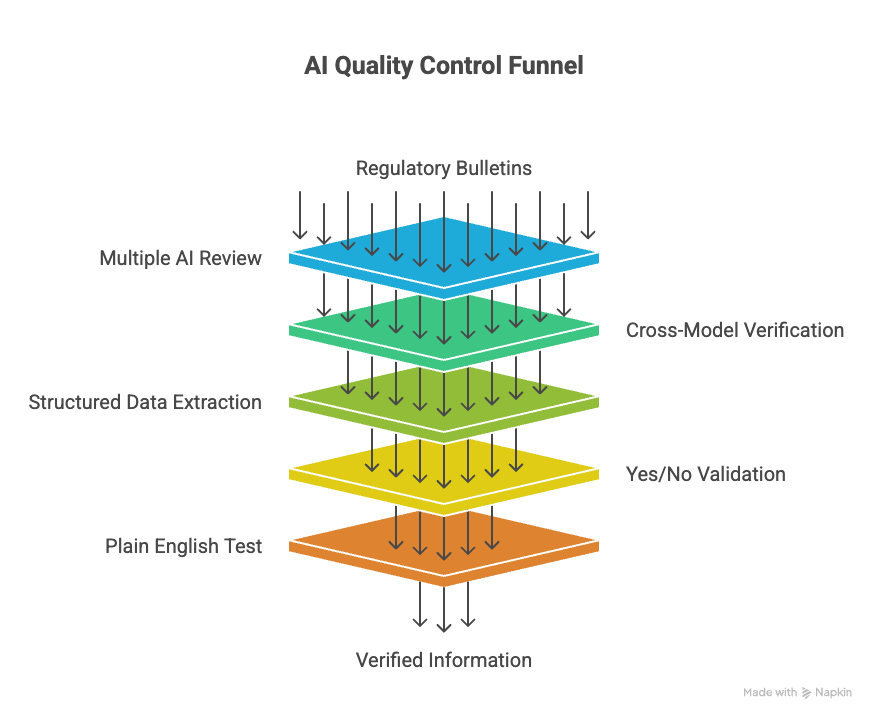
The result? By the time information reaches you, it’s survived five independent quality checks. You’re not trusting AI—you’re trusting the bulletproof system built around it.
By the time information reaches you, it has cleared multiple rounds of independent review. You’re not trusting AI—you’re trusting the quality-control system built around it.
Ready to explore AI with proper safeguards? Let’s discuss what this would look like for your practice area.
📩 Email me at adam@lawsnap.com or click here to choose a time for a free conversation.