
This week’s Judicial Notice is sponsored by

ShareFile helps you deliver a modern client experience with workflow technology that is easy to use and made to fit your firm. ShareFile’s secure digital solution simplifies workflows and improves collaboration by working with your existing technologies. To learn more about ShareFile, check out our website.
It’s the most wonderful time of the year, at least for extroverts like me (less so for introverts like my husband Zach). I’ve attended four holiday parties in the past four days, and I have another four coming up in the week ahead—including two for former workplaces of mine, Above the Law and the U.S. Attorney’s Office (D.N.J.). I look forward to seeing some of you at either or both gatherings.
Now, on to the news.
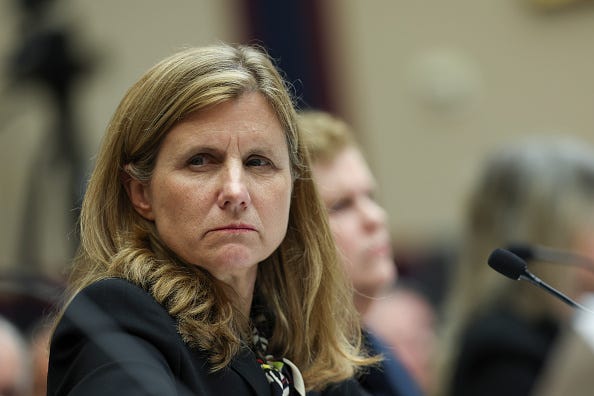
Lawyer of the Week: Liz Magill.
On Saturday, after Tuesday’s infamous congressional hearing about antisemitism on American university campuses—so disastrous it got turned into a Saturday Night Live cold open—Liz Magill announced her resignation as president of the University of Pennsylvania. Her departure doesn’t come as a shock since she was already in hot water going into the hearing, with Penn under an Education Department investigation for antisemitism and major donors pulling gifts from the university. For example, Stone Ridge Holdings, the asset-management company led by Penn alum Ross Stevens, sent a letter to Penn (via Davis Polk) threatening to yank a $100 million gift—but said it might reconsider “if, and when, there is a new University President in place.”
Magill will remain in office until an interim president is selected. She will also remain on the faculty of Penn Law, where she is a tenured professor of law.
Yes, that’s right—Magill is a lawyer, with impressive credentials. She graduated from UVA Law and clerked for a conservative legal luminary, Judge J. Harvie Wilkinson (4th Cir.), and a liberal legal luminary, the late Justice Ruth Bader Ginsburg. Before taking the helm at Penn, she served as dean of Stanford Law School. But her professorial pedigree might have been part of the problem, as she offered dry, academic answers to passionate, pointed questioning from Representative Elise Stefanik (R-N.Y.).
And her legal background might have contributed to her difficulties as well. She offered bloodless, legalistic responses to questions that did not lend themselves to nuance. While there’s a case to be made that Magill (and fellow presidents Claudine Gay of Harvard and Sally Kornbluth of MIT) were partially right on substance, David French correctly noted that their invocation of free-speech principles suffered from a hypocrisy problem. For years, their institutions have aggressively cracked down on alleged “hate speech” from the right, but now that the vitriol is coming from the left, they wrap themselves in the First Amendment. Not a great look.
There’s an important lesson here for lawyers: sometimes you need to speak not from the head, but from the heart. The law as a profession privileges intellect, but what was called for here was emotion. It’s also important to read the room—and if your approach isn’t working, recalibrate in real time. (In Magill’s defense, some of the blame may lie with the law firm that prepped her, WilmerHale—discussed infra as Law Firm of the Week.)
Judge of the Week: Justice Amy Coney Barrett.
When I interviewed her last year about one of her mentors, the late Judge Laurence Silberman, Justice Amy Coney Barrett described herself to me as “hyper-efficient.” So we shouldn’t be surprised to see Justice Barrett as author of the first signed merits opinion of the Term, for the second year in a row. (Interestingly enough, the justice she replaced, the late Justice Ruth Bader Ginsburg, was also often the author of the first opinion during her time on the Court.)
In Acheson Hotels, LLC v. Laufer, Justice Barrett wrote for seven justices in dismissing the case as moot. Plaintiff Deborah Laufer sued Acheson Hotels, just as she has sued hundreds of other hotels, alleging that the company violated the Americans with Disabilities Act (ADA) by failing to state whether it has rooms accessible to the disabled. As noted in Justice Barrett’s opinion, Laufer “has singlehandedly generated a circuit split” on whether an ADA plaintiff in her situation, who has no plans of staying at any of the defendant hotels, has standing to sue.
After the Court granted certiorari, Laufer voluntarily dismissed her case against Acheson, then argued to SCOTUS that the case was moot. Critics complained that Laufer was playing games, dismissing her case because she feared she would lose. Justice Barrett acknowledged the concern, but ultimately still dismissed:
We are sensitive to Acheson’s concern about litigants manipulating the jurisdiction of this Court. We are not convinced, however, that Laufer abandoned her case in an effort to evade our review. She voluntarily dismissed her pending ADA cases after a lower court sanctioned her lawyer. She represented to this Court that she will not file any others. Laufer’s case against Acheson is moot, and we dismiss it on that ground. We emphasize, however, that we might exercise our discretion differently in a future case.
Justices Clarence Thomas and Ketanji Brown Jackson concurred in the judgment. Justice Thomas would have dismissed for lack of standing. Justice Jackson agreed with the majority on mootness but disagreed with vacating the decision below by the First Circuit, under the so-called Munsingwear vacatur doctrine—a technical but important issue.
Congratulations to Justice Barrett on being first out the gate, with an opinion that is vintage Barrett: clear, concise, and unflashy. And don’t expect her to “evolve,” on either style or substance, during her time on the Court. As she told Judge Lisa Branch (11th Cir.) during an interesting, wide-ranging conversation at the Federalist Society’s National Convention, the justice considers herself to be a “one jalapeño gal” in her writing style—in contrast to another former boss and mentor of hers, the late Justice Antonin Scalia, who was a “five jalapeño” prose stylist in her estimation.
In nominations news, the Senate confirmed Magistrate Judge Irma Carrillo Ramirez (N.D. Tex.) to the Fifth Circuit, where she will be the court’s first Latina judge, and Judge Loren AliKhan (D.C.) to the U.S. District Court for the District of Columbia. And the nomination of former Cherokee Nation attorney general Sara Hill (N.D. Okla.) sailed out of the Senate Judiciary Committee with bipartisan support, 14-7, despite Hill stumbling over civil-procedure questions at her hearing. Why? Several GOP members deferred to fellow Republicans James Lankford and Markwayne Mullin, Hill’s home-state senators, who supported her nomination.
Ruling of the Week: United States v. Trump (gag order).
In United States v. Trump—sorry, there are a bunch of those, I’m referring to the D.C. Circuit appeal of the gag order of Judge Tanya Chutkan (D.D.C.)—the court narrowed but largely upheld the order (which it somewhat euphemistically referred to as a “speech-limiting order” rather than a “gag order”). From the 68-page opinion by Judge Patricia Millett, joined by Judges Nina Pillard and Brad Garcia:
[T]he Order is affirmed to the extent it prohibits all parties and their counsel from making or directing others to make public statements about known or reasonably foreseeable witnesses concerning their potential participation in the investigation or in this criminal proceeding. The Order is also affirmed to the extent it prohibits all parties and their counsel from making or directing others to make public statements about—(1) counsel in the case other than the Special Counsel, (2) members of the court’s staff and counsel’s staffs, or (3) the family members of any counsel or staff member—if those statements are made with the intent to materially interfere with, or to cause others to materially interfere with, counsel’s or staff’s work in this criminal case, or with the knowledge that such interference is highly likely to result.
For highlights, see this Twitter thread by Roger Parloff, who considers the opinion “legally very strong.” The big changes are that Trump can now speak about (1) special counsel Jack Smith and (2) witnesses, just not about their roles in this case.
I previously predicted that this case might go to the en banc D.C. Circuit or even the Supreme Court, but after reading Judge Millett’s well-written and persuasive opinion, I’m not so sure. Given my own free-speech extremism, I might have vacated more (perhaps all) of the order—but the panel here struck what many might view as a reasonable middle ground, giving Trump plenty of leeway to discuss the case while protecting the integrity of pending criminal proceedings. So it’s possible other D.C. Circuit judges, plus SCOTUS, might be content to leave well enough alone.
Two other circuit-court opinions worth highlighting:
-
Antonyuk v. Chiumento and Gazzola v. Hochul. In a pair of opinions, one jointly written and one per curiam, a Second Circuit panel—Judges Dennis Jacobs, Gerard Lynch, and Eunice Lee—upheld many but not all provisions of the expansive firearms-regulation law passed by New York State after the Supreme Court’s 2022 decision in New York State Rifle & Pistol Association, Inc. v. Bruen.
-
Kohn v. State Bar of California. In an opinion by Judge John Owens, the en banc Ninth Circuit “reaffirm[ed] that the State Bar enjoys Eleventh Amendment protection in federal court,” but “update[d its] arm-of-the-state jurisprudence to better reflect the Supreme Court’s most recent guidance.” Judge Patrick Bumatay concurred in part and dissented in part, agreeing on the relevant factors but disagreeing with their application here—and in a case of “strange benchfellows,” he was joined by Judge Jennifer Sung. Judge Bumatay is one of the Ninth’s leading conservatives, while I expect Judge Sung—whose nomination ran into trouble over her having signed a scathing letter opposing the SCOTUS nomination of then-Judge Brett Kavanaugh—to become a leading lefty voice on that court.
Litigation of the Week: United States v. Biden (Hunter Biden tax prosecution).
In a 56-page, nine-count indictment, the U.S. Justice Department charged presidential son Hunter Biden with engaging in a four-year scheme to avoid paying at least $1.4 million in taxes, for tax years 2016 through 2019. Filed in the Central District of California—where Biden now resides, in a $4.2 million Malibu mansion—the indictment contains damning and salacious allegations:
The Defendant spent millions of dollars on an extravagant lifestyle at the same time he chose not to pay his taxes. The Defendant spent approximately $1 million in 2016, $1.4 million in 2017, $1.8 million in 2018, and $600,000 in 2019. From January through October 15, 2020, the Defendant received more than $1.2 million in financial support that was used to pay various personal expenses but not any of his federal individual income tax liabilities for 2016-2019. Between 2016 and October 15, 2020, the Defendant spent this money on drugs, escorts and girlfriends, luxury hotels and rental properties, exotic cars, clothing, and other items of a personal nature—in short, everything but his taxes.
Yikes. And the indictment comes just as a new Wall Street Journal poll found Trump leading Biden by four percentage points, 47 percent to 43 percent, in a hypothetical two-candidate ballot—and by six percentage points, 37 percent to 31 percent, when third-party and independent candidates are added. If Trump wins the popular vote by four to six points, the Electoral College will be a landslide.
That said, and despite Republican efforts to turn Hunter Biden into a major campaign issue, I doubt the indictment will move many votes; the people most upset over Hunter are unlikely to vote for Joe Biden anyway. But the news certainly doesn’t help President Biden, and it has the potential to further dampen enthusiasm and turnout for him among Democrats, which has fallen significantly in the wake of his strong support for Israel in its current conflict with Hamas.
Other noteworthy litigations:
-
The Supreme Court heard oral arguments in two important cases, Moore v. United States, concerning “[w]hether the 16th Amendment authorizes Congress to tax unrealized sums without apportionment among the states,” and Harrington v. Purdue Pharma L.P., addressing “[w]hether the Bankruptcy Code authorizes a court to approve, as part of a plan of reorganization under Chapter 11 of the Bankruptcy Code, a release that extinguishes claims held by nondebtors against nondebtor third parties.” Based on the arguments, it sounds like Moore will be resolved on narrow grounds, and Harrington will be a closely divided decision (and not necessarily along ideological lines).
-
The Colorado Supreme Court heard oral argument in Griswold v. Anderson, one of many cases across the country seeking to disqualify Donald Trump from future office based on Section 3 of the Fourteenth Amendment. As noted in the New York Times write-up, “[t]he petitioners face an uphill battle because they must convince the court that they are correct on the four questions at issue in the case: that it was an insurrection when Trump supporters stormed the Capitol on Jan. 6, trying to stop the certification of the 2020 election; that Mr. Trump engaged in that insurrection; that Section 3 applies to the presidency; and that the courts have the authority to enforce it against a candidate whom Congress has not specifically designated.”
-
The Texas Supreme Court stayed a lower-court ruling that would allow a woman confronting health and fertility complications to obtain an emergency abortion. But it’s just an administrative stay, entered to preserve the status quo while the Texas Supreme Court considers the merits, so stay tuned.
Deal of the Week: Alaska Air’s $1.9 billion acquisition of Hawaiian Airlines.
It’s not the biggest deal announced this week, dwarfed by AbbVie’s $8.7 billion acquisition of Cerevel Therapeutics, Honeywell’s $5 billion purchase of Global Access Solutions from Carrier Global, and Roche’s $3.1 billion deal for Carmot Therapeutics. But I have a bias when picking Deals of the Week in favor of widely recognized, consumer-oriented brands, so I’m highlighting Alaska Air Group’s $1.9 billion acquisition of Hawaiian Airlines. The deal—expected to take 12 to 18 months to close, and dependent on various regulatory approvals—is being shepherded by O’Melveny & Myers for Alaska Airlines and Wilson Sonsini for Hawaiian Airlines. Aloha!
Law Firm of the Week: WilmerHale.
This could have been a great week for WilmerHale. A team of Wilmer lawyers led by the legendary Bill Lee got the Federal Circuit to vacate a $2.2 billion patent-infringement verdict against Intel, earning them runner-up honors in Ross Todd’s Litigators of the Week column. The firm was retained for a very high-profile, sensitive investigation, OpenAI’s look into the events that led to Sam Altman’s (embarrassing and quickly reversed) ouster as CEO.
Alas, these positive developments were overshadowed by Wilmer’s ill-fated preparation of two presidents of elite universities, Claudine Gay of Harvard and Elizabeth Magill of Penn, for their widely criticized testimony at a congressional hearing about antisemitism on U.S. university campuses. As noted in a Times article focused squarely on WilmerHale, the firm prepped Gay and Magill and also met with Sally Kornbluth of MIT. If you were wondering why their answers all sounded the same, this might be the reason (although Wilmer apparently used separate teams of attorneys to prep the presidents, according to the Times).
Who were the individual lawyers involved in the witness prep? WilmerHale has long been known for its crisis-management practice, thanks to stars like former deputy attorney general Jamie Gorelick and former White House Counsel lawyer Reg Brown. But Gorelick has stepped back from in-the-trenches practice in recent years, and Brown is no longer at the firm, having moved to Kirkland & Ellis in 2020.
It appears that the partners spearheading this effort were the next generation of leaders at Wilmer: Alyssa DaCunha, co-chair of the firm’s congressional investigations practice, and Felicia Ellsworth, vice chair of the litigation and controversy department. As noted by the Times, DaCunha and Ellsworth were seated in the front row at Tuesday’s hearings. Good times.
As one informed observer wondered to me, “Will Wilmer have the good grace not to send a bill?” Harvard has been a very good client over the years, paying WilmerHale many millions—including tens of millions to handle the affirmative-action case that went all the way to SCOTUS. So I’m guessing the firm will not be billing Mother Harvard, unless it wants to hear “Bye, Felicia” (Ellsworth).
In other Biglaw news, we have some leadership transitions. At Proskauer, chair Steven Ellis is stepping down in April, ahead of the end of his term, because of a health-related issue. At Boies Schiller, former federal prosecutor Matthew Schwartz will succeed the iconic David Boies as chair of the firm, in January 2024.
In other Boies Schiller news, the firm announced a pay raise, to the new Cravath scale, and year-end bonuses, which exceeded $300,000 for some associates. And in other bonus news, Cahill Gordon also announced a Cravath match on salaries, plus special bonuses of $2,500 to $40,000 on top of market-level bonuses. Despite significant partner defections this year, it looks like Cahill is still doing well enough to richly reward its associates.
Move of the Week: Jones Day hires eight Supreme Court clerks.
Once again, Jones Day recruited more outgoing Supreme Court clerks than any other firm, hiring eight (with their justices noted parenthetically): Bijan Aboutorabi (Thomas), Timothy Bradley (Barrett), John Brinkerhoff Jr. (Alito), Henry Dickman (Barrett), Emily Hall (Kavanaugh), Daniel Johnson (Barrett), Christopher Pagliarella (Alito), and David Kenneth Suska (Gorsuch). And once again, the new hires all hail from the chambers of conservative justices. As noted by Lydia Wheeler of Bloomberg Law, every Republican-appointed justice sent a clerk to Jones Day except for Chief Justice John Roberts.
As touted in the firm’s press release, Jones Day has recruited 86 Supreme Court clerks since October Term 2011. I don’t know which firm is in second place, but I’m guessing their number of clerk hires is a fraction of 86. (Speaking of clerk hiring, if you’re aware of SCOTUS clerk hires that don’t appear in my most recent roundup, please drop me a line; I’ll do a fresh hiring update if I get enough new hires.)
Job of the Week: Legal Tech Sales Director at haistack.ai (remote, nationwide).
Haistack.ai seeks a dynamic legal tech sales director, ideally with expertise in legal recruiting and existing relationships with Am Law 200 law firms. This pivotal role focuses on crafting and executing strategic sales plans, driving sales through deep legal-recruitment insights, and establishing enduring relationships in the legal sector. The ideal candidate should possess a Bachelor’s degree in a relevant field, extensive experience in sales and/or legal recruiting, and a track record of effective team leadership in a remote setting. Offering a competitive salary range of $150,000 to $300,000 plus commission and a discretionary annual bonus, this position promises a rewarding career opportunity. Additionally, haistack.ai is offering a $5,000 referral bonus for any candidate referred and hired within 90 days. To learn more and apply, please check out this LinkedIn post.
And now, if you’ll excuse me, I’m stepping away for another holiday celebration—a Hanukkah dinner with family (and latkes and doughnuts, yum). To everyone celebrating, happy Hanukkah!
Thanks for reading Original Jurisdiction, and thanks to my paid subscribers for making this publication possible. Subscribers get (1) access to Judicial Notice, my time-saving weekly roundup of the most notable news in the legal world; (2) additional stories reserved for paid subscribers; and (3) the ability to comment on posts. You can email me at davidlat@substack.com with questions or comments, and you can share this post or subscribe using the buttons below.