
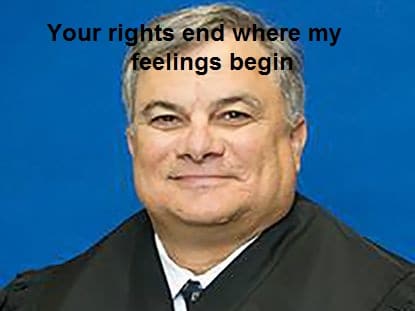
Derrick Jenkins was not pleased that his suit against the Palm Beach County Sheriff’s Department was dismissed, so he decided it was a good idea to let Circuit Judge Howard K. Coates Jr. know how he felt and sent him a kinda motion letter.
The letter ripped the judge as “incompetent” and “unfit to serve,” with expletives added for emphasis.
This barely does justice to Jenkins’ complaints, which expressed how he really felt. It’s worth a full read.
i hope everyone viewing this public document make careful desicions when selecting or electing you, i will hold you personally liable as a man and you’re not immune to jack shit.
The judge was not as pleased to receive this missive as Jenkins was to send it.
And it got Derrick Jenkins thrown in Palm Beach County Jail for 30 days as part of a six-month probation sentence. You can’t publicly curse the judge and get away with it, Jenkins found out the hard way.
But can you? Jenkins didn’t disrupt the proceedings by saying these things in a courtroom. He put them in writing and sent it to the judge. Does he not possess a right to express his views on the judge and his actions?
In a subsequent trial on the criminal contempt before another judge, Judge Coates got his chance to speak his mind.
“You have impugned my reputation in the community by calling me, and I’m not going to repeat it, but an f’ing hypocrite and unfit to serve as a judge,” Coates told Jenkins, according to a transcript. “You have accused me of being incompetent. That causes personal harm. But the harm goes beyond me. It goes to the judicial system as well.”
Jenkins retorted that the judge “should have thick skin.”
Naturally, the article turned to an academic to resolve this conundrum.
Aaron H. Caplan, a First Amendment expert and professor at Loyola Law School in Los Angeles, said Coates appeared to give the nasty letter more consideration than it deserved.
“The smart move would have been to ignore this guy because he’s not saying anything particularly important,” Caplan said. “However, it does sound like it was contempt of court.”
He explained that people can slam a judge all they want online, but not in court, or in a court filing.
Of course, what Caplan sees as the “smart move” contributes nothing of value to the issue. One would expect most judges to laugh off an angry litigant who says mean things about them in a letter, but the question is whether it constituted criminal contempt, smart or not. And Jenkins had a good point, that the judge should have had a thicker skin and not whined about his hurt feelings.
But Judge Coates did not make the “smart move.”
Coates has said that he charged Jenkins because he viewed the letter as a “calculated” attempt to force Coates off the case, had Jenkins tried to appeal his ruling.
“That’s the problem with these types of letters, when they go over the top in terms of their criticism, in my view, a contentious way,” Coates testified. He added that Jenkins, “is making personal comments that would provide a basis for me to recuse myself from any further proceedings in the case, if it were to go forward.”
Many litigants try to manufacture a basis for recusal of a judge they, for whatever reason, dislike. Judges routinely take it in stride and ignore it, thus blunting the effort. How holding Jenkins in criminal contempt helped Coates’ argument against recusal is a bit of a mystery, but for Jenkins, it mattered less than the outcome of his criminal contempt trial.
Judge Panse found Jenkins’ letter was “a clear and present danger to the orderly administration of justice,” and declared him guilty of indirect criminal contempt of court. He told Jenkins it’s a second-degree misdemeanor punishable by up to six months in jail.
Panse sentenced Jenkins to six months of probation, with a requirement to serve the first 30 days behind bars because of the “serious nature of what you did.”
On appeal, Jenkins, who now had lawyers, challenged his conviction as a violation of his First Amendment rights.
Andrew Greenlee and Greg Rosenfeld, lawyers for Jenkins, filed an appeal Oct. 30, that argues the contempt ruling “clearly violated” Jenkins’ Constitutional rights and his conviction should be overturned.
“His letter … said he could not ‘wait til voters wake up and get rid of these f—— clowns you call judges,’” the lawyers wrote, adding, “such speech is entitled to the highest protection under the First Amendment.”
Putting aside that Judge Coates is a thin-skinned whiner, and Judge Panse should be forever barred from using the phrase “clear and present danger,” was Jenkins’ motion letter to Coates an exercise of Free Speech, or was it constrained by the court’s inherent authority to maintain the “orderly administration of justice”?
Why can’t an angry litigant tell a judge he sucks?
*Tuesday Talk rules apply, and hopefully Judge Kopf will relate his “you’re a Nazi” story for context, even though he usually saves it for the night before Christmas.