

The billboard went up. It reflected the views of the owner of a North Carolina gunshop, which means it started with two strikes against it. The targets of its message reacted. The billboard came down.
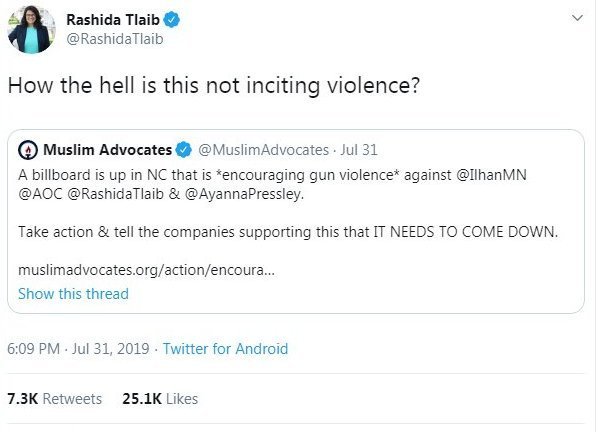
And a member of Congress, the representative of Michigan’s 13th district, conclusively proved that Trump isn’t the only person in government utterly ignorant of our Constitution.
Elie Mystal and Ken White had a “debate” about it, during which Elie was Elie and Ken point out the “low hanging fruit” argument between hugs and kisses. While it clearly wasn’t incitement under Brandenberg, to the extent there is such a thing anymore, it was similarly clear that Ken found the billboard as repugnant as Elie. Protected, but awful.
The rationale was that it’s protected speech we suffer because the Constitution requires it, and if it did not, the people most likely to suffer are the marginalized and vulnerable. In other words, we suffer Free Speech for our own sake, not because there is any inherent virtue in speech with which we disagree.
At Volokh Conspiracy, Eugene dismembers the Brandenburg “incitement” concept.
It’s true that some tiny percentage of listeners may react to such criticism by deciding to violently attack its targets, whether the targets are on the Left or on the Right. But one basic premise of free speech isn’t that we don’t treat speech as “inciting violence” (a label for constitutionally unprotected speech, see Brandenburg v. Ohio (1969)), and suppress its communication to the 99.9999% of people who don’t act violently because of it, just because of a risk that 0.0001% would act violently.
But Eugene then goes to the heart of the problem, showing a deeper appreciation of Free Speech.
And that’s so even for much harsher speech, such as calling people traitors or fascists or other such labels that some might see as morally justifying attacks. It is even more clearly true of simply calling them idiots or “Four Horsemen” (for a famous earlier Four Horsemen reference, see here). That’s true, I think, not just a matter of law but also of political ethics: There’s no basis for morally condemning such speech as supposedly “inciting violence.” (One might mildly condemn it as being nonsubstantive, but that condemnation would of course apply to a vast range of common criticism, and of common praise, of political figures from both sides.) It most certainly does not “NEED[] TO COME DOWN.”
Is there something reprehensible about calling the Squad “four horsemen” or “idiots”? Is there anything improper about someone targeting four members of Congress, who have certainly not be shy about voicing their views, with criticism? Even harsh criticism (although it’s questionable whether this is particularly harsh)?
But Eugene’s view evoked the anticipated response, that these four representative, women, of color, had received death threats, and therefore this criticism stoked the passion of those who would threaten them harm and, because it was a gunshop, seemed to offer the means with which to do so.
In an update, Eugene responded:
UPDATE: Some people seem to think that this speech becomes incitement of violence because it’s a gun store that puts it up, presumably because somehow viewers of gun store advertising are particularly likely to buy a gun and shoot a politician because she was called an “idiot” (and, obviously hyperbolically, an idiotic Horseman of the Apocalypse). No: Calling a politician an idiot, whether it’s on a gun store billboard or anywhere else, isn’t incitement of violence, whether as a legal or as a moral matter. It’s criticism, and one of the fundamental rights of free citizens.
Connecting the items sold by the store doing the criticizing doesn’t alter the legal framework at all, but what of the “moral” perspective?
Note also the implications of that sort of argument: If this sort of criticism becomes illegal or immoral when a gun store says it, surely the same must be even more so as to gun rights advocacy groups (which tend to have much more public stature than ordinary gun stores). Presumably it would be as to prominent gun rights advocates, too. And if something like “idiot” is “inciting violence” in that context, then of course most other criticisms would qualify. (Indeed, criticizing a politician as advocating bad policies would be slightly more likely to encourage violence than criticizing them for being “idiots,” not that either likelihood is substantial enough to warrant condemning the criticism.) What a convenient way for politicians and advocates to try to suppress criticism that comes from their political adversaries.
There’s no question that Tlaib’s cry of incitement is legally wrong and nonsenical, but have we reached the point where the First Amendment’s Free Speech Clause is something we suffer for the sake of its being turned against the “good people”? Is there no possibility that the billboard isn’t merely some hate speech to endure, but a legitimate political view that, for those who believe it, deserves to be seen?
*Tuesday Talk rules apply.