
When asked about the hearings to be held on H.R. 40 in the House of Representatives, Senate majority leader Mitch McConnell offered his facile response, “telling reporters he does not favor reparations ‘for something that happened 150 years ago, for whom none of us currently living are responsible.’”
Reparations. Even President Obama told Ta-Nehisi Coates that he didn’t think reparations would work.
Now, does that mean that all vestiges of past discrimination would be eliminated, that the income gap or the wealth gap or the education gap would be erased in five years or 10 years? Probably not, and so this is obviously a discussion we’ve had before when you talk about something like reparations. Theoretically, you can make, obviously, a powerful argument that centuries of slavery, Jim Crow, discrimination are the primary cause for all those gaps.
That those were wrongs done to the black community as a whole, and black families specifically, and that in order to close that gap, a society has a moral obligation to make a large, aggressive investment, even if it’s not in the form of individual reparations checks, but in the form of a Marshall Plan, in order to close those gaps. It is easy to make that theoretical argument. But as a practical matter, it is hard to think of any society in human history in which a majority population has said that as a consequence of historic wrongs, we are now going to take a big chunk of the nation’s resources over a long period of time to make that right.
Yet, hearings were held.
It is that bill, titled the “Commission to Study and Develop Reparation Proposals for African-Americans Act,” and now sponsored by Representative Sheila Jackson Lee, Democrat of Texas, that the subcommittee has before it. It would authorize $12 million for a 13-member commission to study the effects of slavery and make recommendations to Congress.
This is my fourth try at writing a post about reparations, the ultimate point of which was to say that there can be no legitimate argument against the formation of a Commission to address our national sin of chattel slavery and its continuing consequences. Each try devolved into meandering Gertruding and side issues, all off-point and yet necessary for what sought to be a reasoned discussion in favor of this bill.
I tried to do so without evoking the wrath of the unduly passionate because, well, I am an old white man so anything less than exuberant support was, by critical theory definition, racist. Every attempt to avoid that fate rang empty. Much as I am painfully cognizant of what racism has meant for my friends, my clients, my family,* I fell short.
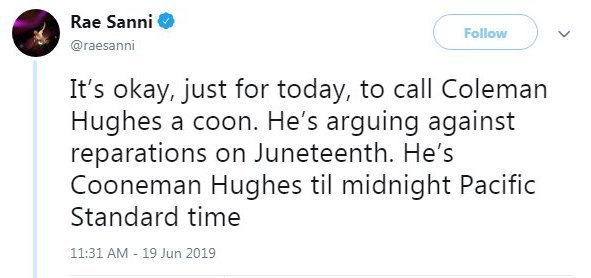
It wasn’t until I saw a twit that I realized why I was incapable of getting anywhere.
Coleman Hughes is a black guy. He was called as a witness by the Republicans and spoke against the idea of reparations. For this, he was called a “coon.” If Hughes can’t express his views without being publicly called a “coon,” what conversation can there be?
This has become the nature of raising issues under the guise of “we need to have a conversation” to face historic problems that have been swept under the rug. We do, but only if its a conversation, and to have a conversation, everyone gets a chance to have their say. That won’t happen.
The same voices that cry for a conversation want others to hear their plight, which is fair enough, but won’t tolerate any reply. Hughes was a “coon.” I would be a racist to raise any question or to do anything less than enthusiastically embrace any demand. Obama can disagree with Ta-Nehisi Coastes. I cannot.
Reparations may technically be the right word, but it’s not helping matters. Just as the word allowed McConnell to dismiss the idea for the wrong reasons, it gives rise to a visceral reaction that it’s just another transfer payment that will neither end the issue, address racism or prove any more “fair” for the mass of Americans who were neither Sons of the American Revolution nor the Confederacy, as our ancestors got here a generation ago without a dime in their pocket. And yet, our success in the new world didn’t require us to overcome our skin color and the baggage that comes with it.
But this can’t be the discussion without it devolving into a frenzy of cries of “racist” if you’re white or “coon” if you’re black. We need to come to grips with our legacy of chattel slavery and it’s less-understood, to those who don’t have to face it, consequences. So this Commission should happen, must happen? Only if we can all speak without being demonized for anything other than obsequiousness.
If Coleman Hughes is a “coon,” even for a day, because he questions the efficacy of reparations, then this Commission will not work, and what would otherwise be critically important is rendered a functional impossibility. Either people can express their views without ad hominem villification or not. And at this moment in time, there appears to be little chance that anyone who raises a question won’t be demonized, whether as racist or “coon.”
We need this Commission, but we can’t have it until everyone at the table gets to speak without being attacked for being evil. This isn’t a new problem in our communications, and I’ve been taken to task for raising it before. But much as I will fight for the right of every person, regardless of race, gender or whatever other characteristics are on the front burner of the moment, I will fight for my own right to speak as well. Once we can all talk, this Commission should happen. Until we can all talk, this Commission is a sham.
*Bet you didn’t know that, but it’s none of your business and shouldn’t matter.