
 This week, we’re turning our attention to a new issue, tracing how the Court’s unanimity rate has changed over time. Between 1990 and 2017, the Court decided 1,223 civil cases, 60.18% of those by a unanimous vote.
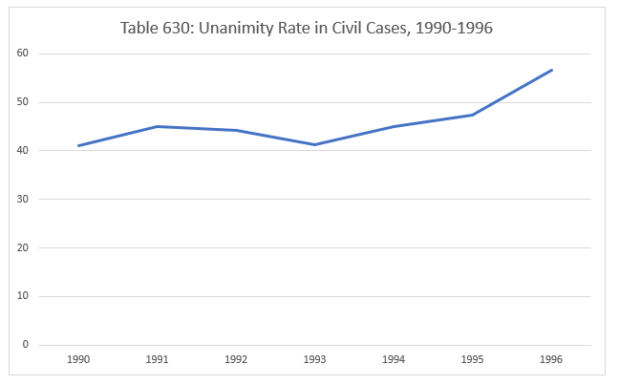
From 1990 to 1996, the Court’s unanimity rate in civil cases was consistently below this long-term average: 41.03% in 1990, 45% in 1991, 44.23% in 1992, 41.3% in 1993, 45.1% in 1994, 47.37% in 1995 and 56.67% in 1996.
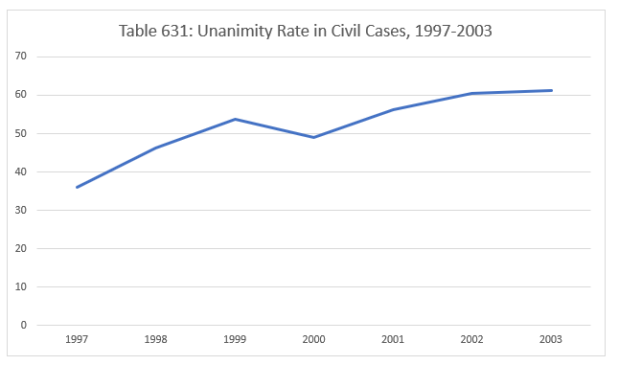
That trend continued up until 2001 – 36% in 1997, 46.3% in 1998, 53.85% in 1999, 48.98% in 2000. For the three years after that, the unanimity rate was close to the long-term average: 56.25% in 2001, 60.42% in 2002, 61.36% in 2003.
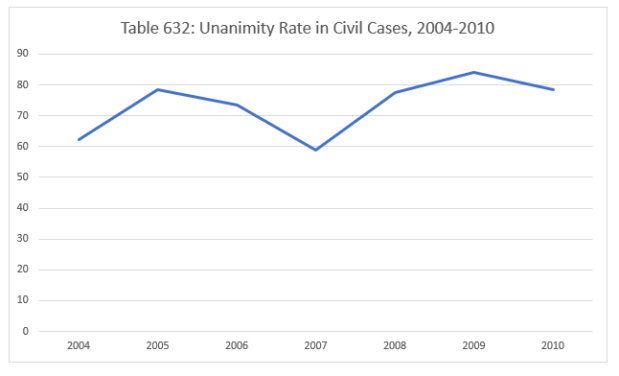
For most of the period from 2004 to 2010, the Court’s unanimity rate was above the long-term average – 62.26% in 2004, 78.43% in 2005, 73.58% in 2006, a one-year dip to 58.93% in 2007, then 77.5% in 2008, 84.09% in 2009 and 78.57% in 2010.
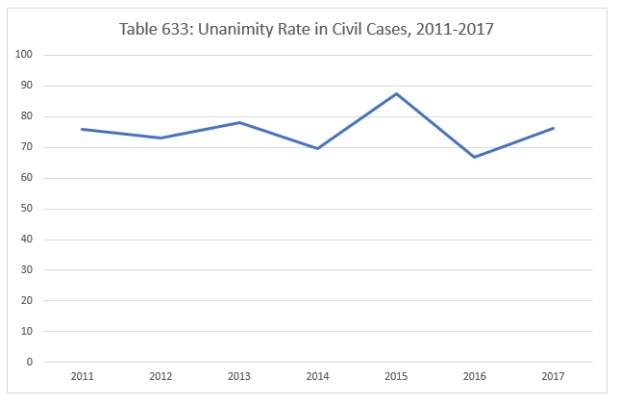
The unanimity rate in civil cases has stayed consistently above the trend during Chief Justice Tani Cantil-Sakauye’s tenure: 75.76% in 2011, 73.08% in 2012, 78.13% in 2013, 69.57% in 2014, 87.5% in 2015, 66.67% in 2016 and 76.19% in 2017.
Join us back here tomorrow as we look at the unanimity rate in criminal cases.
Image courtesy of Flickr by MoonJazz (no changes).