
 This week, we’re turning our attention to a new issue, comparing the evolution of the Court’s unanimity rate in civil and criminal cases over time. Between 1990 and 2017, the Court decided 1,363 civil cases, 67.06% of them unanimously.
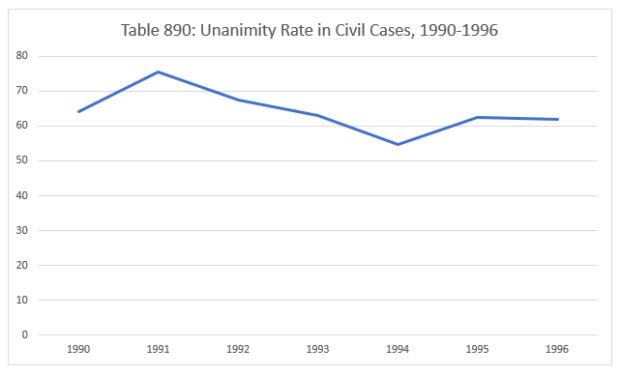
In Table 890, we report the yearly numbers from 1990 to 1996. In 1990, the Court’s civil unanimity rate was 64.04%. In 1991, it was 75.47%. In 1992, it was 67.39%. In 1993, it was 63.16%. In 1994, it fell to 54.67%. In 1995, it was 62.5%. In 1996, the unanimity rate fell slightly, to 61.82%.
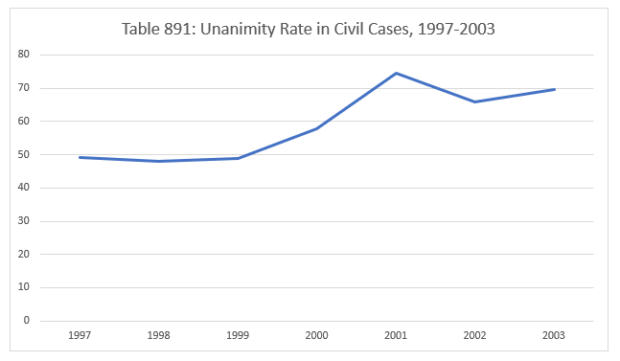
For most of the years 1997-2000, the Court’s unanimity rate in civil cases was well below its twenty-eight year average: 49.21% in 1997, 47.89% in 1998, 48.78% in 1999 and 57.89% in 2000. Then the unanimity rate increased to a more usual level – 74.51% in 2001, 66% in 2002, 69.57% in 2003.
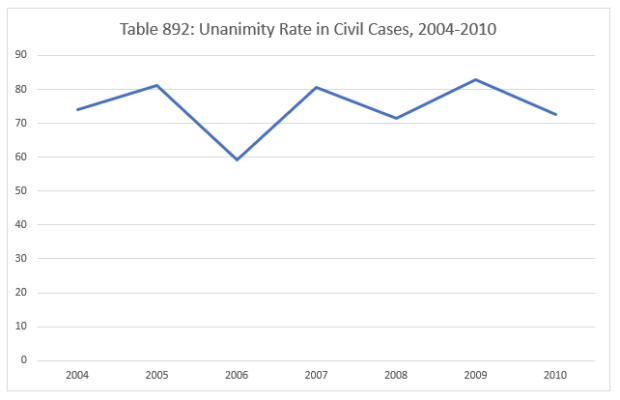
Between 2004 and 2010, the unanimity rate was nearly always over the long-term average: 74.07% in 2004, 81.25% in 2005, 80.49% in 2007, 71.43% in 2008, 82.93% in 2009 and 72.73% in 2010. The only exception was 2006, when the unanimity rate fell to 59.18%.
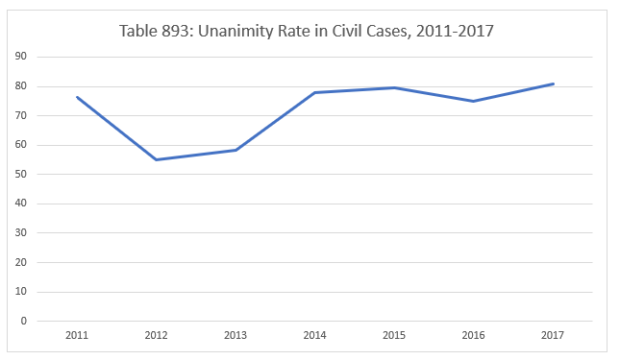
For most of the past seven years, the Court’s unanimity rate in civil cases has remained unusually high – 76.32% in 2011, 77.78% in 2014, 79.55% in 2015, 75% in 2016 and 80.77% in 2017. The only exceptions were a two year dip in 2012 and 2013 – 55% and 58.24%.
Join us back here tomorrow as we review the Court’s unanimity rate in criminal cases from 1990 to 2017.
Image courtesy of Flickr by David Wilson (no changes).