
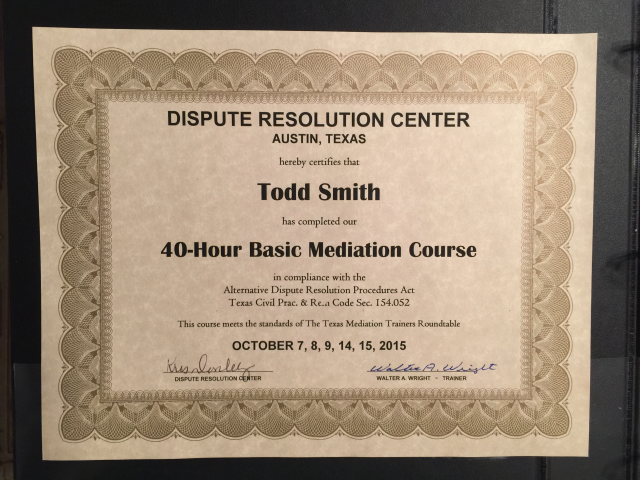
 I spent much of last week and part of this week participating in a mediation training program. Among other things, I learned about a new statute, Chapter 37 of the Texas Government Code (SB 1876), which became effective on September 1, 2015. This statute prescribes how courts are to appoint mediators, as well as guardians ad litem, attorneys ad litem, and guardians. How might this new law affect mediations in the appellate context?
Chapter 37 has two key features. First, it requires a court to establish and maintain a list of all persons registered with the court to serve as a mediator. The list must be posted at the courthouse and on the court’s website. The statute requires posting to take place annually.
Second, the statute establishes a process by which a mediator is to be appointed if the parties cannot agree on one themselves. The court must use a rotation system starting with the first mediator on the list. Once appointed on a case, the mediator goes to the bottom of the list. On finding good cause, however, a court may appoint someone off-list or out of order when the case is complex and the proposed appointee (1) possesses relevant specialized education, training, certification, skill, language proficiency, or knowledge of the case’s subject matter; (2) has relevant prior involvement with the parties or the case; or (3) is in a relevant geographic location.
The statute raises several questions, and the answers are not all that clear. Read on for some examples.
Does Chapter 37 Apply to Appellate Courts?
With exceptions for county-created mediation programs and appointments made under the Family Code, Chapter 37 “applies to a court in this state created by the Texas Constitution, by statute, or as authorized by statute that is located in a county with a population of 25,000 or more.” Appellate courts meet that definition, and the statute explicitly trumps all others in the event of a conflict. So, Chapter 37 would seem to apply to both trial courts and appellate courts, despite some gaps and inconsistencies.
What Is Required to “Register” as a Mediator?
No uniform process exists by which mediators interested in appointments may “register” with appellate courts. The statute leaves that process open. It also provides no guidance on what is “complex.”
Must Appellate Courts Change Their Practices to Comply with Chapter 37?
Although many of the 14 intermediate appellate courts have mechanisms in place for appointing mediators, some do not. By all appearances, Chapter 37 requires those without mediation programs to create a list of registered mediators and to follow the statutory rotation system absent good cause. Because the statute uses mandatory language, courts with mediation programs would need to conform to that procedure as well.
Is Chapter 37 Unconstitutional?
At the request of the Honorable Rory Olsen—a Houston probate judge who spoke out against Chapter 37 before it became law—Rep. Harold Dutton has sought an opinion from the Texas Attorney General on whether Chapter 37 is unconstitutionally vague and intrudes on separation of powers. Rep. Dutton’s letter to the AG focuses on an issue specific to guardians ad litem and attorneys ad litem: how they are deemed “qualified,” as the statute requires. More globally, Rep. Dutton complains that the statute removes a court’s discretion when making appointments and interferes with the court’s inherent power to manage its docket.
A few trial judges have responded to the new law by posting mediator lists on their websites. However, 193rd Judicial District Judge Carl Ginsberg has issued a standing order refusing to comply, citing separation-of-powers concerns similar to those Judge Olsen (through Rep. Dutton) has expressed. Thus far, the appellate courts appear silent on the subject.
Most often, parties to an appeal who are headed toward a court-ordered or voluntary mediation will agree on a mediator, so this issue may not affect a significant number of appellate cases. Nevertheless, it will be interesting to see what happens next.